Unlock Business Growth with the FICO Franchise Model: 5 Key Benefits for Business Owners

Written by Sparkleminds
FICO franchise model

Written By: Resham Daswani, Sparkleminds Editorial Team – Updated August 2026

Quick Answer: Defining A FICO Franchise Model in India

The FICO franchise model (Franchise Invested Company Operated model) provides business owners with a means of combining franchise partner investment with company-led operations. The new shop is run on a day-to-day basis by the corporation and funded by the franchise partner.

Expanding into new cities is a major growth opportunity for Indian businesses—but scaling quickly while maintaining brand control, operational consistency and customer experience can be challenging.

FICO franchise model

For established brands wishing to expand through franchising in India, this approach can provide a viable mix between outside investment and control over operations. In this post we explain what the FICO franchise model is, how it works, its five core benefits, which firms can use it and why it may be the perfect franchise expansion plan.

Understanding The FICO Franchise Model in India

Under this franchise business model, the franchise partner provides the investment for establishing a new outlet, while the franchisor or company operates the business.

The company may manage:

  • Recruitment and staff training
  • Daily operations
  • Customer service
  • Inventory management
  • Marketing implementation
  • Quality control
  • SOPs and operational standards
  • Performance monitoring

The basic structure is:

Franchise partner invests → Company operates → Brand expands

The FICO model allows the business owner to have a greater degree of engagement in the day to day operations as opposed to a typical franchise where the franchisee usually runs the outlet.

Knowing More About The FICO Franchise Model- How It Works?

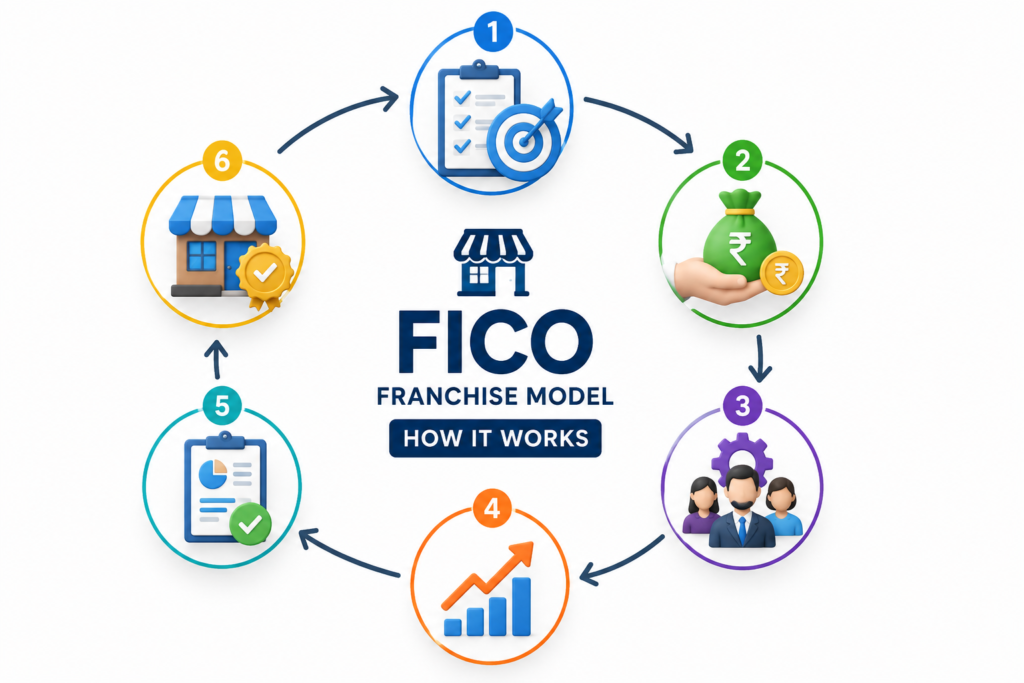
A typical FICO expansion strategy follows a structured process:

  1. The business validates its model – The company establishes that its concept, unit economics and operations can be replicated.
  2. The franchise partner invests – Capital is provided for the new outlet according to the agreed commercial structure.
  3. The company operates the outlet – The franchisor manages staffing, training, SOPs, inventory and customer experience.
  4. Performance is monitored – Sales, customer behaviour, operational efficiency and profitability are tracked.
  5. The model is replicated – Successful locations provide a foundation for expansion into additional cities and markets.

The exact investment, ownership, revenue-sharing and return structure should always be clearly defined in the commercial and legal agreements.
FICo franchise model

5 Key Benefits of the FICO Franchise Model for Business Owners

1. Expand Faster Without Funding Every Outlet

Opening company-owned branches requires significant capital.

With FICO franchising, franchise partners can provide the investment needed for new locations while the business continues to focus on operations, brand development and strategic growth. This allows existing companies to think about multi-city expansion without the need to fund each new outlet totally from internal resources.

2. Greater Brand and Operational Control

The larger a franchise network expands, the more difficult it is for many business owners to safeguard their brand. Since the firm operates FICO locations, it has greater control over:

  • Staff recruitment
  • Training
  • SOP implementation
  • Service standards
  • Quality control
  • Customer experience

For service-oriented businesses such as healthcare, education, food, beauty, and wellness, as well as other service-oriented enterprises, this can be especially beneficial because operational consistency has a direct impact on the reputation of the brand.

3. Increased Consistency in the Customer Experience

Customers have the expectation that different locations of the same brand will provide them with the same experience.

The firm is able to establish uniform standards for service quality, customer engagement, hygiene, product or service delivery, and complaint resolution when it uses a franchise model that is controlled by the company itself.

By maintaining this consistency, brands that are expanding their operations to Tier 1, Tier 2, and Tier 3 locations in India may better safeguard the trust of their customers as the network expands.

4. Centralised Hiring, Training and SOPs

People and processes become increasingly important as a business expands.

Instead of leaving recruitment and training entirely to individual franchisees, a FICO structure allows the company to centralise:

  • Recruitment
  • Employee onboarding
  • Training
  • Performance management
  • SOP implementation
  • Operational audits

This creates a more consistent operating culture across the franchise network.

5. Better Operational Data for Smarter Expansion

Company-operated outlets can provide valuable operational insights.

Business owners can monitor:

  • Sales performance
  • Customer behaviour
  • Inventory movement
  • Staff productivity
  • Marketing effectiveness
  • Outlet-level profitability

This data can help management identify what is working, improve underperforming locations and make more informed decisions about future franchise expansion in India.
FICO franchise model

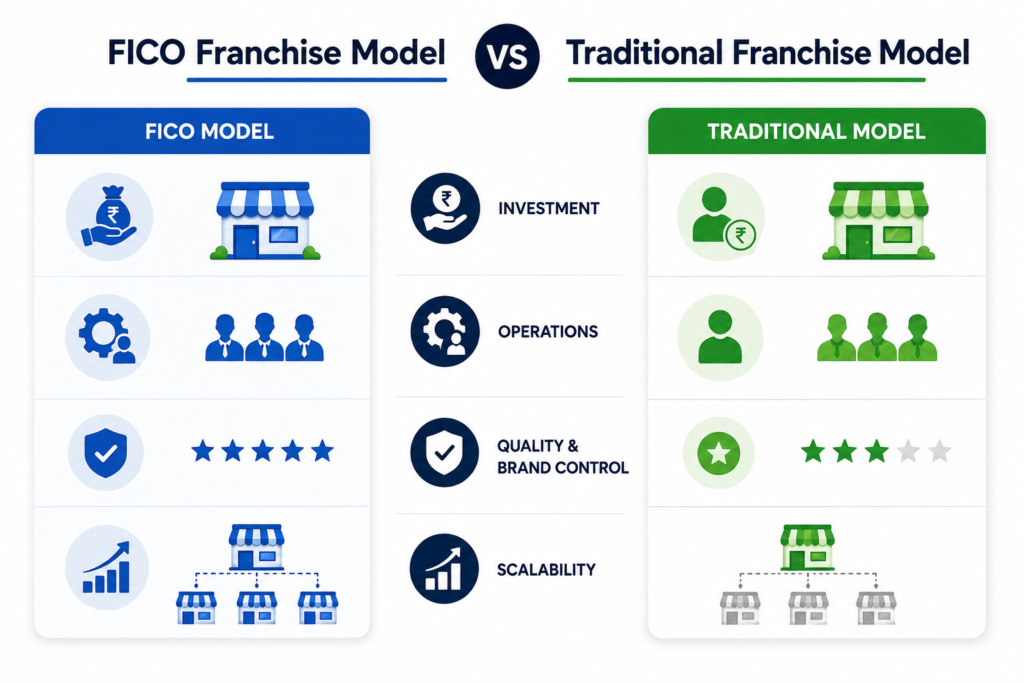
FICO Franchise Model vs Traditional Franchise

The main difference is who operates the outlet.


Factor

Traditional Franchise

FICO Franchise Model

Investment

Franchise partner

Franchise partner

Daily operations

Franchisee

Company

Staff management

Franchisee

Company

Brand control

Can vary

Generally higher

Customer experience

May vary

More centrally controlled

SOP implementation

Franchisee-led

Company-led

Expansion approach

Franchisee-led

More company-led

For business owners who want to expand while retaining greater operational involvement, FICO can be an attractive alternative to a conventional franchise structure.

FICO vs FOCO: What’s the Difference?

FICO and FOCO are often discussed together because both can involve franchise partner investment and company-operated outlets. However, the nomenclature used for franchises might differ from brand to brand.

It is not enough for a business owner to merely know which acronym is being used; the thing that is more significant is how the actual agreement itself defines:

  • Investment
  • Ownership
  • Operations
  • Revenue sharing
  • Expenses
  • Returns
  • Exit terms
  • Operational responsibilities

Business owners should therefore evaluate the commercial structure behind the model, rather than relying only on the terminology.

Which Businesses Can Prove Profitable By Expanding As The FICO Franchise Model?

FICO may be useful for firms in which maintaining operational consistency and providing a positive experience for customers is essential to the success of the brand.

Some of the potential industries are:

Healthcare and Diagnostics

Standardised service, hygiene and operating procedures are critical.

Food and Restaurants

Food quality, service speed, inventory and hygiene need consistent management.

Beauty and Wellness

Customer experience and staff expertise directly influence brand perception.

Education and Training

Consistent centre management, teaching standards and student experience are important.

Fitness and Sports

Equipment, trainers, member engagement and service standards require regular monitoring.

Retail and Consumer Brands

Store presentation, merchandising and customer service can benefit from centralised control.

Is the FICO Franchise Model Right for Your Business?

FICO is not automatically the right franchise model for every business.

Before adopting it, business owners should have:

  • A proven business model
  • Demonstrated customer demand
  • Clear unit economics
  • Documented SOPs
  • Structured HR processes
  • Reliable technology and reporting systems
  • A scalable supply chain
  • Strong operational management

A simple rule is:

FICO can help a proven business scale—it cannot replace a proven business model.

If the business is still testing its concept or struggling with inconsistent operations, strengthening the core business should come before aggressive franchise expansion.

Common FICO Franchise Expansion Mistakes

Business owners should avoid:

  • Expanding before the model is proven
  • Operating without documented SOPs
  • Underestimating staffing requirements
  • Ignoring technology and performance reporting
  • Using unrealistic financial projections
  • Entering markets without adequate demand research
  • Creating unclear franchise agreements
  • Assuming investment alone will guarantee expansion success

In order to achieve sustainable franchise growth, it is necessary to have operational discipline, financial transparency, and a business model that can be replicated.

How Sparkleminds Helps Business Owners Build FICO Franchise Models

For business owners, developing a franchise is about more than finding franchise partners. The business needs the right franchise expansion strategy, operating systems and commercial structure.

Sparkleminds helps businesses evaluate and develop scalable franchise models through services including:

  • Franchise feasibility studies
  • Franchise strategy development
  • FICO model development
  • Financial modelling
  • Franchise documentation
  • Operations manuals and SOP development
  • Franchise recruitment strategy
  • Expansion planning
  • Franchise support systems

The objective is to help business owners build sustainable, professionally managed franchise networks rather than simply add more locations.

Must Reads:

FAQs About the FICO Franchise Model

Can startups use the FICO franchise model?

It can be considered, but the model is generally better suited to businesses with a proven concept, established SOPs, clear unit economics and demonstrated customer demand.

How can Sparkleminds help with FICO franchise expansion?

Sparkleminds helps business owners assess franchise readiness and develop franchise strategy, FICO structures, financial models, SOPs, franchise documentation, recruitment plans and expansion systems.

Conclusion

The FICO franchise model in India can give established business owners an alternative route to expansion by combining franchise partner investment with company-operated locations.

For firms with a proven business model looking to grow to numerous cities while retaining a good deal of operational control, FICO can be a useful tool for franchise expansion. But the correct foundation is the key to successful franchising: robust SOPs, defined unit economics, skilled personnel, operational systems and a scalable business plan.

If you’re a business owner looking at how to franchise your business in India, FICO can be considered when your business has a proven model, strong SOPs and the operational capability to manage multiple locations. The right franchise structure should ultimately support your growth goals without compromising the systems and customer experience that built your brand.

Sparkleminds helps business owners evaluate franchise readiness and develop structured franchise expansion strategies, including FICO franchise models.

View More:


Loading

Crucial Elements in a Foco Model Franchise Agreement in India 2025

Written by Sparkleminds

The franchise industry in India is really taking off, and the FoCo (Franchise Owned, Company Operated) model is becoming a popular pick for both franchisors and franchisees. With the help of this creative approach, franchisees can invest in and own the tangible assets while franchisors retain operational control. As we head into 2025, it’s super important to create a strong and beneficial FoCo model franchise agreement for lasting success.

Let’s take a closer look at the key parts of a FoCo model franchise agreement, specifically designed for the Indian market. This guide is here to help franchisors keep things clear, run operations smoothly, and grow effectively, all while building trust along the way.

Before getting into the crucial elements that you need to include in the FOCO model franchise agreement, for our readers, here’s a brief understanding about the FOCO model in India.

Getting to know the Foco Model

Under the FoCo concept, franchisees put in the initial funding for the company’s physical location, utilities, and machinery. So, the franchisor takes care of the daily operations, using its know-how to keep things consistent and running smoothly.

This model really helps franchisees by reducing their risk since they can lean on the franchisor’s tried-and-true systems. At the same time, it gives franchisors a chance to grow their brand without needing a big upfront investment.

This partnership is built on the franchise agreement, which is a legal document that clearly outlines what each party is responsible for and what they can expect from one another.

Now for the important components that comprise this franchise agreement in India

Eight Important Elements To Include in The FOCO model franchise agreement India 2025

#1. Clearly Outlining Duties and Responsibilities

The FoCo model franchise agreement really needs to clearly outline what the franchisor and franchisee are responsible for:

Franchisor role includes:

  • Oversight of all management, staffing, marketing, and operational matters on a daily basis.
  • It’s important to regularly check in and keep up with the operational standards.
  • Encouraging peak performance through the provision of education, materials, and equipment.
  • By making these roles clear, the agreement helps avoid any confusion or disputes, which makes everything run more smoothly.

The Franchisee role includes:

  • An investment in the building’s framework, machinery, and other physical assets.
  • Making sure we stick to the franchisor’s branding rules and follow all the legal stuff.
  • Assisting the franchisor in overcoming local obstacles or opportunities.

#2. Profit-sharing and financial arrangements

The foundation of a successful franchise agreement based on the FoCo concept is the financial structure. It should have:

  • Investment Information: Clearly state the franchisee’s investment amount and the scope of it (e.g., equipment, branding, location setup).
  • Profit Split: Establish how much of the franchisor’s and franchisee’s total income will go to each party. Investors will be more interested if they see this split as fair and competitive.
  • Costs of Operations: Indicate which running costs, like payroll, utilities, and advertising, are covered by the franchisor.
  • Payment Plans: Can you share some info about the franchise fees, any royalties involved, and other regular charges that might come up?
  • This openness helps both sides have a clear understanding of what to expect financially.

#3. Terms of Renewal and Duration

Establishing confidence depends on the agreement’s terms and renewal provisions:

  • Franchise agreements under the FoCo model often have an initial agreement period of five to ten years.
  • Procedure for Renewal: Clearly outline the processes for extending the contract, such as performance standards, fee modifications, or renegotiation conditions.
  • Conditions for Termination: To protect the franchisor’s brand reputation, specify the conditions under which any party may end the agreement.
  • Clear terms help build a solid base for a lasting partnership.

#4. Brand Guidelines and Intellectual Property

The most significant resource for franchisors is their brand. The agreement needs to protect:

  • Use of Branding and Trademarks: Indicate the franchisee’s permitted usage of logos, trademarks, and other branding components.
  • Compliance Standards: Incorporate provisions guaranteeing that franchisees consistently uphold the franchisor’s branding and operating standards.
  • Confidentiality: Use strong confidentiality agreements to safeguard operational know-how, proprietary procedures, and trade secrets.
  • This enables franchisees to support the franchisor’s objectives while safeguarding the integrity of the brand.

#5. Support and Training

The franchisor’s operational competence is crucial to the FoCo model’s success. The agreement should really highlight:

  • Initial Training: Describe the pre-operations training courses that franchisees and their crews can take.
  • Explain the ongoing assistance that is given in areas like supply chain management, technology, marketing, and quality control.
  • Let’s make sure we have regular audits in place to keep everything compliant and to give us some useful feedback.
  • Having solid training and support in place really helps keep things consistent and boosts the confidence of franchisees.

#6. Alternative Dispute Resolution Process

With the franchise relationship being pretty complex, it’s not uncommon for disagreements to pop up. We should make sure the agreement covers:

  • Arbitration Clauses: Let’s go with arbitration as the go-to way to resolve disputes since it’s quicker and usually saves money compared to going to court.
  • It’s really important to clearly define where disputes will be resolved, especially for franchisors who operate in different states.
  • Consequences and Solutions: Let’s talk about what happens if either party doesn’t stick to the agreement.
  • This helps keep any potential conflicts in check while making sure the partnership stays strong.

#7. Adapting to the Market

India’s market is super diverse and dynamic, so it’s really important to localise franchise agreements.

  • Regulatory Compliance: Include provisions guaranteeing compliance with Indian laws, such as labour legislation, GST, and industry-specific rules.
  • It’s important to recognise the preferences of local customers and the unique aspects of how things operate in different areas.
  • Include clauses addressing force majeure, which can affect operations and include unanticipated events like pandemics, natural catastrophes, or political shifts.
  • Customising the agreement to fit India’s unique landscape really shows that the franchisor is dedicated to making it a success.

#8. Strategy for Franchisees to Exit

Even though the FoCo model helps franchisees lower their risk, it’s crucial to offer them an exit strategy.

  • Franchise Resale: Let franchisees sell their share to a buyer who’s been approved ahead of time, following certain guidelines.
  • Franchise Buyback: Make sure to include a provision that grants the franchisor the opportunity to repurchase the franchise before anybody else.
  • Exit Fees: Make sure to clearly outline any fees that come with ending or transferring ownership.
  • This helps make the transition easy and keeps the franchisor’s interests safe.

In conclusion,

The FoCo model franchise agreement really plays a key role in building a successful partnership in India’s booming franchise scene. Franchisors get a chance to grow their brand without needing to invest a tonne of money, all while keeping a handle on how things run. But, it’s really important to carefully create the agreement so that it considers what both sides want.

If franchisors concentrate on having clear roles, being financially transparent, protecting their brand, and making local adaptations, they can build trust, maintain consistency, and grow their operations successfully in 2025 and beyond.

If you’re already a franchisor or just starting out in the franchising world, having a solid FoCo model franchise agreement is essential for achieving sustainable growth and profitability in India. Meet Sparkleminds experts for assistance in drafting your foco franchise agreement for 2025!

Loading

Steps to convert your existing business into a FOCO model

Written by Sparkleminds

If you are deciding to expand your existing business and thinking of which could be the best franchise model to select for expansion, then read this blog. We have some of the most convincing reasons why the FOCO model is one of the most sought-after franchising options in India.

But before we get into the steps of how you can convert your existing business into a Foco Franchise Model, let us see some advantages of how it can benefit you as the franchisor.

Convert your business into FOCO model

Benefits Of The FOCO Model For Business Owners [Franchisor]

In this business model, franchisees run the day-to-day operations of a business under the franchisor’s brand. Several sectors have seen increased interest in this concept, including services, retail, and the food and beverage industry.

The following are a few factors in favour of the FOCO business model among Indian business owners.

  1. Opportunities for Market Expansion with Reduced Investment: Businesses can enter the Indian market using this model without spending a fortune. To enable the brand to grow without putting a heavy financial strain on the franchisor, franchisees usually cover operating costs.
  2. Benefiting from the Local Expertise: They can gain valuable insights into the local market, customer tastes, and business customs by forming partnerships with franchisees in the area. To tailor the brand to the Indian market, this local knowledge is vital.
  3. Mode of faster expansion: Faster expansion is possible because franchisees are responsible for running the day-to-day operations. When breaking into a huge and varied marketplace like India, where having an operational presence in multiple areas is crucial, this rapid expansion is extremely advantageous.
  4. Helps business owners focus on core business competencies: Franchisees take care of the day-to-day operations, allowing business owners to focus on growing the brand, advertising, and overall strategy. As a result, the brand can play to its strengths and get an edge over the competition.
  5. Scalable business model: Thanks to the FOCO model’s scalability, entrepreneurs can quickly increase their presence in India. Aiming for extensive market presence and consumer accessibility is where this scalability shines.
  6. Motivation for potential investors: Profits for franchisees under this model are proportional to how well their stores do. Moreover, they have an incentive to do their best. Increased operational efficiency and happy customers are possible outcomes of this incentive.
  7. Reduces operational responsibilities: Avoiding micromanagement at each location frees owners to concentrate on company strategy, brand development, and expansion. When breaking into a new and complicated market like India’s, this can be quite helpful for companies.
  8. Ensures operation standardization across all units: The franchisor controls the brand and operating rules, while the franchisee handles day-to-day operations. This helps keep the brand’s integrity intact and guarantees uniformity across all platforms.

So are these not great advantages for you to grab onto? So once you are convinced, let us understand the steps you would require to franchise your business in India as a FOCO model.

Steps To Convert Your Existing Business into A FOCO Franchise Model in India

It takes meticulous preparation, attention to legal details, and efficient execution to convert an established Indian business into an FOCO model. Using the FOCO model, a franchisor can franchise its current business in India by following these steps.

  1. Research the market requirements: Familiarise yourself with the Indian market, customer tastes, and rivalry. Find out where you could put a FOCO franchise and assess how well it would work in your sector.
  2. Consultation with a legal attorney: To learn about and follow India’s franchise rules and regulations, consult an attorney. Make sure that all of the contracts, agreements, and legal papers, comply with the laws of India.
  3. Preparing the comprehensive training manual: Make sure that every part of operating the company is in the comprehensive operations manual. Operating processes, brand norms, advertising tactics and other critical factors are covered in this paper. These will act as a reference for franchisees.
  4. Determine the franchise and royalty fee structure: Figure out the FOCO model’s royalty and franchise fee setup. This should be profitable for everyone involved, while also being competitive and appealing to possible franchisees.
  5. Creating a comprehensive training program: Make sure that franchisees and their employees get thorough training. Any pertinent elements of managing the firm, including product or service expertise, operational procedures, and customer service standards, should be addressed in this programme.
  6. Prepare criteria for potential investors: Find possible investors and establish selection criteria. Verify their capacity to pay, business sense, and dedication to the company. Verify if they are on board with the franchise’s mission and principles.
  7. Prepare and finalize your franchise agreement: Next, it’s time to finalise the franchise agreement. This will spell out everything that each party is responsible for. Make sure the contract is clear and complies with all laws.
  8. Scalability of the FOCO franchise business model: Expand the model by finding and hiring more franchisees in specific areas based on the first franchise’s performance. Make any required adjustments to the model taking into account actual experiences.
  9. Ensures consistency of the brand: Make sure all of the FOCO franchise locations are consistent by implementing these practices. Constant communication to enforce brand standards, modifications to the operations guide and audits at regular intervals are all part of this.
  10. Providing Ongoing Support: Help franchisees out on an ongoing basis with things like marketing, operations, and company development. To resolve issues and exchange best practices, systems of frequent communication and feedback should be put in place.

In a nutshell, the FOCO model provides a foundation for effective franchising operations in India. Moreover, by following these procedures, a franchisor can build and expand its business there while maintaining quality and consistency across all locations.

Also Read: The Best Foco Model Franchises in India

To Conclude,

It is essential to keep in mind that the success of the FOCO model is contingent upon the relationship between the franchisor and franchisees. This is in terms of excellent communication, collaboration, and support.

A successful plan requires that all parties work together to reach the brand’s goals. Before committing to a particular company strategy in an uncharted industry, entrepreneurs should think about getting expert guidance and performing comprehensive market research.

Reach out to us at Sparkleminds to learn how to draft a foco model franchise agreement while expanding your business in India.

Loading

Why Business Owners Prefer to Expand Their Business in India Using The Foco Business Model?

Written by Sparkleminds

Have you ever wondered why the FOCO business model has become one of the most popular franchising options for business owners?  Here are all the details you require to franchise your business using the FOCO business model. Moreover, this will also attract the right investors to take your business forward.

FOCO business model for business expansion

What Makes FOCO Business Model Popular in Franchising in India?

Franchised businesses have been flourishing in India. Also, they are making a significant contribution to the expansion of the country’s economy to a significant degree. Among the many different franchise models, this model, has seen a significant surge in popularity.

Moreover, with the help of this blog, we will investigate the factors that contribute to the widespread popularity of the FOCO model. Also, you will get insights into why business owners connect to this opportunity.

We are going to investigate the primary elements that contribute to the FOCO model’s status as an important shift in the Indian franchising landscape.

#1. Mitigation Of Risks and Sharing Of Responsibilities

The fact is, the FOCO model is risk-sharing. This is frequently in citation as one of the main motivations for its widespread adoption in India. Within the framework of this structure, the franchisor maintains control over the business activities, which guarantees uniformity in terms of the quality of the goods, quality of service, and brand public perception.

At the same time, franchisees reap the benefits of decreased operational dangers, as the franchisor is responsible for managing essential aspects such as logistics, marketing, and training opportunities.

By lowering the barrier to entry for prospective entrepreneurs and encouraging people to step into the company with confidence, this shared responsibility enables new entrepreneurs to enter the market.

#2. Brand Reputation and Recognition of the Brand

The presence of a solid brand identity and a loyal customer base are two things that renowned franchisors bring with them. It is important to note that franchisees that operate under the FOCO model enjoy this significant advantage.

Customers in India frequently like brands they easily connect with. This, therefore, makes it simpler for FOCO business owners to attract and keep customers within their organization.

In addition, the marketing efforts of the franchisor contribute to the visibility of the brand, which in turn increases the likelihood of success for the franchise recipient.

#3. More access to proven business models.

Franchise businesses are true business models that are proven successful. Additionally, the effective systems and procedures by the franchisor are in inheritance by the FOCO Model.

Because of this, franchisees no longer have to start from scratch when developing their business plans, which significantly lowers the likelihood of failure. Entrepreneurs can leverage the experience of the franchisor to achieve profitability more expediently and effectively.

#4. Provision of Ongoing Support and Training

The FOCO Model provides training that is both comprehensive and ongoing, as well as operational support from India. Through the provision of comprehensive training programmes, franchisors ensure entrepreneurs and their employees are equipped with the necessary skills, this will help to successfully run the business.

This assistance continues to the daily tasks, which include the management of inventory, the provision of customer service, as well as the control of quality. Franchisees can concentrate on providing a consistent experience for their customers when they have this guidance.

#5. Numerous success stories of this established business model across India

It is true that success breeds a successful outcome, and the FOCO model has been witnessing to a great number of cases of success throughout India. Entrepreneurs frequently use these stories as a source of inspiration and provide proof of concept.

A number of people are encouraged to consider franchising as an economically feasible opportunity when they are aware that other people have been successful using the FOCO model.


Benefits of the FOCO Business Model For The Franchisor

A business model known as FOCO allows the franchisor to own and control a portion of the franchise locations. This is alongside also allowing franchise units to be independently owned and operated.

There are several advantages that this hybrid model can provide to the franchisor.

  1. Evaluation of the Concept and Standardization of the Brand: To improve the business concept, operational procedures, and marketing tactics, the franchisor can run some company-owned locations as a test market. The establishment and maintenance of constant brand guidelines across all locations is in facilitation. This guarantees a consistent experience for the customer.
  2. Minimizing risks: Having some franchise units owned and operated by the franchisor enables the franchising company to split the economic risk. The franchisor can absorb part of the effects of particular market conditions or obstacles and provide help to franchisees if they occur.
  3. Penetration into untapped markets: A powerful brand presence is possible with the assistance of these. Remember these are carefully put out in key markets. This may entice prospective franchisees, who get motivation to invest in a franchise with a reputable and profitable brand.
  4. Example of a Successful Attempt: There is tangible evidence of the effectiveness of the franchise system that is provided by successful company-owned locations. The feasibility of the company idea is demonstrable. This helps create confidence in potential franchisees.
  5. Diversified revenue streams: In addition to the revenue that is a generation from franchise fees and royalties, the franchisor also can create revenue via the direct running of company-own units. This diversification has the potential to contribute to the general prosperity of the economy.
  6. Ability to Adapt Strategically: The franchisor is allowed to exercise strategic flexibility when they have a combination of owned by the company and franchised businesses. They have the option of operating in areas where franchising would be less ideal, or they can modify their approach according to the particular circumstances that they are dealing with.

Moreover, franchisors need to find the correct balance and retain an effective connection with franchisees, even though a FOCO business model has several advantages. When it comes to the effectiveness of this hybrid paradigm, honesty, open discussion, and a strategy that emphasizes collaboration are all crucial components.

Loading