Franchise training programs help franchisors prepare franchisees and their teams to operate a business according to established brand standards, systems and procedures. Effective training can cover business operations, sales, customer service, marketing, franchise management and ongoing performance improvement. Sparkleminds provides franchise training support for businesses looking to strengthen franchise management, improve sales processes and maintain consistency across their franchise networks.
What is the need for Franchise Training Programs in the franchising business? The franchise training is an instruction to franchisees following the signing of a franchise agreement with a franchisor but before the franchisees’ first day of business.
Such initiatives put a focus on enhancing franchise staff members’ capacities so they may successfully represent a brand in the regions they have chosen.
Franchisees receive training on a variety of themes, including how to maintain brand consistency, how to cultivate a passion for work, how to motivate oneself and others, and many others.
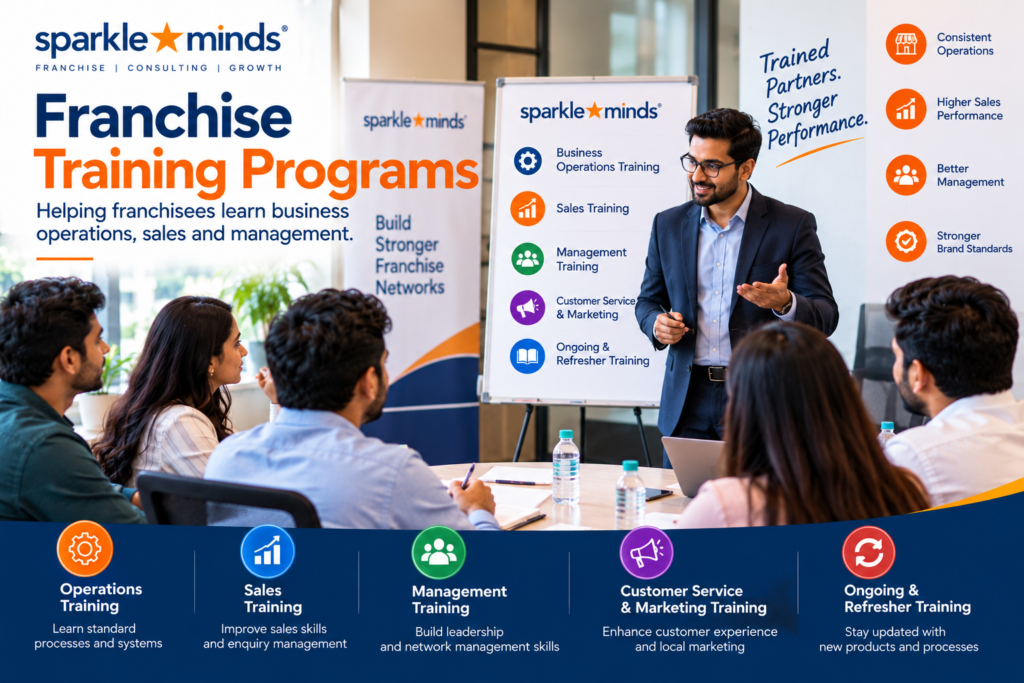
Types of Franchise Training Programs
A franchise training program should prepare franchisees and their employees for the responsibilities involved in operating a franchise. The training format and duration depend on the business model, operational complexity and experience of the participants.
1. Headquarters Training
Headquarters training introduces franchisees to the brand, business model, operating standards, systems and key team members. It may include classroom instruction, demonstrations, assessments and practical exercises before the franchise location begins operating.
2. On-Site Franchise Training
On-site training takes place at the franchise location or another designated training site. It helps franchisees apply the knowledge they have gained to daily activities such as inventory management, customer service, staff supervision and operating procedures.
3. Franchise Operations Training
Operations training explains how to run the franchise according to the franchisor’s established processes. Topics may include standard operating procedures, quality control, product or service delivery, inventory, reporting and customer experience.
4. Franchise Sales Training
Sales training helps franchisor teams understand the franchise offering, manage prospective franchisee enquiries, conduct candidate discussions and follow a structured sales process. It should also cover accurate communication of investment requirements and franchise terms.
5. Franchise Management Training
Management training supports franchisor teams responsible for franchisee relationships, network performance, compliance with operating standards, internal communication and business development.
6. Ongoing and Refresher Training
Training should continue when products, policies, technology or operating procedures change. Refresher sessions can help franchisees and their teams understand updates, address recurring performance gaps and maintain consistent operating standards.
Benefits of Franchise Training For Businesses in India
Each franchise unit’s performance depends on franchise training. Initial and ongoing training makes it clear how a franchise operates, what each employee’s responsibility is, and how everyone may work together to accomplish the goals set in the contract. Franchisees are in line with the franchisor’s values by training.
You can anticipate the following advantages from the training:
- It provides a strong framework and instructs franchisees on how to replicate a franchise business unit.
- It gives them the knowledge and abilities they need to operate a business successfully.
- Franchisees learn about all the resources, tools, and assistance that are accessible as well as the best ways to use them during the training.
- Franchisees can learn about the technical facets of operating a franchise through formal training.
- They can receive training to reach their maximum potential for franchise management and reputation-building.
- Franchisees receive instruction on how to guarantee consistent and long-lasting brand positioning.
- It fosters the growth of devoted and driven franchisees who can create a successful brand.
What Should a Franchise Training Program Include?
A structured franchise training program should be based on the actual responsibilities of franchisees and the standards the franchisor expects them to maintain.
Key components include:
- Brand and business model: The brand’s values, products or services, target customers and franchise operating model.
- Operations manual: Step-by-step instructions for daily operations, quality control and standard procedures.
- Sales and customer service: Product knowledge, customer communication, complaint handling and sales processes.
- Marketing: Brand guidelines, local marketing activities, approved promotional materials and customer acquisition.
- Financial and administrative processes: Budgeting, reporting, billing, inventory records and other relevant business procedures.
- Technology and systems: Training on point-of-sale systems, software, reporting tools and other operational technology used by the franchise.
- Staff management: Recruitment, onboarding, responsibilities, supervision and employee training.
- Assessment and follow-up: Practical evaluations, feedback, refresher sessions and additional support where required.
The program should be adapted to the franchise model and documented in a way that franchisees and their employees can understand and apply consistently.
Key Objectives of Franchise Training Programs
A franchisee training program’s main goal is to guarantee that franchisees have the knowledge, resources, and skills necessary to accurately replicate the franchise business model and to assure consistent, high-quality service delivery throughout the entire network.
Franchise Training Programs by Sparkleminds

FRANCHISE MANAGEMENT TRAINING
The complexities and ethos of working within a franchise organization have their challenges. Sparkleminds conducts specific management training programmes for these growing organizations.
To help them align themselves with the advantages of qualitative franchising. It works on core areas of building the franchise organization; training the franchisor employees dealing with franchising and giving them support on the ground.
This also includes effective franchisor marketing, franchisor compliances, franchisee relationship exercises and adequate responsibility assignments. You will get the best franchise training programs and manuals.
Thus, to ensure they work effectively towards building the business whilst working closely with the franchisees.
FRANCHISE SALES TRAINING
Sparkleminds has a deep understanding of the prospective franchisee. The market conditions and the cultural sensitivities involved in recruiting franchisees across the subcontinent.
It works closely in training the franchisor teams to efficiently maximize all lead generation activities.
So, to conclude a franchise sale. It then works on an ongoing basis with the franchisor’s top management to assess, analyze and oversee the teams that have been achieving the desired results ensuring that the franchiser utilizes the right teams, and the right marketing activities and recruits the right franchisees.
FRANCHISEE OPERATIONS TRAINING
The underlying principle of a sound franchise training programme in place is the optimum usage of the resources deployed in form of divisibility of labour. Also, the correct transfer of the franchisor’s knowledge to all the people in the franchise chain.
During the training, franchisees will understand the work culture. Which in reality is more difficult than teaching them the actual day-to-day operations. Initial training is to train the franchisees. This is conducted before the start of operations.
To emphasize the company philosophy and the brand they represent. Then go into the actual operations
The training is conducted at HQ or designated locations. This is where franchisees typically undergo a combination of a classroom session and then on-the-field training. Starting the day with the instructions in the class.
Then on the field/tasks in the afternoon and summing up in the evening. The next day starts with the review of the previous day learning’s and gradually, on the job part, takes over.
The franchisees take complete responsibility for management. The trainers take a step backwards assuming the role of a coach from thereon.
Franchise Training Programs
Training is also an expensive activity; hence it should always be ensured that it is done with complete preparation. With the aid of the latest technological advancements which offer a lot of features and save time and cost.
A franchise training outline creates a route map for the organization. The preparations are done generally by studying the operations manuals, working at the units, and studying the company’s site.
Later on, pass a preliminary test before attending a regular training programme.
This generally ensures that the pre-training knowledge is imparted to the franchisees. This saves a lot of time during the regular programme.
Thereafter the franchisor should ensure that the franchisee completes the training properly and is now ready to run a unit. If it feels that it needs to impart additional training to a few participants then they must undergo the same.
It is our experience that it is better to educate the franchisee that they might not be able to operate if they do not meet the training pass criterion. Further to terminate their agreements instead of risking the franchise allocations and hampering the business.
That is the precise reason that the franchise selection process should be able to filter such participants at the initial stage itself.
Thereafter additional training programmes are conducted probably once. In case it is required twice a year to refresh the franchisees. Then we update them on all the developments.
Frequently Asked Questions
1. What are franchise training programs?
Franchise training programs prepare franchisees and their teams to operate a franchise according to the franchisor’s business systems, operating procedures and brand standards. They may cover business operations, sales, marketing, customer service, technology and franchise management.
2. Why is franchise training important for business expansion?
Franchise training helps franchisees understand how to operate the business consistently across different locations. It can support better implementation of operating procedures, customer service standards, brand guidelines and business processes as the franchise network grows.
3. What are the different types of franchise training?
Common types include headquarters training, on-site training, franchise operations training, sales training, management training and ongoing refresher training. The right combination depends on the franchise model and the responsibilities of franchisees and their teams.
4. What should be included in a franchise training manual?
A franchise training manual may include brand guidelines, standard operating procedures, product or service information, customer service standards, sales processes, marketing guidelines, staff responsibilities, technology instructions and reporting procedures. Its contents should reflect the franchisor’s actual operating requirements.
5. When should franchisees receive training?
Initial training is generally provided before a franchise location begins operating. Additional training may be required when procedures change, new products or services are introduced, employees take on new responsibilities or performance gaps are identified.
6. How can franchisors measure the effectiveness of training?
Franchisors can assess training through knowledge tests, practical evaluations, completion records, operational audits, customer feedback and relevant business performance indicators. Training results should be reviewed alongside other factors affecting franchise performance.
7. How can Sparkleminds help with franchise training programs?
Sparkleminds offers franchise training support covering areas such as franchise management, sales training and franchisee operations. The appropriate approach depends on the brand’s business model, training requirements and franchise expansion objectives.
8. How often should franchisees receive refresher training?
Refresher training should be scheduled according to the needs of the franchise network. It may be useful after operational changes, new product launches, policy updates or identified performance gaps. The franchisor should establish a suitable schedule and document any required training.
To sum up,
Some franchisees would also need additional manager training including continuous on-site training provided by the franchisor at regular intervals.
Whatever may be your franchisee training requirements call us. We will show you how so many franchise companies have built their success foundations around great training programs. Call us to know more about our franchising services.
Recommended Reads
Explore these resources to learn more about franchise training, operations and network development.
- Franchise Sales Training — Learn about training franchisor teams to manage franchise sales and prospective franchisee enquiries.
- Franchise Operations Manuals — Understand the role of documented procedures in maintaining consistent franchise operations.
- Franchise Management — Explore franchise management support for growing and established franchise networks.
- Training and Support: Building a Successful Franchise Network — Learn why structured training and ongoing support matter as a franchise network expands.
- LMS Integration While Franchising — Explore how learning management systems can support training across multiple locations and regions.