Be a Part of the Ever-Growing Manufacturing Franchise Industry. Know the Manufacturing Opportunities India for starting your entrepreneurship journey. In short, manufacturing Franchise Opportunities in India are gaining a lot of popularity.
Manufacturing opportunities in India cover a wide range of businesses, from food processing and dairy products to packaging, consumer goods and industrial components. The right opportunity depends on market demand, startup capital, machinery, production capacity, licences, distribution channels and the entrepreneur’s experience. Before investing, compare the total setup cost, operating expenses and potential demand for your products. Entrepreneurs can also explore franchise, dealership and distributorship models where suitable, depending on the brand and business arrangement.
Nonetheless, the manufacturing sector is closely connected with engineering and industrial design.
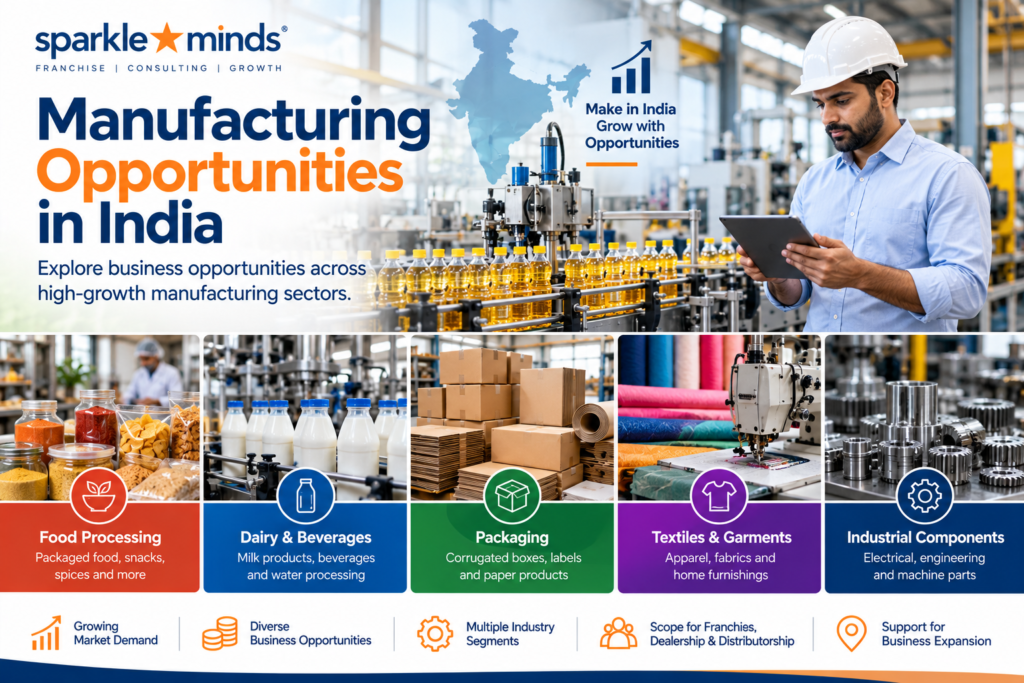
Manufacturing Opportunities in India
Nowadays to reach out to consumers across the country, companies are taking the option of manufacturing franchises, helping others to grow as successful entrepreneurs.
Franchise India brings numerous options for the one having the passion for starting a manufacturing unit.
Furthermore, we bring various options available in a manufacturing franchise like
- food & beverages
- dairy
- water plant as well as bottling and many more
Hence, check the opportunities on www.franchisebazar.com that match your skill level and start reaping the rewards for your investments.
Manufacturing Opportunities across the Globe
Examples in North America include
- General Motors Corporation
- General Electric
- Procter & Gamble
- General Dynamics
- Boeing
- Pfizer
- Precision Castparts
Examples in Europe include
- Volkswagen Group
- Siemens
- Michelin.
A few examples in Asia include
- Sony
- Huawei
- Lenovo
- Toyota
- Samsung
- Bridgestone
Why choose Manufacturing Opportunities in India?

The manufacturing sector of the economy is responsible for taking raw materials and turning them into finished products. Given the constant demand for finished products, new manufacturing companies are launched frequently.
Many manufacturing companies may have their factories in China; while registered as Indian Companies. Starting a new manufacturing company has many potential advantages.
Manufacturing Opportunities in India after covid had stalled operations. However, with the markets opened up post covid, manufacturing opportunities for chemical manufacturing, electronics manufacturing etc are seen to get better with the safety protocols being followed strictly.
Types of Manufacturing Opportunities in India
Manufacturing businesses produce goods for consumers, retailers, wholesalers and other businesses. The right opportunity depends on the product, target market, production requirements and available capital.
1. Food Processing and Packaged Food Manufacturing
Food manufacturing businesses may produce packaged snacks, spices, bakery products, ready-to-cook foods and other packaged food items. Entrepreneurs should evaluate raw material availability, food safety requirements, packaging, shelf life and distribution before investing.
2. Dairy and Beverage Manufacturing
This category includes dairy products, packaged beverages and water processing or bottling. Business owners need to assess sourcing, production equipment, quality control, storage, distribution and applicable food safety requirements.
3. Packaging and Paper Products
Manufacturing options include corrugated boxes, paper packaging, labels and other packaging materials used by retailers, e-commerce businesses and manufacturers. Assess machinery costs, material prices, production capacity and local business-to-business demand.
4. Plastic and Household Products
Depending on the product, opportunities may include household items, containers and other plastic goods. Evaluate machinery, mould costs, raw material supply, product standards and applicable environmental regulations before selecting a manufacturing model.
5. Textiles, Garments and Furnishings
This segment includes garment production, fabric-based products, home furnishings and related items. Consider labour availability, machinery, quality standards, sourcing, buyer requirements and competition.
6. Electrical, Engineering and Industrial Components
Businesses may manufacture selected electrical products, machine components, fittings and other industrial supplies. These opportunities can require technical expertise, quality testing, specialised equipment and relationships with industrial buyers.
The categories above are examples for research, not guarantees of demand or profitability. Confirm product-market demand, regulatory requirements and project costs before committing capital.
How to Choose the Right Manufacturing Business
Choosing a manufacturing opportunity requires more than identifying a product that appears popular. Assess the business from production through to sales.
- Market demand: Identify who will buy the product, how frequently they will order and which competitors already serve the market.
- Investment and working capital: Calculate machinery, premises, utilities, labour, raw materials, packaging, transport and operating expenses.
- Location and infrastructure: Consider access to suppliers, workers, roads, power, water and storage facilities.
- Licences and compliance: Identify the registrations, product-specific approvals, safety standards and environmental requirements that apply to your activity.
- Production capacity: Check whether the proposed machinery and facility can meet realistic sales volumes without excessive fixed costs.
- Sales and distribution: Establish how you will reach retailers, distributors, wholesalers, industrial buyers or direct customers.
- Financial feasibility: Prepare a cash-flow forecast and test whether the business can cover its costs under conservative sales assumptions.
Before finalising an investment, prepare a project report and verify supplier quotations, compliance requirements and potential customer demand independently.
Manufacturing Business vs Manufacturing Franchise
Starting an independent manufacturing business and investing in a manufacturing franchise are different approaches. The right choice depends on the entrepreneur’s experience, investment capacity and preferred level of independence.
Independent Manufacturing Business
An independent manufacturer develops or selects its own products, builds its production process, establishes its brand and finds customers. This provides greater control but also requires the owner to develop the operating systems, supplier relationships and sales channels.
Manufacturing Franchise
A manufacturing franchise may allow an entrepreneur to operate under another company’s brand, processes or agreed business model. Depending on the agreement, the franchisor may provide technical guidance, training, product specifications or marketing support. The exact support, fees, territory and obligations must be confirmed before investing.
Which Model Should You Choose?
Consider an independent manufacturing business if you want greater control over the product and brand. Evaluate a manufacturing franchise if a suitable brand offers a clearly defined model and credible support. In either case, review the agreement, total investment, supply terms, quality requirements and realistic sales potential before making a decision.
Frequently Asked Questions
1. What are the best manufacturing opportunities in India?
Manufacturing opportunities worth researching include food processing, packaged food, dairy products, packaging, textiles, household products and industrial components. The right option depends on market demand, investment capacity, production requirements, competition and access to buyers. No manufacturing business is guaranteed to be profitable.
2. Which manufacturing business can I start with a low investment?
The options available with limited capital depend on the product and whether you manufacture independently, outsource production or operate under an established business model. Small-scale packaging, selected food products and certain assembly or light-manufacturing activities may be worth evaluating. Calculate machinery, licences, working capital and distribution expenses before choosing.
3. How much investment is required to start a manufacturing business in India?
Investment varies considerably by industry, product, production capacity and location. Costs can include land or rent, machinery, installation, raw materials, labour, utilities, licences, packaging and working capital. Obtain supplier quotations and prepare a project report before estimating the total investment.
4. Is a manufacturing franchise different from an independent manufacturing business?
Yes. An independent manufacturer develops and operates its own business model, whereas a manufacturing franchise operates under an agreement with a franchisor. Franchise support and obligations vary by agreement. Compare the fees, supply arrangements, territory, technical support and operational restrictions before investing.
5. Which licences are required to start a manufacturing business in India?
The required registrations and approvals depend on the product, location, facility and manufacturing process. Depending on the business, requirements may include business registration, GST registration, factory-related approvals, pollution-control permissions, product-specific licences and fire or workplace safety approvals. Food businesses must also assess applicable FSSAI requirements. Confirm the rules applicable to your specific activity with the relevant authorities.
6. How can I find manufacturing franchise opportunities in India?
Start by identifying your preferred industry, investment budget, target location and operational experience. Review available opportunities, verify the franchisor’s credentials, understand the complete investment and support offered, and independently assess demand and financial feasibility before signing an agreement.
7. How can Sparkleminds help entrepreneurs explore manufacturing opportunities?
Sparkleminds provides information and support related to business and franchise opportunities. Entrepreneurs can explore relevant opportunities, clarify their investment requirements and evaluate suitable business models. The services and support available depend on the opportunity and the specific engagement.
8. Is a manufacturing franchise different from a retail franchise?
Yes. A manufacturing franchise may involve production rights, technical processes, quality control and supply chain responsibilities. A retail franchise generally focuses on selling products or services through an established brand and operating format. The investment and operational requirements can be very different.
To sum up,
Although a successful manufacturing company hinges upon a competent business model, the demand for manufactured products continues to grow.
As many Asian economies, such as those in China and India, heat up, residents see increases in their wages and increased demand for manufactured products.
So long as the product is not outmoded and the manufacturing facilities are flexible, the business will remain strong.
While manufacturing may be a tough business, it can also be a satisfying one. Instead of producing a service or experience, a manufacturer creates an item.
This may provide the owner of the company with the satisfaction of having made something that people use and, in many cases, deeply value. Therefore, one enjoys the satisfaction of the craftsman on a large scale.
Call us today to know various manufacturing business opportunities in any part of India with ease as well as comfort in your area of interest.
Recommended Reads
Explore these resources to research business opportunities, compare manufacturing models and plan your next business venture.
- Business Opportunities in India — Explore business options across different industries and investment levels.
- Manufacturing Franchise Opportunities — Browse listed manufacturing franchise opportunities across multiple product categories.
- Dealership Business Opportunities — Learn about dealership models for entrepreneurs interested in selling products through established businesses.
- Distributorship Opportunities in India — Explore distributorship models and consider their requirements before investing.
- New Business Ideas — Research other business concepts before selecting an opportunity.