Written By: Resham Daswani, Sparkleminds Editorial Team – Updated August 2026
Quick Answer: Defining A FICO Franchise Model in India
The FICO franchise model (Franchise Invested Company Operated model) provides business owners with a means of combining franchise partner investment with company-led operations. The new shop is run on a day-to-day basis by the corporation and funded by the franchise partner.
Expanding into new cities is a major growth opportunity for Indian businesses—but scaling quickly while maintaining brand control, operational consistency and customer experience can be challenging.
For established brands wishing to expand through franchising in India, this approach can provide a viable mix between outside investment and control over operations. In this post we explain what the FICO franchise model is, how it works, its five core benefits, which firms can use it and why it may be the perfect franchise expansion plan.
Understanding The FICO Franchise Model in India
Under this franchise business model, the franchise partner provides the investment for establishing a new outlet, while the franchisor or company operates the business.
The company may manage:
Recruitment and staff training
Daily operations
Customer service
Inventory management
Marketing implementation
Quality control
SOPs and operational standards
Performance monitoring
The basic structure is:
Franchise partner invests → Company operates → Brand expands
The FICO model allows the business owner to have a greater degree of engagement in the day to day operations as opposed to a typical franchise where the franchisee usually runs the outlet.
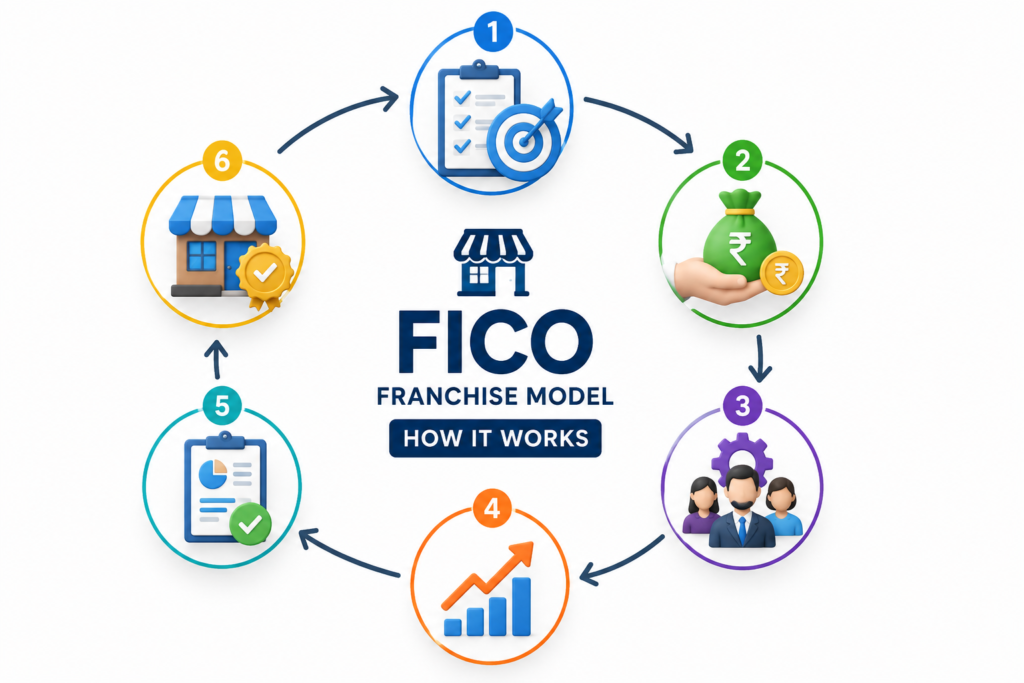
Knowing More About The FICO Franchise Model- How It Works?
A typical FICO expansion strategy follows a structured process:
The business validates its model – The company establishes that its concept, unit economics and operations can be replicated.
The franchise partner invests – Capital is provided for the new outlet according to the agreed commercial structure.
The company operates the outlet – The franchisor manages staffing, training, SOPs, inventory and customer experience.
Performance is monitored – Sales, customer behaviour, operational efficiency and profitability are tracked.
The model is replicated – Successful locations provide a foundation for expansion into additional cities and markets.
The exact investment, ownership, revenue-sharing and return structure should always be clearly defined in the commercial and legal agreements.
5 Key Benefits of the FICO Franchise Model for Business Owners
With FICO franchising, franchise partners can provide the investment needed for new locations while the business continues to focus on operations, brand development and strategic growth. This allows existing companies to think about multi-city expansion without the need to fund each new outlet totally from internal resources.
2. Greater Brand and Operational Control
The larger a franchise network expands, the more difficult it is for many business owners to safeguard their brand. Since the firm operates FICO locations, it has greater control over:
Staff recruitment
Training
SOP implementation
Service standards
Quality control
Customer experience
For service-oriented businesses such as healthcare, education, food, beauty, and wellness, as well as other service-oriented enterprises, this can be especially beneficial because operational consistency has a direct impact on the reputation of the brand.
3. Increased Consistency in the Customer Experience
Customers have the expectation that different locations of the same brand will provide them with the same experience.
The firm is able to establish uniform standards for service quality, customer engagement, hygiene, product or service delivery, and complaint resolution when it uses a franchise model that is controlled by the company itself.
By maintaining this consistency, brands that are expanding their operations to Tier 1, Tier 2, and Tier 3 locations in India may better safeguard the trust of their customers as the network expands.
4. Centralised Hiring, Training and SOPs
People and processes become increasingly important as a business expands.
Instead of leaving recruitment and training entirely to individual franchisees, a FICO structure allows the company to centralise:
Recruitment
Employee onboarding
Training
Performance management
SOP implementation
Operational audits
This creates a more consistent operating culture across the franchise network.
5. Better Operational Data for Smarter Expansion
Company-operated outlets can provide valuable operational insights.
Business owners can monitor:
Sales performance
Customer behaviour
Inventory movement
Staff productivity
Marketing effectiveness
Outlet-level profitability
This data can help management identify what is working, improve underperforming locations and make more informed decisions about future franchise expansion in India.
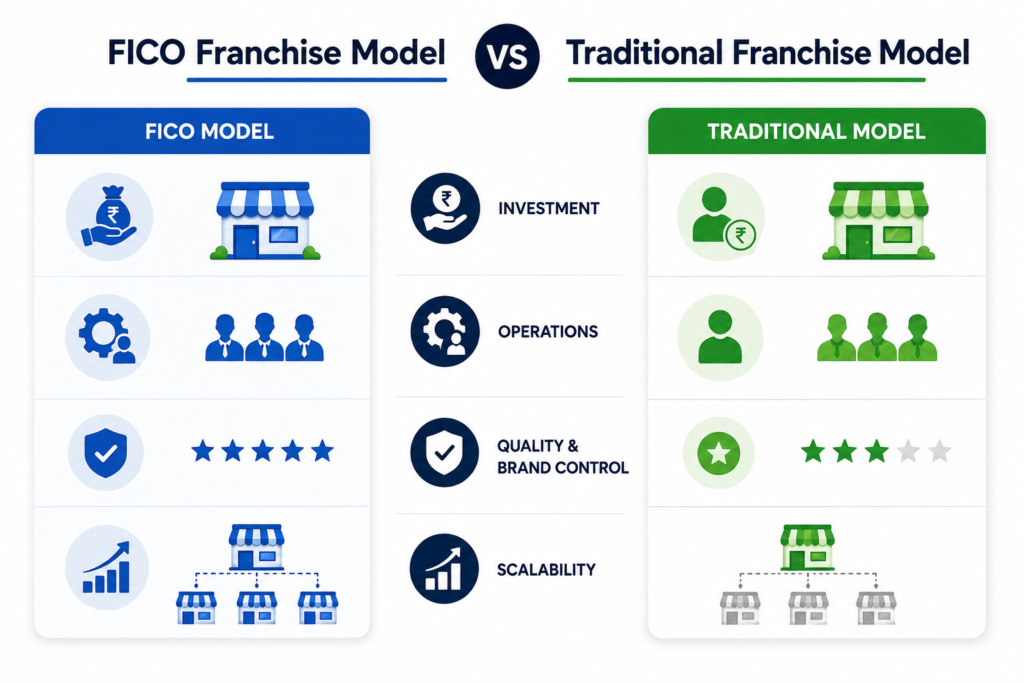
FICO Franchise Model vs Traditional Franchise
The main difference is who operates the outlet.
Factor
Traditional Franchise
FICO Franchise Model
Investment
Franchise partner
Franchise partner
Daily operations
Franchisee
Company
Staff management
Franchisee
Company
Brand control
Can vary
Generally higher
Customer experience
May vary
More centrally controlled
SOP implementation
Franchisee-led
Company-led
Expansion approach
Franchisee-led
More company-led
For business owners who want to expand while retaining greater operational involvement, FICO can be an attractive alternative to a conventional franchise structure.
FICO vs FOCO: What’s the Difference?
FICO and FOCO are often discussed together because both can involve franchise partner investment and company-operated outlets. However, the nomenclature used for franchises might differ from brand to brand.
It is not enough for a business owner to merely know which acronym is being used; the thing that is more significant is how the actual agreement itself defines:
Investment
Ownership
Operations
Revenue sharing
Expenses
Returns
Exit terms
Operational responsibilities
Business owners should therefore evaluate the commercial structure behind the model, rather than relying only on the terminology.
Which Businesses Can Prove Profitable By Expanding As The FICO Franchise Model?
FICO may be useful for firms in which maintaining operational consistency and providing a positive experience for customers is essential to the success of the brand.
Some of the potential industries are:
Healthcare and Diagnostics
Standardised service, hygiene and operating procedures are critical.
Food and Restaurants
Food quality, service speed, inventory and hygiene need consistent management.
Beauty and Wellness
Customer experience and staff expertise directly influence brand perception.
Education and Training
Consistent centre management, teaching standards and student experience are important.
Fitness and Sports
Equipment, trainers, member engagement and service standards require regular monitoring.
Retail and Consumer Brands
Store presentation, merchandising and customer service can benefit from centralised control.
Is the FICO Franchise Model Right for Your Business?
FICO is not automatically the right franchise model for every business.
Before adopting it, business owners should have:
A proven business model
Demonstrated customer demand
Clear unit economics
Documented SOPs
Structured HR processes
Reliable technology and reporting systems
A scalable supply chain
Strong operational management
A simple rule is:
FICO can help a proven business scale—it cannot replace a proven business model.
If the business is still testing its concept or struggling with inconsistent operations, strengthening the core business should come before aggressive franchise expansion.
Common FICO Franchise Expansion Mistakes
Business owners should avoid:
Expanding before the model is proven
Operating without documented SOPs
Underestimating staffing requirements
Ignoring technology and performance reporting
Using unrealistic financial projections
Entering markets without adequate demand research
Creating unclear franchise agreements
Assuming investment alone will guarantee expansion success
In order to achieve sustainable franchise growth, it is necessary to have operational discipline, financial transparency, and a business model that can be replicated.
How Sparkleminds Helps Business Owners Build FICO Franchise Models
For business owners, developing a franchise is about more than finding franchise partners. The business needs the right franchise expansion strategy, operating systems and commercial structure.
Sparkleminds helps businesses evaluate and develop scalable franchise models through services including:
Franchise feasibility studies
Franchise strategy development
FICO model development
Financial modelling
Franchise documentation
Operations manuals and SOP development
Franchise recruitment strategy
Expansion planning
Franchise support systems
The objective is to help business owners build sustainable, professionally managed franchise networks rather than simply add more locations.
It can be considered, but the model is generally better suited to businesses with a proven concept, established SOPs, clear unit economics and demonstrated customer demand.
How can Sparkleminds help with FICO franchise expansion?
Sparkleminds helps business owners assess franchise readiness and develop franchise strategy, FICO structures, financial models, SOPs, franchise documentation, recruitment plans and expansion systems.
Conclusion
The FICO franchise model in India can give established business owners an alternative route to expansion by combining franchise partner investment with company-operated locations.
For firms with a proven business model looking to grow to numerous cities while retaining a good deal of operational control, FICO can be a useful tool for franchise expansion. But the correct foundation is the key to successful franchising: robust SOPs, defined unit economics, skilled personnel, operational systems and a scalable business plan.
If you’re a business owner looking at how to franchise your business in India, FICO can be considered when your business has a proven model, strong SOPs and the operational capability to manage multiple locations. The right franchise structure should ultimately support your growth goals without compromising the systems and customer experience that built your brand.
Sparkleminds helps business owners evaluate franchise readiness and develop structured franchise expansion strategies, including FICO franchise models.
Written By: Resham Daswani, Sparkleminds Editorial Team – Updated August 2026
FirstCry Success Story: How This Startup Became India’s Largest Kids Brand
How did FirstCry become one of the biggest baby and kids retail businesses in India? FirstCry succeeded by recognising a clear vacuum in the Indian market, developing strong category expertise, earning consumer trust and then scaling thru an omni-channel business strategy integrating online shopping, physical locations, private labels and smart acquisitions. The greater message for business owners is simple: a healthy business doesn’t need to remain in one place. With the correct expansion plan, systems and partners it may be a scalable national brand.
So FirstCry’s transition from an online baby-products firm to a huge omnichannel store is more than an inspiring Indian startup success tale. It’s a real-world example of how companies may establish a repeatable expansion model. And for entrepreneurs who are thinking, “How can I expand my business in India?”, FirstCry has some good responses.
The FirstCry Success Story Began With A Simple Problem
Supam Maheshwari and Amitava Saha launched FirstCry in 2010. The creators saw a need that many Indian parents were struggling with at that time – there weren’t many places where you could buy a wide variety of trusted baby and children’s products.
Rather than building another generic e-commerce portal, they decided to focus on one category – babies, children and maternity. That was a big decision. The company began as an online platform providing baby-care, maternity and children’s products. And the proposition was simple:
a whole range of products in one easy destination for parents.
It wasn’t a strategy of selling everything to everyone.
It was about being so pertinent to one segment of customers.
That category-centric approach became one of the cornerstones of the FirstCry business model.
From Online Startup to Omnichannel Brand
A big part of the FirstCry success story was its expansion beyond only internet retail.
The company understood that for Indian consumers, brick-and-mortar stores would remain important, especially for categories related to babies and children. Parents want to view things, compare sizes, understand quality and shop in person. So, FirstCry came up with an omnichannel retail strategy.
Its internet platform provided ease and variety, while physical shopfronts offered exposure, accessibility and an in-person shopping experience.” The company also entered offline retail thru franchised outlets in 2011. Strategically, this was a big step, as franchising allowed the brand to grow its physical footprint without having to rely only on the cash and operations from company-owned stores.
This is where the FirstCry success story is very relevant to owners of existing Indian businesses. This does not mean that a successful business has to create and operate every new outlet. A good franchise model allows a business owner to partner with local entrepreneurs that contribute investment, market expertise and operational engagement while the brand brings the business plan, systems, branding and support.
That’s the power of franchise business expansion when it’s done right.
Why the Omnichannel Model Succeeded
FirstCry does not consider online commerce and retail shopfronts as two independent business lines. Rather, the two channels complemented one other. “Customers can find products online, visit a store, purchase offline and continue to interact in the digital space. Physical stores also helped increase brand identification in regions where online buying was still growing.
Its physical retail base became an important aspect of the company’s multichannel approach, complementing its digital platform, the company said in its disclosures. This is a lesson for Indian Entrepreneurs to take a cue from. If you have a thriving retail, food, education, healthcare, beauty or service business, the question of whether to go all offline or all online may be the wrong one.
The proper question is:
How can the various channels collaborate to make my brand more accessible?
And that approach can produce a lot larger scalability.
FirstCry Created a Network of Over
The FirstCry success story was also because it was able to break the boundaries of being just a marketplace. The company expanded its product ecosystem and created private brands such as BabyHug. The private labels let FirstCry have greater control over product positioning, pricing and customer experience, while enhancing the broader brand ecosystem.
The corporation also grew thru smart acquisitions. In 2016, FirstCry bought BabyOye from Mahindra Retail to boost its footprint in the baby and maternity segment. It later branched out into neighbouring parts of the parental ecology.
This demonstrates a key principle of corporate growth:
And expansion doesn’t have to imply additional outlets.
It might also signify:
Expanding to new cities
Expanding Product Categories
Producing private-label products
Acquiring related businesses
Establishing distribution relationships
Franchise network building –
Going global
Build a stronger customer ecosystem
These are various roads to advancement for the aspiring business owner.
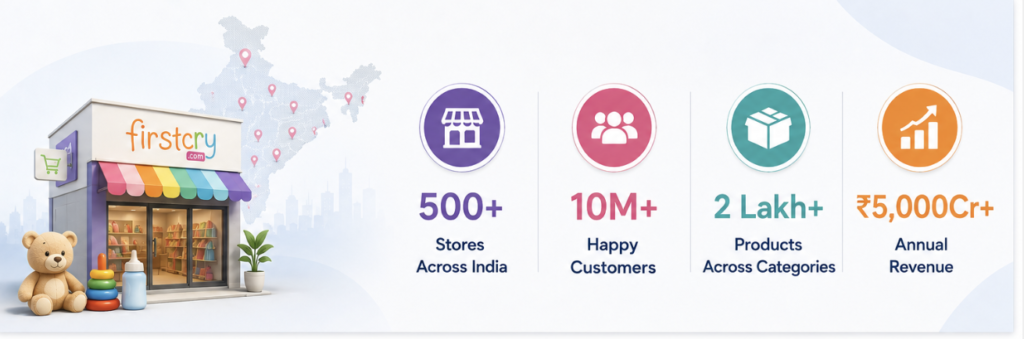
The numbers show what scale can be. FirstCry’s growth has also resulted to tremendous operating scale.
According to its financial reports, FirstCry’s parent firm Brainbees Solutions has announced that its consolidated revenue for FY2024-25 rose 18% to almost ₹7,659 crore compared to the previous year. Its India multichannel business accounted for ₹5,278 crore.
As of March 2025, the company operated 1,156 modern outlets including corporate-owned stores under the labels FirstCry and BabyHug. Its own brands accounted for more than 55% of revenues.
The corporation still issues quarterly earnings and financial reports, giving investors and business watchers a glimpse of its operating outcomes.
These numbers key because they tell a story entrepreneurs typically underestimate: It’s not simply ambition that creates scale, but systems. One successful outlet is one success. But coming up with a business strategy that can be copied across hundreds of locations is a whole different challenge.
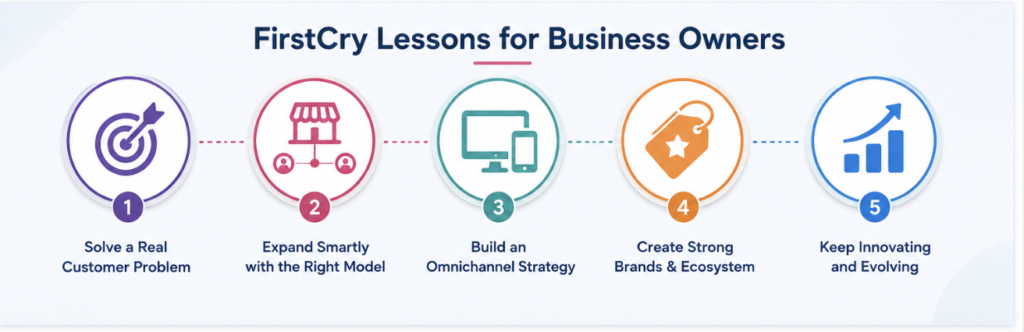
FirstCry Lessons for Business Owners
1. Address an actual customer concern
FirstCry did not start with the query, “What business can we start? It identified an issue for parents and went about solving it. That’s equally vital for existing business owners. Before expanding, question:
What makes my business different from the competition and why would clients seek the same experience in another city?
If the answer is obvious, you could have the ingredients for a scalable business.
2. Create a scalable business model
It’s hard to grow a business model that depends wholly on its creator. Opening ten extra shops can create ten times the complexity if the owner has to be involved in every decision, customer interaction, supplier negotiation and operational procedure. The opposite strategy is required for franchising.
The business needs established processes for topics like:
Store operating (
StaffTraining
Customer support
Purchasing
Marketing Technology
QC (Quality control)
Finance accounting
Brand guidelines
This turns the business from a founder-dependent operation to a replicable franchise model.
3. Physical expansion must not be underestimated
At times, the growth of e-commerce gives the sense that traditional stores are becoming irrelevant. But FirstCry’s experience is a more complex story. It has run an online platform and a physical retail network side by side as part of a multi-channel strategy.
Many Indian firms still believe in the power of physical presence to build trust, visibility and local market penetration. Franchise networks can expedite that presence.
4. Look beyond your home cities
Many successful Indian firms get complacent once they have established themselves in one city. The founder understands the customers, suppliers, employees and the market firsthand. But that comfort can be a hindrance to advancement.
FirstCry’s expansion is a case in point of the possibilities of moving away from a specific business offering to many markets rather than being geographically concentrated.
The question should eventually become for a business owner:
Can my business operate anywhere else?
to:
What do I need to modify for my business to work elsewhere?”
Now that’s a far more strategic expansion.
5. Leverage franchise partners as local growth drivers
A franchise partner is not just a source of money. The appropriate franchisee may offer:
Knowledge of local market
Real estate know-how
Local relations:
Staff management
Customer intelligence
Money for expansion
Entrepreneurial Dedication
This can be especially helpful for a company that wishes to penetrate many cities without having to bear the full financial and operational burden itself. This is why the early utilisation of franchise-owned outlets by FirstCry is one of the most important portions of the company’s journey to entrepreneurs considering franchise business opportunities in India.
Why FirstCry Is More Than a Startup Success Story
Looking at FirstCry, it is tempting to think that e-commerce was the reason for its success.
This would be to miss the point.
The corporation didn’t just erect a website and wait for clients.
It created a brand category specialist.
It created a vast product ecosystem.
It also incorporated a physical retail store.
It employed franchising as a way of expanding.
It created private labels.
It made purchases.
It grew internationally.
And it kept investing in the client experience.
That was the beginning of a much more powerful business than just an online store. That is an essential distinction to entrepreneurs. Technology can assist a business to grow but it is a scalable business strategy that allows for continued expansion.
Implication to Indian Business Owners
Suppose you already have a profitable business.
You have clients.
You have a product or service with a market demand.
Your brand is known in your city.
But it’s beginning to slow down since you can’t personally oversee another location. This is where franchising can be worth looking at for growing your firm.
Don’t have all your personal capital invested into every new store. Create a franchise opportunity that has a structure where partners who qualify invest in and operate locations under your brand. But franchising should not be considered just the sale of franchise rights.
Before creating a franchise model a business owner must consider:
Is the company financially sound?
Are the unit economics compelling?
Can the operations be reproduced?
Is it a different brand?
Can new franchisees get a good return?
Are the processes written down?
What will franchisees get?
What lands should be proposed?
What is the correct fee/royalty structure for franchises?
What are the legal agreements and compliance requirements?
These questions will establish if a business is truly ready to franchise.
Key Takeaways From the FirstCry Success Story
Perhaps the most essential lesson from FirstCry is not about the number of stores, its income or even its technology. It’s the ability to take a strong business idea and convert it into a repeatable growth engine.
The founders noticed a gap in the market.
They specialised.
They created trust with their customers.
They increased their product line.
They blended internet and offline channels.
And they built systems that gave the brand the opportunity to reach customers beyond what the founders could accomplish themselves.
That’s entrepreneurship, scalable, literally.
Should I Franchise My Business or Not: Is It the Right Decision for You?
If your firm has reached a point where clients are begging for your brand in other places, your unit economics are established and you can reproduce your operations, franchising could be the next natural stage of expansion. But it should not only be “get more franchisees.”
The aim should be:
Create a franchising structure that is mutually beneficial for the brand, the franchisee and the customer.
FirstCry’s story is a case study on how a business may evolve from solving a local need to developing a national ecosystem.
That’s the actual lesson for Indian entrepreneurs.” You don’t need to develop another FirstCry. You have to understand why FirstCry was able to scale and what of those concepts can you apply to your firm.
Final Thoughts
At the end of the day, the FirstCry success story is a narrative about scaling.
A niche idea turned into a niche brand
A speciality brand become an omnichannel enterprise.
An omnichannel business created a physical presence.
And a scalable approach paved the way for national and international expansion.
The message to Indian business owners is simple. If you have a business with established demand, excellent unit economics and a replicable operating model, then expansion thru franchising can help you reach markets that would be difficult to win thru company owned growth alone.
The next important question for the ambitious entrepreneur might not be “Should I continue to grow?”
It could be:
“Is my business ready to be a brand that other entrepreneurs can grow with?”
Written By: Resham Daswani, Sparkleminds Editorial Team – Updated August 2026
Apne Business Ko Franchise Kaise Kare? Quick Answer
Apne business ko franchise karne ke liye sabse pehle ye check karna hota hai ki aapka business scalable, profitable and also repeatable hai ya nahi. Iske baad franchise business model develop karna, SOPs banana, franchise fee aur royalty structure decide karna, brand aur legal documentation ready karna, franchisee training system banana aur suitable franchise partners identify karna hota hai.
Simple words mein, apne business ko franchise kaise kare ka answer sirf “franchise dena shuru kar do” nahi hai.
Aapko apne existing business ko ek replicable business system mein convert karna hota hai jise ek trained franchise partner aapke brand standards ke according doosre city mein bhi operate kar sake.
Franchising in India can be particularly beneficial for business expansion for businesses that already have a proven client base, defined operating processes and a business plan that can be copied across locations. Current franchise guidance also promotes company validation, systemisation, brand strength and franchise planning before development.
Business Ko Franchise Kaise Kare? Sabse Pehle Ye Samjhein
Franchising ka matlab hai kisi entrepreneur ko aapke brand name, business model, systems, processes, products or also services ka use karne ka contractual right dena.
Aap franchisor hote hain.
Jo entrepreneur aapke brand ke under business operate karta hai, moreover, woh franchisee hota hai.
Franchisee generally outlet setup aur business operations mein investment karta hai, while franchisor provides the brand, operating system, training, support and other agreed resources.
Depending on your model, franchisor revenue may come from:
The exact commercial structure should be based on your business economics rather than copied from another franchise brand.
Kya Har Business Ko Franchise Kiya Ja Sakta Hai?
Nahi. Har business franchise-ready nahi hota.
This is one of the most important questions a business owner should answer before searching for “apne business ko franchise kaise kare.”
Your business should ideally have:
Proven demand
Consistent sales
A clearly defined operating model
Repeatable processes
A strong value proposition
Reasonable profitability
Customer retention or also repeat business
Potential to operate in other markets
Systems that can be taught to another operator
Agar business ka pura operation aapki personal presence par depend karta hai, to pehle us business ko systemise karna zaroori hai.
Therefore, Franchise tabhi scalable hoti hai jab business owner ke bina bhi business model reasonably operate kiya ja sake.
Apne Business Ko Franchise Mein Kaise Convert Kare?
Business ko franchise mein convert karna basically business systemisation + franchise model development ka process hai.
1. Apne Business Ka Franchise Feasibility Check Karein
Sabse pehle analyse karein:
Kya mera business franchise ke liye suitable hai?
Check:
Current revenue
Profitability
Customer demand
Competition
Operational complexity
Investment requirement
Scalability
Market potential
Aapko ye bhi identify karna chahiye ki aapka business kis type ke franchisee ke liye suitable hoga.
For example, a food brand may require an operator with strong outlet-management skills, while an education or consulting business may require a franchise partner with local networking and sales capabilities.
Franchise Model Kaise Banaye?
A successful franchise model sirf franchise fee decide karne se nahi banta.
Moreover, aapko decide karna hota hai:
Franchisee kya invest karega?
Franchisor kya provide karega?
Franchisee outlet kaise operate karega?
Royalty kaise calculate hogi?
Territory kaise define hogi?
Training kaun provide karega?
Marketing ka responsibility kiska hoga?
Quality control kaise hoga?
Franchise agreement mein kya terms hongi?
Therefore, aapka franchise model financially attractive for the franchisee aur commercially sustainable for the franchisor dono hona chahiye.
Franchise Business Model Kaun Sa Choose Kare?
Different businesses may require different structures.
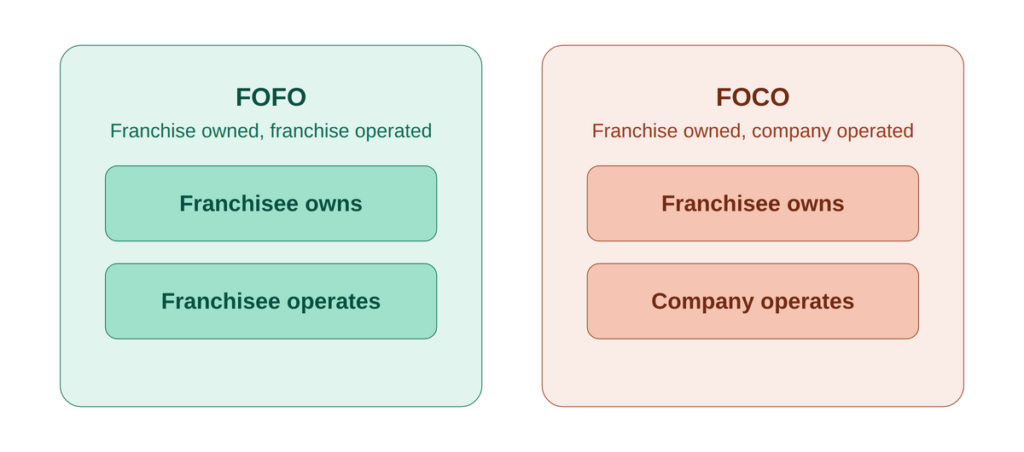
FOFO Franchise Model Kya Hai?
FOFO – Franchise Owned, Franchise Operated
Is model mein franchisee investment karta hai aur outlet ko operate bhi karta hai.
Moreover, this can work well where the franchisor has established SOPs and wants franchise partners to manage local operations.
FOCO Franchise Model Kya Hai?
FOCO – Franchise Owned, Company Operated
Franchisee investment provide karta hai, while company operations mein greater control rakhti hai.
This model can be considered where operational consistency is particularly important.
Company-Owned Model vs Franchise Model
Company-owned outlets offer more direct management, but require the business owner to put up more capital in each shop.
Franchising can help a brand grow with the use of franchise partner finance and local involvement, but it also comes with the duty of managing franchise partnerships and maintaining brand standards.
Apne Business Ki Franchise Dene Ke Liye Kya Chahiye?
A business owner ko franchise launch karne se pehle several components prepare karne chahiye.
Strong Brand Identity: Your logo, visual identity, positioning, customer experience as well as marketing communication should be standardised.
Proven Business Model: A franchisee should understand what they are investing in and also how the business operates.
SOPs and Operations Manual: Every important process should be documented.
Franchise Financial Model: Investment, fees, recurring costs as well as commercial arrangements should be clearly defined.
Franchise Agreement: The legal relationship between franchisor as well as franchisee should be appropriately documented.
Training System: Franchisees and their employees need structured training.
Franchise Support System: The franchisor needs to determine what support continues after the outlet launches.
Franchise SOP Kaise Banaye?
SOP – Standard Operating Procedure – franchise business ka backbone hota hai.
Aapko document karna chahiye:
Store opening process
Store closing process
Customer handling
Sales process
Product/service delivery
Staff recruitment
Staff training
Inventory management
Vendor management
Quality checks
Complaint handling
Marketing process
Reporting system
Further, think about this question:
“Agar main kal apne business se completely remove ho jaun, kya ek trained person is business ko meri system ke according chala sakta hai?”
Agar answer “no” hai, your business probably needs more systemisation before franchising.
Franchise Dene Mein Kitna Kharcha Aata Hai?
This is another important search question for business owners.
Franchise development ki koi single fixed cost nahi hoti.
The investment required can vary based on:
Industry
Business size
Existing systems
Number of outlets
Legal requirements
SOP development
Technology
Training
Branding
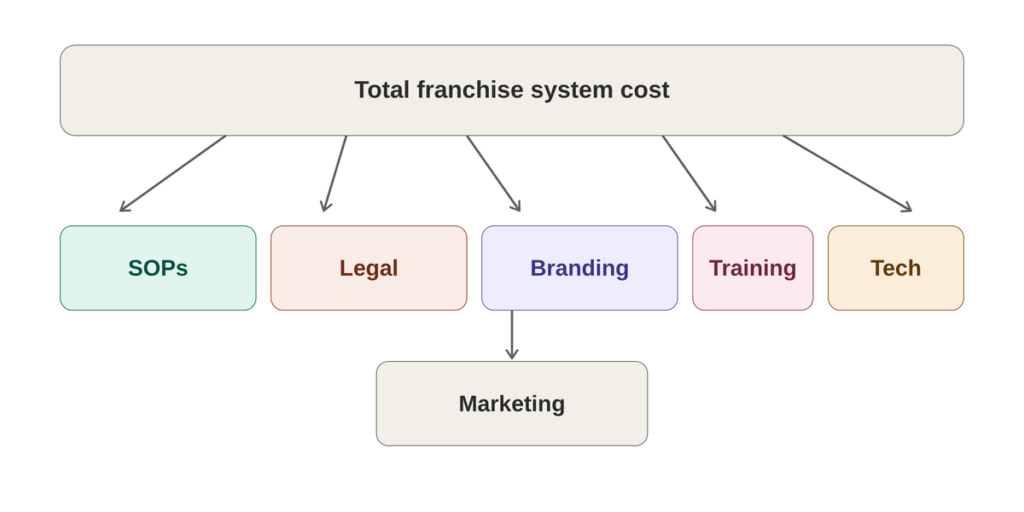
Franchise marketing
Consultant requirements
A small service business and a multi-location restaurant chain will obviously require different levels of franchise preparation.
Instead of asking only “franchise banane mein kitna paisa lagega?”, business owners should calculate the cost of building a complete franchise system.
Franchise Agreement Kaise Banaye?
“Franchise agreement kaise banaye?” is an important commercial and legal question.
The agreement should clearly define matters such as:
Franchise rights
Territory
Franchise term
Fees
Royalty
Brand usage
Intellectual property
Operating standards
Training
Marketing responsibilities
Supplier arrangements
Reporting requirements
Renewal
Termination
Confidentiality
Dispute-related provisions
Indian business owners should work with qualified legal professionals for franchise documentation rather than relying on generic agreements downloaded from the internet.
Once your franchise model is ready, the next question becomes:
“Franchise kaise deni hai aur franchise partner kaise milega?”
This is where many business owners make a mistake.
Don’t select a franchisee only because they have the money.
Look for:
Financial capability
Business understanding
Local market knowledge
Sales ability
Operational commitment
Brand alignment
Willingness to follow SOPs
Long-term business mindset
The right franchise partner can become an important growth asset.
The wrong franchise partner can create operational problems and potentially damage your brand reputation.
Business Ko India Mein Kaise Expand Kare Through Franchising?
Once your business becomes franchise-ready, you can create a structured India expansion strategy.
Instead of randomly accepting franchise enquiries, identify priority markets.
Tier 1 Cities
Large markets can provide strong demand but may also involve:
Higher rentals
Higher competition
Higher operating costs
Tier 2 Cities
These can offer opportunities for brands that understand local customer demand and price sensitivity.
Tier 3 Cities
For selected business categories, smaller cities can provide opportunities where organised branded offerings are still developing.
Your city expansion strategy should consider:
market demand + competition + investment + rental cost + local purchasing power + franchisee availability.
Franchise Business Expansion Mein Market Research Kyun Zaroori Hai?
Before entering a new city, ask:
Kya mere product ya service ki demand wahan hai?
Research:
Local competitors
Customer demographics
Pricing
Existing brands
Property availability
Rental levels
Local purchasing power
Supply chain
Franchise partner availability
Market research and feasibility analysis are repeatedly highlighted in franchise-development guidance because they help determine whether the model can be replicated and whether a particular market is suitable.
Apne Business Ko Franchise Karne Ke Fayde Kya Hain?
Franchising can offer several potential advantages for established business owners.
Business Expansion Without Funding Every Outlet Yourself: Franchisees generally invest in establishing their own locations, reducing the need for the franchisor to fund every outlet directly.
Faster Market Expansion: A franchise network can allow a brand to establish a presence in multiple markets more quickly than relying exclusively on company-owned outlets.
Local Business Knowledge: Franchise partners can bring knowledge of local customers, competition and market conditions.
Recurring Revenue Potential: Depending on the commercial structure, franchisors may generate franchise fees, royalties or supply-related revenue.
Stronger Brand Presence: Successful franchise outlets can increase brand visibility and create opportunities for further expansion.
Main franchisee ko kitna training aur support dunga?
Kaunse Indian cities mere expansion ke liye suitable hain?
Kya mujhe franchise consultant ki professional support chahiye?
If you cannot answer several of these questions, your business may need additional preparation before launching its franchise model.
Final Takeaway: Apne Business Ko Franchise Kaise Kare?
Apne business ko franchise karna ek structured business expansion strategy hai—not simply a way to sell franchise outlets.
A successful franchise brand is built on:
Strong Business + Scalable Model + SOPs + Brand + Financial Structure + Legal Framework + Training + Franchisee Support + Right Expansion Strategy
Agar aapka business profitable hai, customer demand proven hai aur operations ko standardise kiya ja sakta hai, franchising could become a powerful route to expand your brand across India.
The most important question is therefore not just:
“Apne business ko franchise kaise kare?”
It is:
“Kya mera business franchise ke through sustainably scale hone ke liye ready hai?”
If the answer is yes, the next step is to build the right franchise model before you start looking for franchise partners.
Want to turn your existing business into a scalable franchise brand? Connect with Sparkleminds to explore your franchise expansion strategy in India.
FAQs
Apne business ko franchise kaise kare?
Apne business ko franchise karne ke liye business feasibility check, franchise model development, SOP creation, financial structuring, legal documentation, training, franchise support and franchisee selection ki process follow karni hoti hai.
Aap apne business ki franchise kaise de?
Pehle business ko franchise-ready banayein, commercial model and franchise documentation prepare karein, suitable franchise partners identify karein aur structured onboarding and training process establish karein.
Business ko franchise mein convert kaise kare?
Business ko franchise mein convert karne ke liye existing operations ko systemise aur document karein, brand standards define karein, franchise economics develop karein and ensure karein ki model different locations mein replicate ho sake.
Franchise business model kaise banaye?
Investment requirements, franchise fee, royalty, territory, operating duties, training, marketing and ongoing support structure define karna hota hai for franchise model banane ke liye.
Franchise dene ke liye kya chahiye?
Aapko generally a proven business model, strong brand, SOPs, franchise economics, appropriate legal documentation, training system and franchisee-support framework ki zarurat hoti hai.
Franchise business kaise start kare?
Agar aap existing business owner hain, franchise business start karne ka first step franchisee dhoondhna nahi, balki apne existing business ko franchise-ready banana hai.
Franchise kaise beche?
Franchise ko sirf sales product ki tarah sell karne ke bajay, business owners ko suitable franchise partners identify karke unhe transparent investment, operating model, support and commercial information provide karni chahiye.
Ek franchise business mein royalty kya hoti hai?
Royalty is an ongoing commercial payment that a franchisee may pay to the franchisor according to the agreed franchise structure. It may be calculated as a percentage of sales, a fixed amount or another agreed mechanism.
India’s building and infrastructure business is experiencing one of the strongest phases of expansion in its history. The demand for excellent construction products is enormous, fuelled by residential housing, commercial developments, smart cities, industrial parks, premium interiors and rehabilitation projects. Moreover, Premium brands are seeing remarkable growth in categories like tiles and sanitaryware, modular kitchens, architectural hardware, flooring, paints, lighting, doors, windows, roofing solutions, and interior finishes.But even with demand on the rise building products business eventually hit a point where it is difficult to grow much more. Opening firm owned branches in various places demands huge resources, managerial bandwidth, warehousing, recruitment as well as operational supervision. Growth slows, not due to a lack of demand, but because scaling is too expensive.
This is what makes franchising so attractive to India’s fastest-growing building products business.
The franchise model helps manufacturers, distributors and luxury product companies to expand swiftly, while retaining quality, brand identification and profitability.
If you have a luxury building products firm and wish to have a significant presence across India, franchising might be your most strategic development move.
This book will show you:
why franchising is a brilliant fit for construction companies,
how the model builds long-term value,
what investors seek,
and also how Sparkleminds helps firms build successful franchise networks.
What’s fuelling the explosive growth of India’s Building Products Business Industry?
India’s building ecosystem is developing across various industries simultaneously.
Drivers of growth include:
Urbanisation growth
Investment in public infrastructure
Affordable Housing Programs
High-end residential developments
Interiors of luxury homes
Office expansion (commercial)
Hospitality projects “
Health care infrastructure
Retail projects
Development of Tier II and Tier III cities
Today’s customers don’t buy building products based on pricing alone. More and more they give priority to:
Premium Grade
Design / visual
Durability of goods
Materials that are sustainable
Corporate image
Help with installation
Guarantee
Technical prowess
Nevertheless, this trend has opened up massive prospects for premium construction product firms with differentiated solutions.
Why Expansion Becomes Hard Eventually
Many successful construction product companies start off growing through distributors, dealers, architects, builders as well as project sales.
But as they grow, they face common obstacles.
Heavy capital investment
Every new showroom requires:
Commercial real estate
Internal configuration
Storage
See inventory
Staff Recruitment Marketing
Operations in the local region
Thus, opening a few corporate owned locations ties up crores of rupees in capital.
Complexity of management
Managing 20 or 50 locations directly entails dealing with:
Employment
Trainings
Inventory Operations
Customer support
Sales goals
Conformity
Marketing to locals
The operations become progressively complex.
Market Penetration Slower
India has hundreds of markets that are bright. Also, it takes years to get into each city on its own. Meanwhile, competitors usually set up a local monopoly.
Local Market Expertise
Every city is different.
People in Jaipur and Bengaluru buy differently.
Customer expectations are different in Kochi than in Lucknow.
Local entrepreneurs know these markets better than corporate teams.
Franchising: A Smart Strategy for Expansion
A franchise model combines your proven business system with entrepreneurs who invest their own capital to build the business.
Rather than operating each location on your own, franchise partners are local company owners invested in building your brand.
“It’s a scalable, capital-efficient expansion model.
The benefits of franchising for luxury construction product businesses are often difficult to match with traditional growth.
Rapid Geographic Expansion
A structured franchise network can build presence in numerous locations at the same time instead of opening 5 outlets owned by the company over a span of 3 years.
Moreover, this will hasten market penetration and improve brand visibility across the country.
Lower capital requirements
Franchise partners will often invest in:
Display Rooms
Interiors
Warehousing.
Fonds de roulement
Local clubs
Sales Ops
The franchisor’s focus is:
Branding
Innovative product
Supply chain
Training & Development
Technology Marketing Support
Franchise administration
Therefore, this enables quicker growth without over-expending capital.
Business Owners Very Motivated
Employees are paid salary. Franchisees build their own businesses.
Franchise partners are often investing their own money and so may be more committed to sales, customers and local marketing.
Increased brand visibility
Multiple branded franchise shops in India boost visibility among:
A larger physical presence adds client confidence as well.
Improved Customer Experience
Well trained franchise partners can offer:
Demonstrations of products
Technical guidance
Project Tips
Installation coordination
After-sales service
Therefore, this increases client happiness and creates long-term commitment.
What Building Product Business Opportunities Are Franchisable?
Many entrepreneurs think that franchising is limited to eateries as well as retail businesses.
Many building product companies are, in fact, wonderful franchise prospects.
Some examples are:
Premium tile brands
Modular kitchen manufacturers
Flooring contractor .
Lighting Products
Smart home gadgets
Architectural hardware
Aluminium system –
Windows and doors
Paints companies
Waterproofing systems
Roof systems
Bathtubs
Plumbing Fixtures
Smart Home
Decorative panels
Brands of plywood
Laminates,
Interior decoration goods
Stone & marble solutions
Kitchen appliances
Fittings of luxury
Franchising can be an effective expansion option if you have a consistent operating model and high client demand.
Ready to Franchise Your Building Products Business?
Not all businesses are ready to franchise right away. Further, most successful franchise brands have:
Proven Business Concept: Your business products should be selling consistently to customers.
Powerful Brand Identity: Your brand needs to be recognised and trusted by customers.
Healthy Margins: While franchisees need to see attractive returns, the brand needs to stay profitable too.
Standardised Operations: “We want the customer experience to be the same in every showroom, wherever it is.
Dependable Supply Chain: To succeed, franchises need inventory on hand when needed.
Clear Business Systems: Training manuals, operating procedures, sales processes and marketing frameworks are must be in place or developed before expansion.
What Franchise Investors Are Seeking Today
Investor expectations have shifted a lot. They don’t select brands based on advertising anymore. Instead they concentrate on the basics of the business.
The most serious franchise investors are looking for:
Establish brand credibility
Strong demand for product
Margins healthy
Conservation Areas
Complete training Marketing support
Open books
Stock you can rely on
Tech support
Possibility of Expansion
Therefore, stronger franchise enquiries come to building products business that meet these expectations.
How Sparkleminds Helps Building Product Businesses Franchise Successfully
Many businesses think of franchising as simply producing a franchise brochure. The truth is, successful franchise development takes strategy. Moreover, Sparkleminds helps premium businesses establish scalable franchise systems from the ground up.
We suggest:
Franchise Viability Evaluation: We assess your firm for franchise-readiness, identifying areas for improvement before scaling.
Building a Franchise Business Model: We help to define:
Investment architecture.
Business model
Franchise fees
Royalty structure
Design of territory
Store formats
Partner Requirements
Franchise Disclosure Document: Professional documentation boosts investor confidence.
This includes:
Franchise Info Memo (FIM)
Franchise Contracts
Operation instructions
Training guides
Standard operating procedure /
Franchise Marketing
Targeted visibility is a must for a good franchise opportunity.
Franchise Partner Acquisition: It is more crucial to identify the proper franchisee than the fastest one. We assist find talented entrepreneurs who fit your business goals.
Franchise Support Launch: We help companies in every step of opening new franchise locations from onboarding to training to operational set-up.
Common Mistakes Product Companies Make When Transitioning to Franchise
Many brands fail because they grow without the necessary mechanisms in place.
Don’t make these mistakes.
Choose anyone who pays: Choose a franchise partner on capability, commitment as well as market understanding, not just investment capability.
Training is Weak
Franchisees need to have a broad understanding of:
Sales Products
Customer interaction
Installation
Technical Data
Training should never be considered as a one-off activity.
Inconsistent brand branding: Uniform showrooms, displays, pricing as well as communication build client trust.
Inadequate inventory planning: Building products typically need large inventories and also specialised logistics.
It is important to plan the supply chain efficiently.
No Continued Support
Franchisees seek ongoing assistance in marketing, operations, technology as well as business development.
Strong support from the franchisor contributes to long-term network performance.
Why Premium Brands Stand to Gain the Most
The premium building brands have a lot of competitive advantages.
Moreover, Customers who buy premium products often care about:
Consulting with experts
Product / Quality
Excellence in design
Installation help
Warranty
Long term durability
This leads to better client relationships and better profit margins than in a business that is driven exclusively by price.
Premium brands are also popular with franchisees because differentiated products mean less direct price competition.
Future of Building Products Franchising in India
India’s construction sector is predicted to be one of the strongest contributors to the economy during the next 10 years.
Trends emerging include:
Green Building
Sustainable building
Intelligent homes
Premium interiors
energy efficient materials
Modular construction
Premium renovations
Project management – digital
Branded building solutions
Companies that develop national franchise networks now will be better able to capitalise on the opportunities of tomorrow.
The early adopters usually benefit from higher brand awareness, stronger partnerships with dealers and wider market penetration.
Why Sparkleminds
At Sparkleminds, we know that every construction products firm has its own unique assets.
Instead of simply providing a generic franchise package, we develop franchise growth strategies that are personalised to your products, market positioning, investment model and long-term goal.
Our experience includes franchise consultancy, business expansion strategy, franchise sales, legal documentation, partner recruitment and nationwide franchise development.
Whether you manufacture high-end construction materials, interior solutions, home renovation items or specialised building technology, we assist you to develop your firm into a scalable franchise brand.
Last thoughts
India’s building materials market is at an inflection point. Urban expansion, infrastructure spending, premium housing and a growing appetite for branded building solutions are driving the market. For business owners it’s a rare opportunity to expand beyond regional markets and create a national footprint.
Franchising is a feasible way to achieve such expansion without the hefty financial load of opening company-owned locations in every city. With the right systems, reliable supply chains, effective support for franchises and a carefully selected partner network, your brand can grow faster while still maintaining quality and consistency.
If your luxury building materials company has already shown its worth in the marketplace, now is the time to think bigger. A properly structured franchise model opens up new revenue streams, increases your brand exposure and positions your organization as a renowned leader across India.
Franchise advisors with experience, such as those at Sparkleminds, can help you outline your expansion journey, scale it for sustainability and turn a successful business into a respected national franchise network.
FAQs
Can you franchise a building products business?
Yes. The franchise model can be successful for businesses in premium construction material, home improvement, interiors, sanitaryware, flooring, lighting, modular kitchens and other such categories, provided they have a proven business and steady demand in the market.
Is it better to franchise or to open company-owned branches?
Franchising is a route to grow faster, with less cash, for many firms that want to expand and to use motivated local entrepreneurs to build market presence.
What is the average investment of a franchisee?
The investment will depend on aspects such as size of showroom, inventory requirements, city, product category and business style. Every brand has a different investment structure.
How long does it take to franchise a business?
Once the franchise model, protocols and documentation are established, companies can start recruiting franchise partners. The entire timeline is contingent upon business readiness and growth ambitions.
What does Sparkleminds do to help business owners?
Sparkleminds offers end-to-end franchise consultancy covering franchise strategy, paperwork, operations manuals, investor marketing, franchise sales, partner recruitment and launch support in India.
The home decor and interior designing space in India is evolving quicker than ever. The niche luxury sector is a trendy lifestyle trend. The home decor & interior business is experiencing a tsunami of change, thus, transforming the way Indians design, furnish and enjoy their homes, driven by rising disposable incomes, more urbanisation and a love for beautiful living.
The country’s home retail sector is expected to grow to $237 billion by 2030, with the wall décor category alone forecast to increase from $690 million in 2024 to $1.21 billion in 2032. Moreover, these figures present a significant potential for entrepreneurs, investors and global brands looking to tap into India’s growing décor and interiors market.
The franchising has emerged as one of the most feasible solutions for the business owners to expand across the various cities of India. It’s the combination of brand consistency and local market agility that allows decor and interior enterprises to scale swiftly while maintaining quality and design integrity.
Indian Home Decor & Interior Business Space – The Market Ready For Disruption
1. The Age of Aesthetic Existence
Design, comfort and personalisation are becoming crucial for Indian consumers. Today’s decor is aspirational and lifestyle focused – modular kitchens, smart lighting, sustainable materials and minimalist furniture. For the “Instagram generation”, home design is a way of showing who you are. Also, Décor expenditure is on the rise.
2. Urbanisation & Tier II/III Growth
Metros like Mumbai, Delhi & Bengaluru remain to be the bastions but the real growth is coming from Tier II & III towns like Indore, Surat, Coimbatore & Lucknow. Moreover, cities with higher disposable income, real estate development and desire-driven consumerism all give an excellent foundation for franchise in decor and interiors.
3. Digital effect and e-commerce
Platforms such as Pinterest, Instagram and Amazon have democratised design inspiration. Also, consumers are increasingly researching, comparing and purchasing décor products via the internet. Omnichannel expansion has become a necessary following the digital revolution, combining physical showrooms with online presence.
4. Smart Homes & Sustainable Living
Sustainable materials, energy-efficient designs and smart home integrations are changing the game. Thus, brands that resonate with these trends are getting noticed by millennial and Gen Z homeowners.
Franchising: The Optimal Growth Model
Franchising is an option for decor and interior business firms to spread up across diverse sectors in India with low risk and also scaling up. Here is how it works:
1. Local knowledge, global norms
The local market is known to franchisees, while franchisors maintain brand consistency. Because of this partnership, the interior design firms can meet the tastes of the locals without lowering their standards of quality or style.
2. Speed to Market
To create corporate owned stores all over India, you need a lot of funds. Franchising is a fast expansion method that enables companies to be in multiple locations at the same time through pooled investment.
3. High ROI & Long Term Growth
Home decor franchisees will enjoy good margins as well as repeat revenue as clients will spend on modifications and additions over time. It’s a model that provides steady streams of cash, and long term brand loyalty.
4.Real people’s success stories
HomeLane, Pepperfry and Livspace have grown fast, through franchising as well as partnering. Their success shows that franchising is a viable option in the interiors and décor market in India.
City wise home decor & interior business expansion opportunities Opportunity in City
City
Market Potential
Consumer Trend
Expansion Opportunity
Bengaluru
High
Tech‑savvy homeowners, smart homes
Modular furniture, automation décor
Mumbai
Very High
Luxury interiors, compact spaces
Space‑saving furniture, premium décor
Delhi NCR
High
Renovation boom, design‑conscious buyers
End‑to‑end interior solutions
Hyderabad
Moderate
Real estate growth, young professionals
Affordable décor franchises
Pune
High
Modern apartments, sustainability focus
Eco‑friendly décor brands
Surat & Ahmedabad
Emerging
Tier II affluence, aspirational living
Mid‑range furniture franchises
Lucknow & Indore
Growing
Expanding real estate, family homes
Modular kitchens, décor boutiques
Steps to Creating a Decor Brand That Can Support a Franchise
Successful franchising in the interior and décor industry involves the following:
Branding and Positioning: Focus on one area of home décor, such as eco-friendly, modular, high-end, or smart. The correct franchise partners and consumers will seek you out if you have a distinct identity.
Best Practices: Create all-inclusive guides on franchise administration, shop design, product sourcing, customer service, and advertising solutions.
Assistance & Coaching: Educate franchisees on the latest fashion trends, sales tactics, and online marketing. Maintained a constant level of brand experience.
Marketing/Lead Generation: Generate franchise leads using SEO-optimized content, Google Business Profile posts and social media campaigns.
We at Sparkleminds do have experience in designing these strategies for Décor business.
Sparkleminds’ Contribution To Interior & Decor Growth
Having more than 28 years of expertise in franchise consultancy, Sparkleminds has enabled hundreds of companies to expand across India and outside. Sparkleminds for Home Decor & Interior Firms:
Franchise Consulting – From Concept to Launch.
Market research & feasibility analysis – identification of high potential cities & investors profiles.
Franchise recruitment – connecting businesses with qualified partners.
Digital Marketing & SEO Strategy for Visibility & Lead Generation.
Global Expansion Advisory – Helping Indian Decor Brands Go Global
Therefore, sparkleminds is the bridge between opportunity & execution and the partner of choice for brands at all levels of growth
Emerging Trends Influencing India’s Décor & Interior Industry
IoT and smart homes: Connected technologies are changing how people use their places. Decor brands of the next decade include smart lighting, automatic blinds, as well as voice-controlled devices.
Sustainable/green material: “They are considering more bamboo, reclaimed wood, as well as recycled fabrics. Sustainability differentiates throughout time, not just now.
Experience-Driven Retail: AR/VR technology is transforming showrooms into experience centers where customers may view decor options. Franchisors will have a competitive advantage with immersive retail.
Global Expansion: Indian design brands are taking their design skills to the Middle East, Southeast Asia as well as Africa. Franchising is a very easy way to expand globally.
Conclusion – Why Is Franchising Home Decor & Interior Business is a Good Idea For You?
The story of India’s home décor & interior company growth is one of desire, opportunity and revolution. The market for beautiful, useful, and sustainable living spaces is projected to approach $237 billion by 2030.
Franchising is the fastest and most sustainable strategy for entrepreneurs and international businesses to expand up in cities across India. Décor and interior firms can extend across the country and still retain their brand identity with local knowledge, internet marketing and established franchising methods.
At Sparkleminds, we help décor and interior businesses take advantage of this potential and guide them through each stage of growth from conceptualisation to implementation.
FAQs
What is the growth rate of home décor and interior company in India?
Increased disposable income, urbanisation, real estate development and also exposure to foreign design ideas have all played a part in India’s décor boom. Furniture today is seen as a mirror of the consumer’s lifestyle and status.
How Franchising Can Benefit Home Decor Business?
Franchising is an easy way to build brands quickly, with little money. It links local expertise with brand standards, speeding time to market and bringing sustained growth.
How to start a franchise of home decor in India?
Identify your brand speciality, build a franchise model and engage with a company such as Sparkleminds to get support with market research, franchise documentation and recruitment.
Which are the top cities to franchise in Décor & Interiors segment?
Mumbai, Delhi and Bengaluru metros are leading in luxury decor, while Tier II cities like Indore, Surat and Coimbatore are emerging as high growth markets riding on the increasing middle
What is the investment needed to establish a home décor business in India?
Investment by brand and city Entry level décor franchises can be set up at ₹15-20 lakhs and premium interior design franchises can be priced at ₹50 lakhs to ₹1 crore. The charges are often franchise fees, merchandise and also showroom set up fees
What is the profit margin in a home décor & interior franchise?
Depending on where you are, your brand positioning and how effective your operations are, you can be lucrative. The average ROI for franchisees of décor in India is 25-40% per annum and break even point is achieved in 18-24 months. Steady income from remodelling cycle and recurring purchases.
The Indian beauty & wellness sector has evolved from a highly unorganised industry to one of the fastest growing consumer industries. Grooming is not a luxury anymore; it is a daily chore. The surge in men’s grooming popularity and regular visits from busy city professionals. Even Tier-2 and Tier-3 communities are catching up with salon culture.Salon operators can take advantage of the demand and franchise. Franchising is an avenue for a successful salon to replicate its formula in many places to establish a network that can grow fast. But enthusiasm alone won’t take investors to the promised land. They want to see if it can grow.” That’s where the strength of AI-driven technologies come in. “Investors will be enticed to bring artificial intelligence into the daily business to show the salon owners the efficiency, customer loyalty and profitability.
This post is a chance for salon owners to prove they are investor ready. The facts investors desire, with the models and stories, but with the power of AI to build credibility, efficiency and profitability. You will receive a checklist of how to share your salon development narrative and position yourself as an investor ready brand.
AI Beauty Salon Business Expansion – High Growth Potential
Disposable income: families now visit the hairdresser once a month. This is a continuing requirement.
Men’s grooming is booming. Men’s grooming is becoming a mainstream market and investors are getting a great return on investment.
There is a lot of demand and not much competition in Tier 2 and Tier 3 cities. The fastest way to get into these sectors is through franchising.
AI Adoption Smart booking apps, predictive inventory systems and loyalty programs can help hairdressers save money and improve the client experience.
Like, a salon firm in Lucknow that scaled to three shops in two years, and a men’s grooming business in Bengaluru that made angel investors happy by showing proof of repeat demand.
What Investors Want
Investors want to know that you understand your business and the industry in which you operate.
They’re looking for your vision for the company and how you’re going to get there.
They want to hear your financial projections and how you’ll put their money to work.
Investors want to see that you have a competitive advantage and a plan to sustain it.
They want to see that you have a strong management team and a plan for talent acquisition and retention.
Investors want to know that you know your target market and have a plan to get to them.
They want to know that you have a sound marketing strategy in place, and that you have a plan to measure your progress.
Investors want to know you have a plan for scaling your business, and a plan for managing growth.
They want to see that you have a plan in place to defend your organization from hazards and that you have a plan to mitigate those risks.
Investors want to know you have a plan to earn returns for them, and a plan to disperse those profits.
They want to know you’ve got a plan to manage your capital structure and you’ve got a plan to optimise your financial performance.
Basically, investors want to know you’ve got a plan for everything related to your ai powered beauty salon business. They want to see that you are a skilled and capable business leader and that you can successfully execute that plan.
Investors want three pillars – demand, repeatability and defence.
Demand indicators: repeat visit rates, Monthly active customers, Average ticket size
Your technique’s repeatability is evidenced by repeatability SOPs, training modules, as well as supplier contracts.
AI-Based Defensibility Construction for Building Loyalty Programs for Unique Brand Items
All are critical: The proof of a market is demand. If it happens again, it can happen in large numbers. Defensibility is a proof of life.
The Art of Attracting Your Investors with Numbers
Data communicates a story in numbers. Numbers are not always easy to understand and also even harder to get what they signify in the context of the tale they are telling. This is the reason we need stories.
Storytelling is the skill of conveying a tale with statistics. Data is the raw material of a story. It’s worth stressing that Data is not the story. “It’s just the stuff we use to tell a story. Moreover, Data is the best way to communicate a story.
Data is the most objective way to tell a narrative. And that’s the best kind of story telling. Data is the most objective way to tell a story because it’s not a matter of opinion. Data is the most powerful method to tell a story because that’s the most powerful way to tell a tale. The best way to tell a story is with data, because it’s the best way to tell a story.
It’s not about the numbers. It’s about the emotional connection your brand has with investors. That’s where the power of story telling is.
Origin Story Tell us about how your salon got established, the hurdles you overcame and also the niche you found.
Growth journey & Share your growth adventure –
how did you go from a single store to multiple outlets,
what did you learn along the road
and also how has customer demand validated your plan to work.
Vision of the future: Where do you see the brand in 5 years? (2) Number of locations Town to target. How AI Will Help You To Grown Up Entrepreneur, Started With 400 sq ft. Salon. Started with Bridal Services and then grew into a chain. It was a money-interest story.”
How AI Is Changing The Modern Salon Franchise
Apps to search
Smart Scheduling – AI predicts busy periods to redeploy staff to reduce idle time.
AI client loyalty apps can track client behaviour, offer personalised services and prompt clients to re-book.
Inventory Management: Algorithms inform you how you use something so you don’t get hoarded or under-stocked.
focused Advertising: AI can analyse customer data to create focused advertising, which can help to improve conversion rates.
Artificial Intelligence in the Workplace:
Bengaluru salon cuts no-shows by 30% with AI booking
AI Loyalty Apps Mumbai Salon Increase 25% repeat visits
Predictive Stock Control Cut Wasted Expenses by 15 %. Delhii Salon
Each one contains a small story: the problem, the AI solution and how the investors reacted.
How to Prepare Your Beauty Salon Business As A Franchise
Your franchise is your own business. The only difference is that you are working under someone else’s brand and with their guidance. This means that you will need to prepare yourself and your beauty salon franchise business for success. Here are some tips to get you started.
Discuss topics:
Standardised Processes – SOPs Recorded
Stylist and Manager Replicate Program Training Modules
BRAND STANDARDS: Define look and feel and the consumer experience.
Technology stack – AI tools and integration “And also what do you think the next chapter in the story is?
If you don’t document the processes, you’ll lose investors. The training courses allow them to create faith in scalability in the following ways:
Selling Your Franchise Opportunity
Tactical Investor Decks – Focus on AI integration & unit economics.
Thought Leadership Blogs 1. Become a thought leader in your sector
Social Proof 2.0 Hear from franchisees as well as consumers
Transparency of public metrics creates trust
For instance, a group of salons posted their average ticket size and repeat rate on LinkedIn and started receiving investment enquiries.
Risk and mitigation
Worker supply inflation Long term supplier contracts Attrition – Structured training as well as incentives to keep attrition of people to a minimum.
Seasonality Tie demand to festival advertising and bridal packages.
Technology Adoption Lag Work with SaaS firms for hassle free onboarding.
The salon had a novel solution to frequent worker turnover, surprising investors with a loyalty bonus plan.
Conclusion: Investor Ready
Franchise= A beauty salon franchise is not an outlet. It’s about replicating success. Standardised processes as well as AI assisted solutions may help to develop contemporary, scalable and investor friendly salon operations.
nice metrics, make a nice story, and how can AI add efficiency. Do that and therefore you may wow the investors and develop a brand that will flourish in the fast growing beauty and wellness space in India.
A comprehensive handbook for business owners as well as franchisors on successful franchise growth, unit economics, franchisee selection, territory planning and scalable expansion. A franchise expansion strategy in India is a methodical way of developing a franchise network while safeguarding unit economics, franchisee profitability, brand consistency and operational excellence.
India’s franchise industry in 2026 is valued at $65–70 billion, growing at 12–15% annually, with average ROI benchmarks ranging from 20% to 60% depending on the sector. Education franchises deliver the fastest payback (12–24 months), while food and retail franchises offer strong but slower returns.
Employment Impact: 1.5 million+ direct jobs, millions more indirectly
Expansion Drivers:
Rising disposable incomes in Tier‑2 & Tier‑3 cities
Preference for branded experiences over unorganised retail
MSME & entrepreneurship support from government
Digital infrastructure enabling AI‑driven franchise operations
The key to expanding without sacrificing profitability is to only grow when your current sites are financially sound, territories are viable, you have acceptable franchisees, and the business has the SOPs, support systems and governance to handle more locations.
Rapid franchise growth can boost revenue and market reach, but growing too quickly can also multiply weak unit economics, increase support costs, create territory conflicts and dilute customer experience. Successful franchisors are consequently focused on developing a successful, repeatable and scalable franchise model, not just on creating more outlets.”
The most essential question for company owners in India is not “how many outlets can we open?” but “Can we support more outlets without diluting the outlets we have?”
What’s a franchise expansion strategy?
Franchise expansion strategy is a planned plan that a franchisor utilises to develop its franchise network while ensuring profitability, franchisee performance, operational consistency and brand standards.
Good strategy should be able to answer five questions:
Which cities or states shall we invade?
What is the business potential of a place?
What kind of franchisee should we look for?
Can our systems cope with more outlets?
When do we accelerate, decelerate or stop expansion?
Nonetheless, the number of outlets is not a valid metric of franchise success.
A network of 50 successful, professionally managed outlets can be healthier than a network of 150 outlets where the franchisees are suffering, support expenses are increasing and operating standards are inconsistent.
How Excessive Franchise Expansion Can Destroy Profitability
When the franchise network outstrips the systems that support it, rapid development is dangerous.
1. Poor Unit Economics Get Amplified
If an outlet is already low margin, has costly rent, staffing costs or unrealistic sales estimates, launching more outlets will not alleviate the fundamental problem. For example, food franchises in India typically deliver 25–45% ROI with a payback of 18–36 months, while education franchises average 30–60% ROI with faster payback (12–24 months).
It can replicate it.
Thus, expansion should be based on the economics of a healthy franchisee unit, not just the quantity of franchisee queries.
2. Quality of Franchisee Can Decline
When expansion goals become aggressive, organisations may prioritise selling franchises over franchisee suitability.
This creates a risk.
A franchisee should not be judged only on financial capability. Think about:
managerial ability
Corporate involvement
Local market expertise
Customer service orientation
Personnel supervision
Openness to Following the Operating System
Long term commitment
Therefore, choosing a franchisee is a decision about growth, not just revenue.
3. Overlap of Territory May Hurt Existing Franchisees
Too near opening of outlets may result in:
Cannibalisation of customers
Decreased sales per outlet
Disputes with franchisee
Pricing pressure
Marketing disputes
Population, purchasing power, competition, catchment area, consumer behaviour and local market economics must all be considered while developing territory.
A successful outlet does not guarantee another outlet should open nearby.
4. Each new outlet means higher support costs
More outlets need more:
Training
Technology Auditing Field support
Marketing coordination.
Franchisee communications
Supply Chain Management
If the support infrastructure does not grow along with the network, the founder can become the bottleneck.
When to Expand Your Franchise Business?
When existing units have sustainable economics, the operating model is reproducible, appropriate franchisees are available, territories are commercially feasible and the support infrastructure can support new locations, a franchise business should consider speeding development.
High turnover, strong demand, but competitive & cost‑sensitive
Education Franchises
₹5L – ₹25L
12–24 months
30% – 60%
Asset‑light, recurring fee revenue, fastest ROI
Retail Franchises
₹10L – ₹40L
24–42 months
20% – 40%
Steady returns, inventory management critical
Service/Logistics
₹2L – ₹10L
6–12 months
15% – 25%
Quick breakeven, lower margins, depends on local demand
High‑Investment Formats
₹60L – ₹2Cr+
36–60 months
20% – 35%
Premium gyms, auto services, large restaurants; require deep involvement
Evaluate 5 areas before you scale.
1. Strong Unit Economics
Current outlets have to prove that their business strategy is commercially viable.
Where credible data is available, use actual outlet performance, rather than depending solely on forecasts.
2. Reproducible operations
The question is can a franchisee provide the same customer experience without the founder being there?
Otherwise, the business may need to raise standardisation before going further.
3. Franchisee’s performance
Existing franchisees review
“Are they doing SOPs?”
Are the operating standards in place?
Is sales sustainable?
Are customers being managed well?
Is there management of the employes?
And a very clear practical sign of whether you’re ready for franchising is how your current franchisees are doing.
4. Proper Support Capacity
Ask:
Who will support, supervise and train 20 more outlets for next year?
If the response is still the “founder,” it may be that the company is outgrowing its infrastructure.
5. Good Governance
An expanding franchise network needs clear regulations about:
Brand Guidelines
Territorial Rights
Promotion
Purchasing
Audit Reporting
Failure to comply
Dispute settlement
Governance is meant to provide predictability in major decisions rather than case-by-case decisions.
6-Part Strategy to Franchise Expansion in India
1. Validate Unit Economics Before Scaling Outlets
According to industry benchmarks, average ROI across Indian franchises ranges from 20% to 60%, depending on sector and location. Instead of starting with a goal like “100 locations in three years” start with:
So, what is a financially healthy franchise unit?
Understand its investment, sales potential, operating costs, break even point as well as payback duration.
This is especially critical when growing from metropolitan markets to Tier-2 and Tier-3 locations where rent, consumer behaviour, competition and purchasing power may be different.
2. Define the Perfect Franchisee
Before you ramp up franchise recruitment, build a clear profile of the franchise partner the firm needs.
Based on the business concept, this may include:
Independent operators
Existing entrepreneurs
Multiunit operators
Professionals making the move to company ownership
Investors with an experienced operations manager
The best profile will depend on your sector.
The principle is the same:
Do not choose a franchisee based on their ability to afford the investment.
3. Develop SOPs That Can Scale
SOPs become even more crucial as founders move further away from day-to-day operations.
They need to have clear criteria for things like:
Customer’s experience
Supply of a product or service
Staffing Stock
Quality control
Marketing reporting
Complaint management
Safety and regulatory compliance
But more SOPs don’t necessarily guarantee better control.
It’s not maximum control, it’s not maximum freedom.
The right balance differs by franchise model.
Founder intervention has a lot to do with micromanagement. Governance rests on systems, clear responsibilities and predictable processes.
As the franchise grows, the founder should gradually move away from:
System Designer -> Decision-Maker -> Operator -> Governance Leader
If the founder is still authorising day-to-day choices throughout a broad network, then the franchise model hasn’t been really scalable.
The purpose of governance is not to take away franchisee autonomy. It is to define the limits of that autonomy.
5 Signs Your Franchise Is Growing Too Fast
Watch for these signs:
Franchisees are having a hard time: New outlets won’t cure bad current units.
The founder is still the escalation point: If the founder is still being troubled with routine operating problems then the system requires strengthening.
SOP breaches are on the rise: Regular exceptions may suggest fuzzy rules, bad implementation or uneven application.
Tensions between franchisees are mounting: Disputes over territory, pricing, support and marketing might be indicators of deeper systemic problems.
Support capacity not enough for outlet growth: If the rate of franchise sales is faster than the ability to teach, assist and manage in the field the network is at risk.
These warning symptoms often creep up. Long before a significant failure is apparent, franchise systems can begin to deteriorate thru minor deviations, inconsistent enforcement and growing founder dependence.
Common Questions on Expanding Franchise Business in India
What is the finest franchise expansion strategy in India?
The optimal strategy for franchise expansion balances unit economics, franchisee selection, territory planning, SOPs, support capacity and governance. The aim should be profitable and long-term expansion, not just opening more outlets.
How to successfully build a franchise business?
Accelerate development with proper validation of unit economics, selecting the right franchisees, developing replicable SOPs, thoughtful planning of territory and ensuring support infrastructure can support more locations.
What are the dangers of fast franchise growth?
Fast growth may lead to lesser rigour in franchisee selection, territory cannibalisation, uneven customer experience, more support expenses, poor SOP compliance and diminishing franchisee profitability.
How can a franchisor stay profitable as it grows?
Protect current territories Choose the right franchisees Manage outlet level economics Grow franchise network to maintain operational standards and enhance support capacity
What’s the right growth rate for a franchise business?
There is no single outlet goal. The right pace is the fastest the franchisor can keep unit profitability, customer experience, franchisee performance and operational control.
What is the biggest mistake in franchising expansion?
The number of stores is not a measure of success. Healthy franchisees, excellent unit economics, scalable systems, and consistent brand execution are all needed to build a franchise in a sustainable way.
Summary
With India’s franchise industry growing at 12–15% annually, sustainable expansion depends not on outlet count but on maintaining ROI benchmarks and franchisee profitability. In India, a successful franchise expansion strategy is not about opening the maximum number of outlets. It is about developing a franchise network that can expand without becoming financially or operationally weak.
“Before expanding, franchisors should validate unit economics, choose the right franchisees, plan territories, strengthen SOPs, build adequate support capacity and establish predictable governance.”
But the biggest question isn’t:
“What’s the timeline on the next 50 outlets?”
It is:
“Our system can support the next 50 outlets without weakening the 50 we have?”
That’s the difference between fast franchise growth and sustained franchise expansion.
For many Indian business owners, franchising appears at a familiar crossroads. The business is stable. Customers are returning. Revenues are predictable. And yet, growth feels capped. Opening company-owned outlets demands capital, management bandwidth, and operational risk that most founders are not eager to multiply.This is where franchising enters the conversation.
But franchising your business in India is not merely a growth tactic. It is a structural transformation of how your business operates, earns, and scales. Many founders misunderstand this. They treat franchising as a faster version of expansion, only to realise later that they have franchised instability, inconsistency, or weak economics.
This guide is written to prevent that mistake.
If you are searching for how to franchise your business in India, this is not a checklist to rush through. It is a founder-level playbook that explains what franchising really means, when it works, when it fails, and how to approach it step by step—without losing control of your brand or burning long-term value.
What Does It Actually Mean to Franchise Your Business?
At its core, franchising is not about selling outlets. It is about replicating a proven business systemthrough independent operators (franchisees), under strict brand, operational, and commercial controls.
When you franchise your business, you are no longer running outlets. You are running a network.
That distinction is critical.
In a franchised model:
You earn through franchise fees, royalties, and system leverage
Your success depends on franchisee profitability, not just top-line growth
Your role shifts from operator to system designer, trainer, and regulator
Many Indian founders struggle with this transition because their strength lies in day-to-day execution. Franchising demands something different: documentation, discipline, and delegation.
Is Franchising Right for Every Business? (Short Answer: No)
Not every successful business should be franchised.
This is an uncomfortable truth, but an important one.
Franchising works best when three conditions already exist:
The business performs consistently, not occasionally
The business can be taught, not just “managed by the founder”
The unit economics work without heroic effort
If your profitability depends on your personal presence, special relationships, or informal decision-making, franchising will expose those weaknesses quickly.
Common businesses that franchise well in India:
QSR and organised food formats
Education, training, and skill centres
Fitness, wellness, and personal care services
Standardised retail formats
Home and B2B services with repeat demand
Businesses that struggle with franchising:
Founder-dependent consultancies
Highly customised service models
Businesses with unstable margins
Models with poor unit-level profitability
Franchising does not fix weak businesses. It amplifies them.
Founder Readiness: The Question Most People Skip
Before thinking about steps, costs, or legal requirements, every founder should pause at one question:
Is my business ready to be franchised—or am I just ready to grow?
These are not the same thing.
Signs your business may be franchise-ready:
Your outlet performance is predictable month after month
Customer experience does not depend on specific individuals
Operating processes are repeatable
Costs, margins, and break-even timelines are clearly understood
You can explain your business to a stranger and they can run it
Warning signs you should not ignore when you franchise your business:
Frequent firefighting at outlet level
High staff churn affecting service quality
Profitability varies wildly by month
Decisions live in your head, not on paper
Expansion feels urgent, not planned
Many Indian businesses franchise too early, driven by opportunity rather than readiness. That is one of the biggest reasons franchising fails in India.
Franchising vs Other Expansion Options
Before committing to franchising, founders should compare it with other growth models. Franchising is powerful—but it is not always the best choice.
Expansion Model
Capital Required
Control Level
Scalability
Risk Profile
Company-Owned Outlets
High
Very High
Medium
High
Franchising
Low–Medium
Medium
High
Medium
Dealership / Distribution
Low
Low
High
Medium
Licensing
Low
Very Low
High
High
Joint Ventures
Medium
Shared
Medium
Medium
Franchising offers a balanced trade-off: faster scale without full capital burden, but at the cost of direct control. The founder must be comfortable managing through systems instead of authority.
The Biggest Misconception About Franchising in India
One of the most damaging myths in the Indian market is this:
“With franchising, I just get royalties while others manage the company.”
In reality, franchising demands more structure, more planning, and more accountability than running company-owned outlets.
As a franchisor, you are responsible for:
Training franchisees
Monitoring compliance
Protecting brand standards
Supporting underperforming units
Updating systems as the market evolves
Moreover, franchisees do not buy your brand alone. They buy your ability to help them succeed.
This is why franchising should be treated as a business model redesign, not a sales exercise.
Key Takeaway
Franchising is not a shortcut to growth. It is a discipline-heavy growth strategythat rewards businesses built on clarity, consistency, and also strong unit economics.
If you approach franchising with the same mindset you used to run your first outlet, you will struggle. If you approach it as a system builder, you gain the ability to scale across cities, states, and markets—without multiplying your risk.
Moving from Intention to Structure
Once a founder decides that franchising is the right path, the real work to franchise your business begins.
Moreover, this is where most Indian businesses stumble.
They rush to sell franchises without first building the structure required to support them. Thus, the result is predictable: confused franchisees, inconsistent execution, brand dilution, and eventual conflict.
Remember, franchising is not something you announce. It is something you engineer.
In this section, we break down the step-by-step process to franchise a business in India, in the same sequence followed by franchisors who scale sustainably.
Step 1: Validate Unit Economics (Before Anything Else)
Before legal documents, branding decks, or franchise advertisements, one question must be answered clearly:
Does one unit of your business make enough money for someone else to run it profitably?
Founders often look at their own profits and assume the model works. That is a mistake. A franchise unit must support:
If the numbers only work because you are involved every day, the model is not ready.
This step often reveals uncomfortable truths—but it saves founders from expensive failures later.
Step 2: Decide What You Are Actually Franchising
Many businesses believe they are franchising a “brand.” In reality, franchisees buy a system.
You need clarity on:
What exactly is standardised
What flexibility franchisees are allowed
What non-negotiables protect your brand
This includes decisions around:
Product or service mix
Pricing controls
Supplier arrangements
Marketing standards
Customer experience benchmarks
Franchising works when 90% of decisions are pre-made and only 10% are left to discretion.
Ambiguity at this stage creates conflict later.
Step 3: Build the Core Franchise System (Not Just Documents)
This is the most underestimated stage of franchising.
Further, a franchise system includes:
Operating procedures
Training processes
Support mechanisms
Performance monitoring
Founders often jump straight to agreements and fees, but without systems, those documents become meaningless.
Therefore, core systems every franchisor needs:
Store opening and setup guidelines
Day-to-day operating SOPs
Staff hiring as well as training framework
Quality control and audit processes
Reporting and communication structure
The goal is simple: A reasonably capable franchisee should be able to run the business without calling the founder daily.
If your business knowledge still lives only in your head, you are not ready to franchise yet.
Step 4: Design the Franchise Commercial Business Model
This is where founders make decisions that affect the long-term health of their network.
A franchise commercial business model typically includes:
One-time franchise fee
Ongoing royalty structure
Marketing or brand fund contribution
Territory definition
The mistake many Indian founders make is pricing for short-term revenue, not long-term network success.
If franchisees struggle financially, your royalties stop anyway.
The commercial model must balance:
Franchisor sustainability
Franchisee profitability
Market competitiveness
Thus, a well-designed franchise earns consistently over time, not aggressively upfront.
Step 5: Put Legal Safeguards in Place (Without Overcomplicating)
India does not have a single franchise law, but that does not mean franchising is legally casual.
At a minimum, founders must address:
Franchise agreement structure
Intellectual property protection
Term, renewal, as well as exit clauses
Territory and non-compete terms
Dispute resolution mechanisms
The franchise agreement is not just a legal document. It is a business relationship manual.
Moreover, agreements that are overly aggressive may scare good franchisees. Agreements that are too loose expose the brand.
Thus, balance matters.
Step 6: Prepare for Franchisee Selection (Not Franchise Sales)
This is another critical shift in mindset.
Strong franchisors do not “sell franchises.” They select partners.
Early franchisees shape your brand more than marketing ever will.
Good franchisee selection focuses on:
Financial capability (not just net worth)
Operating discipline
Willingness to follow systems
Local market understanding
Long-term intent
A bad franchisee costs more than a delayed expansion.
It is better to launch with five strong franchisees than twenty weak ones.
Step 7: Launch in a Controlled Manner
Expansion too soon is one of the biggest and most frequent franchising errors in India.
Successful franchisors:
Launch in limited geographies first
Learn from early franchisee performance
Improve systems before scaling aggressively
The first 5–10 franchise units are not about revenue. They are about learning as well as refinement.
Every issue faced at this stage becomes a lesson that protects future franchisees.
A Simple View of the Franchising Journey
Stage
Founder Focus
Readiness
Should we franchise at all?
Economics
Does the unit model work?
System Design
Can this be replicated?
Commercial Model
Is it fair as well as sustainable?
Legal Structure
Are roles and also risks clear?
Franchisee Selection
Who should represent us?
Controlled Launch
Can we support before scaling?
Remember, skipping steps does not save time. It multiplies problems.
Therefore,
Franchising your business in India is not a single decision. It is a sequence of deliberate actions.
Founders who succeed treat franchising like building a new company—one that exists to support, regulate, and also scale independent operators.
Those who fail treat it like a sales channel.
The difference shows up not in the first year, but in year three.
The Real Cost of Franchising: What Founders Usually Miss
When founders ask about the cost to franchise their business in India, they are usually looking for a single number.
That number does not exist.
Franchising is not a one-time expense; it is a phased investmentspread across planning, system building, legal structuring, and also ongoing support. Businesses that underestimate this end up launching prematurely or cutting corners that later become expensive to fix.
The purpose of this section is not to scare founders—but to help them budget realistically and avoid the most common financial traps.
Two Types of Costs Every Founder Must Separate
Before breaking down line items, founders should understand one critical distinction:
Franchisor Setup Costs – What you spend to create the franchise system
Franchisee Setup Costs – What your franchisee spends to open an outlet
Thus, confusing the two leads to poor pricing decisions and unrealistic franchise pitches.
This guide focuses on franchisor-side costs, because that is where most planning failures occur.
Stage 1: Pre-Franchising & Strategy Costs
These are the costs incurred before you onboard your first franchisee.
They are often invisible—but unavoidable.
Typical components include:
Franchise feasibility assessment
Business model evaluation
Unit economics validation
Expansion strategy planning
Some founders attempt to skip this stage to save money. That usually results in expensive course corrections later.
Estimated range: ₹1.5 lakh – ₹4 lakh (Depending on depth and external support used)
Stage 2: System & SOP Development Costs
This is the backbone of franchising.
If your operating systems are weak, no amount of legal documentation will save the model.
Costs here relate to:
Documenting operating processes
Creating training frameworks
Standardising service or also product delivery
Designing support and audit mechanisms
This stage demands time, internal effort, and often external guidance.
Estimated range: ₹3 lakh – ₹8 lakh
Founders often underestimate this because they assume “we already know how to run the business.” Knowing and teaching are not the same thing.
Stage 3: Legal & Structuring Costs
Franchising in India does not require registration with a central authority, but that does not mean it is informal.
Legal costs usually include:
Franchise agreement drafting
IP protection (trademark registration, if not already done)
Commercial terms structuring
Exit and dispute frameworks
A well-drafted agreement protects both sides. A poorly drafted one creates conflict.
Estimated range: ₹1.5 lakh – ₹4 lakh
Avoid ultra-cheap templates. They rarely reflect real business dynamics and often fail when tested.
Stage 4: Brand & Franchise Sales Collateral
Once the system and structure are in place, founders need to present the opportunity clearly.
This includes:
Franchise pitch decks
Brand presentation materials
Onboarding manuals
Basic digital assets (landing pages, brochures)
This is not about marketing hype. It is about clarity and transparency.
Estimated range: ₹1 lakh – ₹3 lakh
Founders who overspend here before fixing systems often attract the wrong franchisees.
Stage 5: Initial Franchise Support Costs
This is the most overlooked expense—and the most dangerous to ignore.
Your first franchisees will need:
Handholding
Training support
Setup assistance
Troubleshooting
If founders assume franchise fees will immediately cover these costs, they risk cash flow stress.
Support costs increase before royalty income stabilises.
Estimated range (first 6–12 months): ₹3 lakh – ₹6 lakh
This phase separates serious franchisors from accidental ones.
Summary: Typical Franchisor Investment Range
Cost Category
Estimated Range
Strategy & Feasibility
₹1.5L – ₹4L
SOPs & Systems
₹3L – ₹8L
Legal & Structuring
₹1.5L – ₹4L
Sales Collateral
₹1L – ₹3L
Initial Support
₹3L – ₹6L
Total Estimated Investment
₹10L – ₹25L
This is a realistic range for most Indian SMEs franchising responsibly.
Businesses claiming to franchise for ₹2–3 lakh usually compromise on systems or support—and pay for it later.
How Franchise Fees Fit into the Picture
Franchise fees are not meant to:
Recover all your setup costs immediately
Generate instant profit
They exist to:
Filter serious franchisees
Cover onboarding and initial support
Create commitment
Royalty income, not franchise fees, is what sustains franchisors long-term.
Pricing franchise fees too high scares good partners. Pricing them too low attracts unprepared ones.
Budgeting Mistakes Founders Must Avoid
Expecting franchise fees to fund everything: Early-stage franchising almost always requires upfront investment.
Ignoring internal time costs: Your time spent building systems has an opportunity cost.
Underestimating support expenses: The first few franchisees are always the hardest.
Scaling marketing before systems: More leads do not fix weak foundations.
A Practical Financial Mindset for Founders
Franchising should be viewed as:
“Creating a long-term asset rather than a campaign that pays off right away.”
Founders who approach franchising with patience, planning, and adequate capital build networks that last. Those who chase fast recovery often struggle to retain franchisees.
To sum up,
The cost to franchise your business in India is not low—but it is predictable if planned correctly.
The real risk lies not in spending money, but in spending it in the wrong order.
When franchising is treated as a long-term system investment, it becomes one of the most capital-efficient ways to scale. When treated as a shortcut, it becomes a distraction.
Why Legal Structure Is About Control, Not Compliance
Many Indian founders delay legal structuring because India does not have a single, central franchise law. That is a dangerous misunderstanding.
Franchising may not be heavily regulated, but it is legally intensive. Your agreements, intellectual property protection, and commercial clauses are what define:
How much control you retain
How disputes are resolved
How exits are handled
How your brand survives mistakes
In franchising, law is not paperwork. It is risk management.
The Franchise Agreement: Your Operating Constitution
The franchise agreement is the most important document you will sign as a franchisor.
It is not just a contract. It is the written version of:
Your expectations
Your boundaries
Your long-term intent
Founders often copy templates or over-legalise agreements. Both approaches fail.
Core elements every Indian franchise agreement must address clearly:
Grant of franchise and scope of rights
Territory definition and exclusivity (or lack of it)
Term, renewal, and termination conditions
Fees, royalties, and payment timelines
Brand usage and intellectual property protection
Operating standards and audit rights
Non-compete and confidentiality clauses
Exit, transfer, and dispute resolution mechanisms
A good agreement is balanced. An aggressive agreement attracts weak franchisees. A loose agreement invites misuse.
Intellectual Property: Protect Before You Scale
One of the most common franchising mistakes in India is expanding before protecting the brand.
Before onboarding franchisees, founders must ensure:
Trademark registration (at least applied for)
Clear ownership of brand assets
Defined usage rights for franchisees
If you do not legally own your brand, you cannot enforce standards.
IP protection is not optional in franchising—it is foundational.
Do You Need a Franchise Disclosure Document (FDD) in India?
India does not mandate an FDD like the US, but transparency is still essential.
Many mature franchisors voluntarily create FDD-like disclosures covering:
Business background
Financial expectations
Support commitments
Risk disclosures
This builds trust and reduces disputes later.
Founders who hide risks to “close deals” usually pay for it through exits, defaults, or legal conflict.
Transparency scales better than persuasion.
Franchisee Selection: The Decision That Shapes Everything
Franchisee selection is where franchising succeeds or collapses.
Your first franchisees will:
Represent your brand publicly
Stress-test your systems
Influence future franchisee perception
Choosing the wrong franchisee is harder to undo than a bad location.
Strong franchisees usually demonstrate:
Financial stability, not just capital
Willingness to follow systems
Operational discipline
Long-term mindset
Respect for brand standards
Red flags founders should never ignore:
Obsession with returns, not operations
Resistance to processes
Unrealistic income expectations
Desire to “run it their own way”
Pressure to close quickly
Franchising is a partnership, not a transaction.
The Most Common Founder Mistake at This Stage
Many founders confuse franchise interest with franchise readiness.
High enquiry volumes do not mean:
Your systems are strong
Your model is validated
Your support structure is ready
Scaling too early magnifies problems quietly—until they surface publicly.
Smart franchisors slow down before they speed up.
Launching the First Franchisees: What Actually Matters
The first 5–10 franchise outlets are not about revenue.
They are about:
Learning what breaks
Refining SOPs
Improving training
Strengthening support
Founders who treat early franchisees as “test cases” without support lose credibility quickly.
Early franchisees should feel like partners in building the system, not experiments.
The Founder’s Final Franchising Checklist
Before launching your franchise model, pause and check the following honestly:
Business Readiness
Is unit-level profitability consistent?
Can the business run without your daily presence?
Are margins resilient across locations?
System Readiness
Are SOPs documented and usable?
Is training structured and repeatable?
Are quality checks clearly defined?
Legal & Structural Readiness
Is the franchise agreement balanced and tested?
Is your brand legally protected?
Are exit and dispute clauses realistic?
Financial Readiness
Do you have capital for the first year of support?
Are franchise fees priced for sustainability?
Have you budgeted for slow initial growth?
Founder Mindset
Are you ready to shift from operator to system leader?
Are you comfortable enforcing standards?
Are you prepared to support before you earn?
If multiple answers feel uncertain, pause. Franchising rewards patience far more than speed.
Final Takeaway: Franchising Is a Leadership Decision
Franchising your business in India is not about multiplying outlets. It is about multiplying responsibility.
You stop being the hero operator and become the architect of a system that others rely on for their livelihood.
Founders who succeed in franchising:
Respect the process
Invest in structure
Choose partners carefully
Scale deliberately
Those who rush often learn the hard way.
If done right, franchising becomes one of the most powerful, capital-efficient ways to scale a business in India—without losing ownership, identity, or control.
How long does it take to franchise a business in India?
Typically 6–12 months from decision to first franchise launch, depending on readiness and system maturity.
Can small businesses franchise successfully?
Yes—if the model is simple, profitable, and standardised. Size matters less than structure.
Is franchising cheaper than opening company-owned outlets?
In the long run, yes. In the short term, franchising still requires serious upfront investment.
Can I franchise without consultants?
Some founders do, but most benefit from external perspective—especially for feasibility, systems, and agreements.
When should I stop franchising and consolidate?
When support quality drops, franchisee profitability declines, or systems start breaking under scale.
Franchise! Franchise! Franchise! A term that we are hearing and reading in most editorials and newspapers today. But is it that simple to franchise my business in India, you always wonder as a businessman. Well, when it comes to expanding your own business, you would always like to have that precaution and ensure that you follow the process properly before giving your business franchise to a new entrepreneur.
So this blog is for all those to-be franchisors. You will get a step-by-step guide on how to start franchising your business in India in 2024, in the simplest yet effective way, and how we can help you sail smoothly and quickly.
Want to franchise your business? But wondering if there are steps you need to follow. Well, yes. Every move that you take forward into franchising your business needs to be carefully planned, and have the right strategies in place which suit your business requirements and how will you reach your goal.
Make My Business A Franchise in India 2024 In 7 Simple Steps
Before you onboard the franchising journey, we have observed various business owners checking if they are ready to give franchises. By questioning yourself,
Why, When & How Can I Give Franchise of My Business?
Will it be profitable for me to franchise my business?
Am I ready to convert from a business owner to being a franchisor?
The answers to your queries are right here, and there is no smoke and mirrors involved. Let’s be honest: it is not only challenging and time-consuming, but it also comes with significant expenses.
On the other hand, this is precisely where our clients are saved by our experience. We are here to guide you through the entire process and assist you in achieving the goals that you have set for yourself.
To simplify your thought process and make it easier for you to understand how to franchise your business in India, here are some sections dedicated to helping you understand the process.
1. Are you and your business franchise-ready?
This clearly explains that you as a business owner should check if you are ready to become a franchisor and if you have a business model that is ready to be franchised.
This is an instrument for self-evaluate that will provide you with immediate results regarding the current state of performance of your company. We provide evaluation tools and franchising checklists that you can use to make a list of everything that has been done and everything that still needs to be done.
3. Have you thought about your Franchise Registration?
Maintaining the integrity of your brand, including its intellectual property, systems, and processes. To begin, we have provided you with an overview of the fundamental registrations for your comprehension.
4. How are you going to make your franchise successful? Do you have a plan?
It is important to maintain amicable relations between the franchisor and franchisee after franchising has commenced. In reality, how does one accomplish this? Possible groundwork for starting a franchise includes researching and understanding franchise models, developing important success characteristics, and learning from the errors of other franchisors.
5. Do you have a business model to franchise with a proven track record?
To get a business model ready for franchising it is important to understand the right strategies and documentation that are involved in it.
In India, franchising isn’t defined by any specific laws or acts. But it falls under the Indian Contract Act. Therefore, you need to ensure that the franchise business model you create, is by the specific laws in the country. You must organize your business and then create a franchise system that is both robust and complete.
Once you have designed your franchise business model, set criteria to select the potential investors to take your business forward. Do it in a selective manner, and onboard the right candidates.
Also, you should create a comprehensive operations handbook that covers all aspects of your company’s operations from beginning to end. Those who are just starting as franchisees will use this manual as a training guide. Together with the operations handbook, you will also need to build training programmes that will be used in conjunction with it. Instruments and programs that are based on computers, as well as instructional films, are extremely efficient.
The next most important thing in your business model is how to protect your business. As a result, it is of the utmost importance to possess the right documentation to safeguard your brand by establishing appropriate legal and regulatory procedures. Patents, licenses, trademark registration, and franchise agreements are the paperwork that are required to be submitted.
6. Market your franchise opportunity, Prepare the Marketing Plan and Use The Right Marketing Strategies
It doesn’t stop there when you have your potential entity onboard. Promoting your brand and constant effort on the marketing front are important. Prepare a marketing plan including but not limited to:
Who is your intended audience and how do you intend to communicate with them?
The financials that will be involved in marketing.
Different ways you will be carrying out the marketing activities.
It is important to provide your potential investors with clarity by discussing the capital that will be invested, the break-even analysis, the projected demand for your goods or services in their markets, the working capital that will be required to maintain the business, the return on investment, and the scope of the business thoroughly.
In a nutshell, a comprehensive Franchise Kit that will serve as the indispensable foundation for the process of expanding your business. For the best possible outcomes, this should be carried out professionally.
7. Franchise Your Business in India Right Away!
Reach out to us today at Sparkleminds for the expert guidance you need to franchise your business. We collaborate closely with every facet of your franchise business and build solid franchise foundations for clients of all sizes. In the end, we want to see you succeed in your franchise growth endeavors, both now and in the future.
Is It Profitable To Franchise Your Business in India in 2024?
The growth and success leading to the profitability of the business depend on various factors.
We can help you understand some key aspects that can help you understand the profitability of your business.
There is the possibility of turning a profit for your business if it has a model that has been tested and proven to be successful and that can be replicated.
Determine the level of interest in your product or service that exists in the Indian market. One of the factors that raises the likelihood of success is the presence of a significant demand.
Franchisors make revenue through the collection of initial franchise fees as well as continuous royalties. The franchisor should be able to contribute to the success of the business while also providing franchisees with value and ensuring that these fees are competitive.
To ensure the success of the entire franchise network, it is essential to provide franchisees with effective training and assistance. If your company requires considerable training and continuous support, you should be sure that the fees and royalties associated with the franchise can cover these expenses.
In franchising, having a brand that is powerful and easily recognizable is an asset. If your brand is well-established, it has the potential to draw customers and future franchisees.
It is essential to modify your business model according to the preferences and conditions of the local market. A significant factor that will contribute to the success of your franchise is your familiarity with the cultural and commercial environment in India.
It is necessary to comply with the laws and regulations governing Indian franchises. In addition to being expensive, legal troubles can be detrimental to the reputation of the brand.
Choosing the appropriate partners is of the utmost importance. Make sure you choose people who are not just motivated but also possess the essential talents and are in agreement with the values and vision of your company.
Analyze the competitive environment in India. When there is a high degree of competition, it is vital to differentiate oneself from the competitors and to have a unique value proposition.
The franchisor and franchisee locations should both make investments in marketing and promotional activities to raise awareness and attract clients to both locations.
Consistently assess and enhance your franchise system in response to franchisee feedback and market developments. Before deciding to franchise a business, it is critical to perform extensive market research and financial analysis and to consult with an expert.
Although franchising may offer profitable opportunities, the achievement is not assured and necessitates meticulous strategizing, implementation, and continuous oversight.
To Conclude,
Reach out to Sparkleminds for more details on getting started with Franchising your business in India.