FirstCry Success Story: How 1 Idea Grew Into 400+ Cities Across India

Written by Sparkleminds
FirstCry Success Story

Written By: Resham Daswani, Sparkleminds Editorial Team – Updated August 2026

FirstCry Success Story: How This Startup Became India’s Largest Kids Brand

How did FirstCry become one of the biggest baby and kids retail businesses in India? FirstCry succeeded by recognising a clear vacuum in the Indian market, developing strong category expertise, earning consumer trust and then scaling thru an omni-channel business strategy integrating online shopping, physical locations, private labels and smart acquisitions. The greater message for business owners is simple: a healthy business doesn’t need to remain in one place. With the correct expansion plan, systems and partners it may be a scalable national brand.
FirstCry Success Story

So FirstCry’s transition from an online baby-products firm to a huge omnichannel store is more than an inspiring Indian startup success tale. It’s a real-world example of how companies may establish a repeatable expansion model. And for entrepreneurs who are thinking, “How can I expand my business in India?”, FirstCry has some good responses.

The FirstCry Success Story Began With A Simple Problem

Supam Maheshwari and Amitava Saha launched FirstCry in 2010. The creators saw a need that many Indian parents were struggling with at that time – there weren’t many places where you could buy a wide variety of trusted baby and children’s products.

 Rather than building another generic e-commerce portal, they decided to focus on one category – babies, children and maternity. That was a big decision. The company began as an online platform providing baby-care, maternity and children’s products. And the proposition was simple:

  • a whole range of products in one easy destination for parents.
  • It wasn’t a strategy of selling everything to everyone.
  • It was about being so pertinent to one segment of customers.

That category-centric approach became one of the cornerstones of the FirstCry business model.

From Online Startup to Omnichannel Brand

A big part of the FirstCry success story was its expansion beyond only internet retail.

The company understood that for Indian consumers, brick-and-mortar stores would remain important, especially for categories related to babies and children. Parents want to view things, compare sizes, understand quality and shop in person. So, FirstCry came up with an omnichannel retail strategy.

Its internet platform provided ease and variety, while physical shopfronts offered exposure, accessibility and an in-person shopping experience.” The company also entered offline retail thru franchised outlets in 2011. Strategically, this was a big step, as franchising allowed the brand to grow its physical footprint without having to rely only on the cash and operations from company-owned stores.

This is where the FirstCry success story is very relevant to owners of existing Indian businesses. This does not mean that a successful business has to create and operate every new outlet. A good franchise model allows a business owner to partner with local entrepreneurs that contribute investment, market expertise and operational engagement while the brand brings the business plan, systems, branding and support.

That’s the power of franchise business expansion when it’s done right.

Why the Omnichannel Model Succeeded

FirstCry does not consider online commerce and retail shopfronts as two independent business lines. Rather, the two channels complemented one other. “Customers can find products online, visit a store, purchase offline and continue to interact in the digital space. Physical stores also helped increase brand identification in regions where online buying was still growing.

Its physical retail base became an important aspect of the company’s multichannel approach, complementing its digital platform, the company said in its disclosures. This is a lesson for Indian Entrepreneurs to take a cue from. If you have a thriving retail, food, education, healthcare, beauty or service business, the question of whether to go all offline or all online may be the wrong one.

The proper question is:

  • How can the various channels collaborate to make my brand more accessible?
  • And that approach can produce a lot larger scalability.

FirstCry Created a Network of Over

The FirstCry success story was also because it was able to break the boundaries of being just a marketplace. The company expanded its product ecosystem and created private brands such as BabyHug. The private labels let FirstCry have greater control over product positioning, pricing and customer experience, while enhancing the broader brand ecosystem.

The corporation also grew thru smart acquisitions. In 2016, FirstCry bought BabyOye from Mahindra Retail to boost its footprint in the baby and maternity segment. It later branched out into neighbouring parts of the parental ecology.

This demonstrates a key principle of corporate growth:

  • And expansion doesn’t have to imply additional outlets.

It might also signify:

  • Expanding to new cities
  • Expanding Product Categories
  • Producing private-label products
  • Acquiring related businesses
  • Establishing distribution relationships

Franchise network building –

  • Going global
  • Build a stronger customer ecosystem
  • These are various roads to advancement for the aspiring business owner.

The numbers show what scale can be. FirstCry’s growth has also resulted to tremendous operating scale.

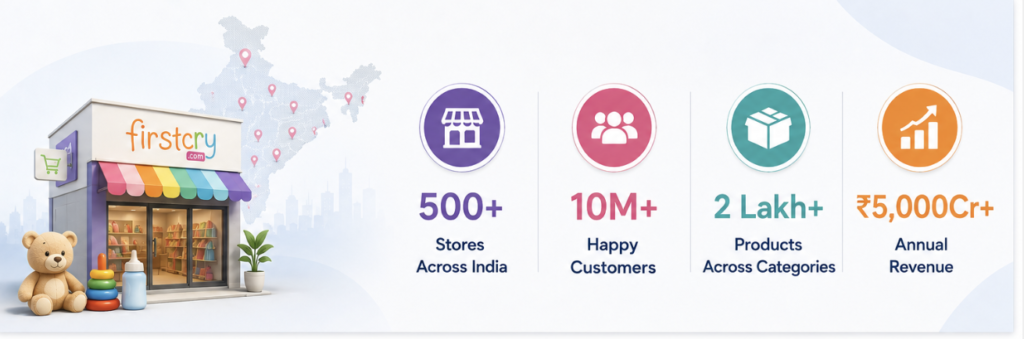
According to its financial reports, FirstCry’s parent firm Brainbees Solutions has announced that its consolidated revenue for FY2024-25 rose 18% to almost ₹7,659 crore compared to the previous year. Its India multichannel business accounted for ₹5,278 crore.

  • As of March 2025, the company operated 1,156 modern outlets including corporate-owned stores under the labels FirstCry and BabyHug. Its own brands accounted for more than 55% of revenues.
  • The corporation still issues quarterly earnings and financial reports, giving investors and business watchers a glimpse of its operating outcomes.

These numbers key because they tell a story entrepreneurs typically underestimate: It’s not simply ambition that creates scale, but systems. One successful outlet is one success. But coming up with a business strategy that can be copied across hundreds of locations is a whole different challenge.
FirstCry Success Story

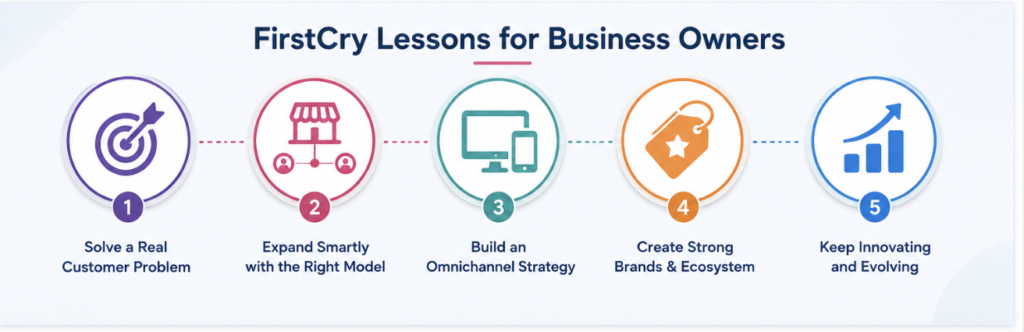
FirstCry Lessons for Business Owners

1. Address an actual customer concern

FirstCry did not start with the query, “What business can we start? It identified an issue for parents and went about solving it. That’s equally vital for existing business owners. Before expanding, question:

  • What makes my business different from the competition and why would clients seek the same experience in another city?

If the answer is obvious, you could have the ingredients for a scalable business.

2. Create a scalable business model

It’s hard to grow a business model that depends wholly on its creator. Opening ten extra shops can create ten times the complexity if the owner has to be involved in every decision, customer interaction, supplier negotiation and operational procedure. The opposite strategy is required for franchising.

The business needs established processes for topics like:

  • Store operating (
  • StaffTraining
  • Customer support
  • Purchasing
  • Marketing Technology
  • QC (Quality control)
  • Finance accounting
  • Brand guidelines

This turns the business from a founder-dependent operation to a replicable franchise model.

3. Physical expansion must not be underestimated

At times, the growth of e-commerce gives the sense that traditional stores are becoming irrelevant. But FirstCry’s experience is a more complex story. It has run an online platform and a physical retail network side by side as part of a multi-channel strategy.

Many Indian firms still believe in the power of physical presence to build trust, visibility and local market penetration. Franchise networks can expedite that presence.

4. Look beyond your home cities

Many successful Indian firms get complacent once they have established themselves in one city. The founder understands the customers, suppliers, employees and the market firsthand. But that comfort can be a hindrance to advancement.

FirstCry’s expansion is a case in point of the possibilities of moving away from a specific business offering to many markets rather than being geographically concentrated.

The question should eventually become for a business owner:

  • Can my business operate anywhere else?

to:

  • What do I need to modify for my business to work elsewhere?”

Now that’s a far more strategic expansion.

5. Leverage franchise partners as local growth drivers

A franchise partner is not just a source of money. The appropriate franchisee may offer:

  • Knowledge of local market
  • Real estate know-how
  • Local relations:
  • Staff management
  • Customer intelligence
  • Money for expansion
  • Entrepreneurial Dedication

This can be especially helpful for a company that wishes to penetrate many cities without having to bear the full financial and operational burden itself. This is why the early utilisation of franchise-owned outlets by FirstCry is one of the most important portions of the company’s journey to entrepreneurs considering franchise business opportunities in India.
FirstCry Success Story

Why FirstCry Is More Than a Startup Success Story

Looking at FirstCry, it is tempting to think that e-commerce was the reason for its success.

This would be to miss the point.

The corporation didn’t just erect a website and wait for clients.

  • It created a brand category specialist.
  • It created a vast product ecosystem.
  • It also incorporated a physical retail store.
  • It employed franchising as a way of expanding.
  • It created private labels.
  • It made purchases.
  • It grew internationally.
  • And it kept investing in the client experience.

That was the beginning of a much more powerful business than just an online store. That is an essential distinction to entrepreneurs. Technology can assist a business to grow but it is a scalable business strategy that allows for continued expansion.

Implication to Indian Business Owners

Suppose you already have a profitable business.

  • You have clients.
  • You have a product or service with a market demand.
  • Your brand is known in your city.

But it’s beginning to slow down since you can’t personally oversee another location. This is where franchising can be worth looking at for growing your firm.

Don’t have all your personal capital invested into every new store. Create a franchise opportunity that has a structure where partners who qualify invest in and operate locations under your brand. But franchising should not be considered just the sale of franchise rights.

Before creating a franchise model a business owner must consider:

  • Is the company financially sound?
  • Are the unit economics compelling?
  • Can the operations be reproduced?
  • Is it a different brand?
  • Can new franchisees get a good return?
  • Are the processes written down?
  • What will franchisees get?
  • What lands should be proposed?
  • What is the correct fee/royalty structure for franchises?
  • What are the legal agreements and compliance requirements?

These questions will establish if a business is truly ready to franchise.

Key Takeaways From the FirstCry Success Story

Perhaps the most essential lesson from FirstCry is not about the number of stores, its income or even its technology. It’s the ability to take a strong business idea and convert it into a repeatable growth engine.

The founders noticed a gap in the market.

  • They specialised.
  • They created trust with their customers.
  • They increased their product line.
  • They blended internet and offline channels.
  • And they built systems that gave the brand the opportunity to reach customers beyond what the founders could accomplish themselves.

That’s entrepreneurship, scalable, literally.

Should I Franchise My Business or Not: Is It the Right Decision for You?

If your firm has reached a point where clients are begging for your brand in other places, your unit economics are established and you can reproduce your operations, franchising could be the next natural stage of expansion. But it should not only be “get more franchisees.”

The aim should be:

  • Create a franchising structure that is mutually beneficial for the brand, the franchisee and the customer.
  • FirstCry’s story is a case study on how a business may evolve from solving a local need to developing a national ecosystem.

That’s the actual lesson for Indian entrepreneurs.” You don’t need to develop another FirstCry. You have to understand why FirstCry was able to scale and what of those concepts can you apply to your firm.

Final Thoughts

At the end of the day, the FirstCry success story is a narrative about scaling.

  • A niche idea turned into a niche brand
  • A speciality brand become an omnichannel enterprise.
  • An omnichannel business created a physical presence.
  • And a scalable approach paved the way for national and international expansion.

The message to Indian business owners is simple. If you have a business with established demand, excellent unit economics and a replicable operating model, then expansion thru franchising can help you reach markets that would be difficult to win thru company owned growth alone.

The next important question for the ambitious entrepreneur might not be “Should I continue to grow?”

It could be:

“Is my business ready to be a brand that other entrepreneurs can grow with?”

Loading

4 Trends Reshaping India’s Retail Business in India – A Guide For All Retail Business Owners

Written by Sparkleminds

Owning a retail business in India, is in itself a lucrative opportunity, and one of the fastest-growing across the Indian economy.  Segments like clothing to fashion accessories, supermarkets to convenience stores, and electronics to service retail, there is a demand for anything today.  So all those retail business owners considering franchising their business across the country, grab this opportunity right away.

Yes, 2024 is an amazing year for retail business owners because of the many trends reshaping this business segment.

Trends Reshaping The Retail Business A guide for retail business owners

4 Fascinating Trends That Are Shaping The Retail Business Industry – For All Retail Business Owners

As the year 2024 unfolds, many megatrends are reshaping its dynamic landscape. These factors are changing the way people shop, the way businesses operate, and even the way society is structured overall, which is good and bad news for retailers.

Therefore, to succeed in this ever-changing landscape, it is essential to grasp these trends.

#1. E-commerce: Seizing the Front and Centre Position in the Digital Storm

The industry for online shopping in India has been seeing a phenomenal expansion in recent years.  Moreover, it is projected to reach an astounding 350 billion dollars by the year 2025. The exponential development in smartphone usage, which is anticipated to reach 700 million by the year 2024, is a major contributor to this growth, which represents a 25% increase throughout this period.

The retail landscape is being reshaped by the digital revolution, which is driving traditional brick-and-mortar shops to change and adapt to this new environment.

Here are some factors which contributed to this tsunami.

  • Surge in smartphones: The Indian e-commerce growth is driven by smartphone penetration. Online shopping is now accessible to more people because of affordable internet and smartphones. E-commerce has grown and changed consumer behaviour, with more individuals preferring online buying.
  • Omnichannel retailing: E-commerce is driving brick-and-mortar retailers to change their strategy. Omnichannel retailing, where real stores blend with internet platforms to offer a seamless buying experience, is growing. This mix gives customers the feel of in-store shopping with the ease of internet shopping.
  • Use of social media platforms: The emerging trend of social commerce is being spearheaded by platforms such as Facebook and Instagram. These platforms are revolutionising product marketing and sales by incorporating shopping into social media feeds. This makes shopping more interactive and interesting by blending browsing and purchasing. These platforms are increasingly using influencer marketing, live broadcasts, and interactive content to boost sales.

Here are some solutions to the opposed challenges listed above.

  • Retailers need an effective digital strategy to compete. Users-friendly sites, mobile applications, and e-commerce platform engagement are examples.
  • Retailers should prioritise mobile-first initiatives due to smartphone use. This includes mobile-optimized websites, and mobile apps, with simple usability and fast download times.
  • Social media marketing is now required. Retailers must use targeted advertisements, influencer partnerships, and content marketing to engage customers.
  • Giving clients more fulfilment alternatives is key. Localised delivery and click-and-collect services allow clients to order online and then pick up in-store quickly.

In a nutshell, India’s e-commerce industry is changing swiftly due to technology and consumer preferences. Digital evolution and omnichannel strategies will help retailers succeed in this new digital commerce era. Virtual and offline retail are merging, making Indian retail more digital, personalised, and customer-centric.

#2. The Emergence of Generation Z: Consumers Who Are Socially Conscious and Have Their Preferences

The generation that came of age around 1996 and 2012 is making waves in the business world. This group accounts for 27% of the Indian population and has a large purchasing power of $3.8 trillion. Gen Z is defined by a strong sense of social and ecological consciousness and a desire for genuine and meaningful products, in contrast to earlier generations. They have come of age in a digital world.

Here are some factors which contributed to this tsunami.

  • Gen Z prioritises ethics and sustainability. This generation cares about product quality, price, sourcing, and environmental and social impact. Gen Z emphasises personalised interactions and experiences over material goods. Their ideal brands actively incorporate values into their business structures.
  • The first digital natives are Gen Z. They are deeply connected to online resources, social networking sites, and mobile technologies. Connectivity has changed their communication, consumption, values, and expectations. They are environmentally sensitive and value sustainability and ethics in their personal and brand lives.

Here are some solutions to the opposed challenges listed above.

  • Sustainability: Retailers must practise sustainability. This may include employing eco-friendly products, decreasing carbon emissions, and fair labour. Establishing confidence with Gen Z consumers requires transparency in these actions.
  • Moral Purchasing Practices: Gen Z prefers ethically sourced and made products. Fairtrade, local support, and avoiding exploitative labour are examples.
  • Online Community Building: Engaging Gen Z on social networks and other channels is vital. Interactive web content, brand communities, and Gen Z-aligned influencers can work.

In short, retailers need to comprehend and fit Gen Z’s beliefs to engage them. The marketing strategy, supplier long-term viability and social accountability must be rethought. Retailers can recruit this socially conscious youth and support social and environmental goals by doing so. Gen Z’s preferences both pose a challenge and a chance for businesses to innovate and adapt in consumer marketplaces.

#3. Tapping into Tier II  & III Cities

Both Tier II and Tier III areas are emerging as the next frontier for growth in India’s retail sector, which is undergoing a substantial transition at the moment. These more compact communities, which are distinguished by their fast urbanisation and rising levels of discretionary income, are now responsible for 56 per cent of the total retail spending in the country.

For business owners who are interested in expanding their retail business beyond the crowded metropolitan areas and Tier 1 cities, this shift creates a significant market opportunity that is virtually unexplored.

Here are some factors which contributed to this tsunami.

  • Understanding the market potential in small towns: Tier II and Tier III communities have growth potential for numerous reasons. Living styles are changing due to rapid urbanisation, and increasing materialism. Due to the reverse movement of professionals and local industry growth, discretionary incomes are rising in certain locations. This economic upturn is developing a fresh generation of consumers who want modern retail but have specific wants.

The potential is huge, but challenges must be overcome. Poor logistical networks can impede operations. These markets have diverse regional tastes and rely heavily on payment methods, particularly cash-on-delivery for online goods.

Retailers need strategies to seize these opportunities. Given the strong mobile prevalence in these locations, localising content and optimising for mobility-first experiences are crucial. Partnering with local vendors can help understand the diverse market.

Here are some solutions to the opposed challenges listed above.

  • Retailers must tailor products to local tastes. This entails recognising regional tastes, cultural differences, and market demands.
  • Retailers should prioritise mobile-friendly platforms due to growing mobile usage. These places have simple-to-operate mobile applications as well as websites optimised for lower bandwidths.
  • Last-mile distribution and cash collection with local Kirana retailers can transform the game. These stores are well-established in their areas and can serve internet retailers.
  • Locally relevant marketing tactics are needed by retailers. Regional advertising, local influencer collaborations, and community-based marketing are examples.

In short, Tier II and Tier III Indian towns offer retailers substantial growth potential. However, understanding local consumer behaviour, interests, and challenges is crucial to success in these areas. Retailers who can customise their strategy to these markets’ unique needs would benefit from diving into this untouched goldmine. The retail landscape in India is changing, and these little towns will shape its future.

#4. Use of AI & Technology

AI, ML, and automation are revolutionising retail. These technologies are changing retail businesses, from managing inventory to customer service and fraud detection. These advances help businesses streamline procedures, boost efficiency, and personalise shopping experiences.

Here’s how AI & Robotics are transforming the retail industry.

  • AI Chatbots: Retailers increasingly use chatbots equipped with AI for customer assistance. These 24/7 chatbots quickly and accurately handle client inquiries and concerns, improving customer service.
  • Transformation of warehouses by robotics: Warehouse operations are being transformed by robotics. Automated separation, packing, and shipping enhance delivery times and accuracy, improving customer satisfaction.

Here’s why Retail Business Owners should embrace technology.

  • Retailers need to put money in powered by AI platforms to compete. These platforms streamline processes and reduce manual errors by handling customer service and inventory management.
  • Retailers can understand client preferences and behaviours by analysing data. This data will be used to customise marketing and goods on offer, making purchasing more enjoyable.
  • Robotics and AI can improve operational efficiency. This reduces costs, improves efficiency, and allows scaling.

To sum up, Retailers must integrate machine learning, artificial intelligence, and automation technologies to succeed in a fast-changing industry. These technologies help stores improve operations, personalise experiences, and boost consumer loyalty. Adopting these technologies will become a major distinction in the competitive retail sector as it evolves.

To Conclude, Here’s How Retail Business Owners Can Navigate The Future of Retailing in 2024

Retail business in India in 2024 depends on flexibility and adaptation. After the pandemic, retailers require digital transformation to be competitive in an e-commerce-dominated industry. Gen Z’s diversified, tech-savvy, and socially concerned choices will shape market trends, therefore catering to them is vital.

Those who understand and react to these dynamic transformations will determine retail in India’s future, assuring survival and profitability in an ever-changing landscape.

For more details, reach out to us at Sparkleminds, to expand your retail business across the country.

Loading

Why Franchising Your Retail Shop in India Can Be A Profitable Move in 2024?

Written by Sparkleminds

Do you have a retail shop which is currently vacant?  If you are planning to rent it out, try franchising it.  Did you know you can also use the franchise model for your retail shop?  Confused?  Well, it’s true.  Make use of 2024 to franchise your retail shop in India.

Our blog and experts at Sparkleminds will guide you through franchising your retail shop in India, what benefits you could make while franchising, who are the potential investors to look out for while franchising your retail store and more.

Franchising your Retail Shop in India a Profitable Move in India.

Want To Franchise Your Retail Shop? – A Guide For Property Owners in India 2024

For all those retail shop owners, let us get started with this comprehensive road map in understanding why 2024 is the right time to give a franchise of your retail shop in India.  

This guide is all about understanding how you can increase the revenue streams on your property, the fundamentals of franchising and creating an attractive opportunity to attract the right investors to your property.

In India’s competitive retail market, franchising has risen to a position of major prominence. It has become a potent growth mechanism that can be utilised by both established businesses and new entrepreneurs.

Compelling reasons why you should franchise your retail shop include.

  1. Use well-established brands: You can provide prospective business owners access to well-known and respected brand names by making your store available as a franchise. This has the potential to substantially increase the selling point of your space.
  2. Minimal risk – Since the potential investor will use his capital and expertise, it reduces the risk to you as the owner.
  3. Additional Revenue Stream: The recurring rental income that is typically included in franchise agreements helps to maintain a steady cash flow for your company.
  4. Win-Win Relationship: Potential investors have a strong incentive to be successful since their achievements have a direct bearing on the popularity and financial success of the brand. A collaboration that is in everyone’s best interest can flourish when interests are aligned like this.
  5. Potential to expand rapidly: Franchising can help you buy more properties and expand your business by letting you reach new markets and areas.

In short, there are many benefits that are associated with franchising your retail shop, especially to reputed brands.  A simple example is a mall owner who rents out his retail spaces to famous brands and thus can enjoy the fruits of the revenue that is generated from the stores.  

So, no matter if you are a single retail shop owner or a commercial property owner, franchising your property in India in 2024 is a profitable move, you shouldn’t miss out on.

But as the saying goes, every business growth comes with certain challenges and therefore, while franchising your property you may also encounter certain challenges but we can provide the possible solutions to overcome them.

Challenges & Possible Strategies To Consider While Franchising Your Property in India 2024

While considering venturing into franchising it is important to consider firstly if your property is best fit to franchising.  

To start with, here are some factors to consider while assessing franchise stability before giving your shop as a franchise. 

  1. Strength of the brand: The success of the brand that is linked with your store is an essential component in determining the suitability of a franchise. Take into account the following:
    • Recognition of the Brand: A brand that is well-known and has a good reputation is more likely to be successful in recruiting franchise owners. 
    • Maintaining consistency: The ability of the brand to maintain consistency in product quality, service standards, and the overall experience that customers have with the brand is an essential component. Franchise opportunities frequently present themselves in the guise of enticement when they are presented by reputable brands.
  2. Market Demand of the product: It is necessary to do market demand research in order to determine whether or not the products and services offered by the franchise you choose are in line with customer demands in that area.  Consider factors like:
    • Determining the current trends of the industry you plan to franchise your shop to.  Check if there has been a constant demand for those products or it is a stagnant market.
    • Analysing the level of competition n that area is also very crucial.  For example if you consider franchising your retail shop to an electronics brand, is there room for improvement in the market that your store could fill? Your retail store’s potential for becoming a franchise is improved if there is clear evidence that customers want your particular speciality.
  3. Is your store franchise replicable?:  The ability to successfully replicate a business concept is essential to franchising. Evaluate the possibility for replication of your store by taking the following into consideration:
    • Are the activities and procedures that take place in your store capable of being standardised and repeated in other locations? Remember, the franchisees require certain instructions to follow.
    • Determine whether or not the concept of your shop can be efficiently expanded without diluting its core appeal. This is because entities have an interest in expanding their businesses, and so the whole model ought to be scalable.

These are the 3 most crucial challenges you could come across while giving franchise of your retail store in India.  Once you have thought about these and have the possible strategies to over come it, go ahead and choose the appropriate brand for your shop.

Is Your Retail Shop Franchise-Ready?

You may have overcome the challenges but have you checked about the legal and financial compliance which is necessary for any growth.  Yes.  Being legally and financially prepared is very crucial

Here’s what it involves.

When you decide to rent your property to a franchise, there are a number of factors, both legal and financial, that you need to take into consideration. Because this can be a difficult procedure, it is essential that you speak with an attorney so that you can be sure your rights are protected.

Some of the legal considerations are:

  1. Franchise Rent Agreement: One of the most crucial document for every property owner is the franchise rent agreement.  But why?  This is because it lays out the roles and responsibilities of the property owner and the potential franchise investor.  This agreement should include important clauses like:
    • Term of the agreement.
    • Dispute resolution
    • Roles & Responsibilities of both the parties
    • Non-competant clause
    • Protection of IPs
  2. Understanding the local laws and regulations: There may be rules and laws in the area that say how a franchise can rent property.  For instance, some cities have zoning laws that limit the kinds of businesses that can be in certain areas.
  3. Protection of IPs: The brand name, logo, and marketing tools are all intellectual property rights that belong to the franchisor and are linked to the franchise. It should be very clear in the franchise agreement how the entity can use these intellectual property rights.
  4. Termination Clause: This is a clause which specifies the conditions under which the agreement will be terminated.  This can be because of non-competance, or any other kind of dispute.
  5. Dispute Resolution: Franchise rent agreement should also include a clause for any kind of dispute resolution in case there is any misunderstanding and how it will be resolved.  Taking the help of legal experts or attorneys will be advisable.

Now that you have sorted out the legal and financial aspects, it is time to prepare an attractive package to entice potential investors to franchise your retail shop.

Creating an Attractive Franchise Package – Attract Potential Investors Using A Franchise Proposal

Here are some key factors to consider when creating a franchise package or a franchise proposal to attract the right tenant.

  1. Providing a competitive rent: It is important that the rent you propose is comparable to that of other properties in the neighbourhood that are leased to franchises. You could also wish to consider providing additional incentives, such as a rent-free time or an allowance for tenant enhancements. 
  2. Provision of a turnkey solution: Franchises are seeking for “turnkey” solutions, which mean they want everything they require to start their own business to be given for them. This indicates that franchises want everything to be done for them. This includes both the real estate and the training that goes along with it.
  3. Flexibility in leasing terms: It’s possible that franchises will have very particular criteria for the conditions of the lease, such as the amount of rent or the length of the lease. Maintain a flexible stance regarding these requirements so that your real estate might become more appealing to investors. 

Once you have considered these factors, it is time to market your property to prospective franchises. Make use of online portals, advertising or even networking to attract franchises.

Key Takeaways When Franchising Your Property in India 2024

Before you decide to rent your property to a franchise, it is crucial to complete the necessary research and gain an understanding of the business model used by franchises. This involves having an awareness of the reputation of the franchisor, the financial performance of the franchise system, and the market for the business that is being franchised.

You need to make sure that you have a documented leasing agreement with the franchise that spells out both sides’ rights and responsibilities in detail. A dispute resolution clause and a clause allowing for early termination of the lease should also be included in the agreement.

If you rent your property to a franchise, you should be prepared for the property to undergo alterations during the term of the lease. 

It is critical to maintain a level of involvement in the partnership with the franchise. This involves keeping an eye on the franchise performance and preparing for and responding to any issues that may crop up.

Reach out to Sparkleminds to know more.

Loading

5 ways to expand a Retail Business in India

Written by Sparkleminds

The most challenging aspect of starting your own business is getting it off the ground. Extreme dangers and a great deal of unknown information are inherent in the situation. Only 50% of enterprises have survived in the past five years, so congratulate yourself and the team for being in the business. It’s high time you up your business game!

5 ways to expand a Retail Business in India

Are you the Business owner, who wants to know how to expand a retail firm in India and is finding ways to improve an established retail business in India? This is for you. Let’s examine the 5 best strategies for expanding a flourishing retail business in India.

1. Adding a new location

Being present in a new location to expand your retail business is undoubtedly one of the most obvious ways to expand your business. This must be a deliberate choice, as creating a new site entails a significant amount of work and frequently a considerable investment.

Keep in mind that growing your business requires more than merely duplicating your current store. Even though you wish to build on a winning model, a new location will bring in a new clientele. What worked in one city or community may not apply to another.

To maintain consistency across all of your sites with your operations and retail logistics make sure you maintain the same processes, rules, channels for communication, multi-location POS, payroll, customer service, etc. This makes it simple to compare many locations or measure crucial KPIs from one store to another store. By streamlining processes, onboarding and training of the personnel should be well-organized.

A proven method to grow your business is to open in a new location considering a few key KPIs

2. Sell on New Channels

Retailers now are fortunate to have access to no. of sales channels than ever before to market their goods. Diversifying your company into a new sales channel is a safer and less expensive option to expand.

  • Your own e-commerce business is the best place, to begin with. Setting up a simple e-business is simpler than ever before now.
  • Third-party online markets are even simpler. They earn a commission from each transaction, similar to a consignment shop, but if you don’t have the time or resources to open your own, selling on platforms like Amazon or eBay makes it simple to get started without making a big investment.
  • Last but not least, social media has become a fast-growing sales channel, particularly if you already have a massive fan base and a well-established brand presence on Facebook, Instagram, or Pinterest.

You can sell directly on the social networking platform itself or connect your e-commerce store to posts there. Additional services that further simplify the purchasing procedure and relieve almost all of the strain from the seller have made this process even simpler.

3. Expand Your Product Line

Expanding what you sell is another fantastic way to grow your retail business. It is advisable to roll out new goods or services as long as the expansion is consistent with your existing brand image.

When you do decide to expand your product line, keep in mind to test each new addition and compare its performance to that of your current offerings. To make this simple, utilize a retail POS system.

You can easily evaluate the performance of each new product thanks to detailed product reports, which also give you the information you need to decide what is best for your company.

4. Set up Pop-Up Shops

The Pop-up store is an efficient way to increase brand identification and educate customers about your store. They are a simple and inexpensive way to expand your business. They also have several other outstanding advantages for the expansion of retail:

  • Pop-ups promote the brand presence and educate customers
  • They’re a simple approach to attract some media attention.
  • A new product can be tested to evaluate how well it sells.
  • They enable you to move inventory slowly to free up much-needed warehouse space.

A pop-up shop is an initial step toward an aggressive retail expansion, so don’t underestimate the power of pop-ups

5. Partner with Businesses

Partnering with another established company for a new product/ service launch is the safest way for business expansion. This entitles you to bypass the majority of the initial outlay. The collaborating company already has the infrastructure and resources in place to reach your target market.

Eg: Find a nearby company that offers apparel to young adults if you sell children’s clothing and are considering doing the same in the outlet of the collaborating company. Request them to stock a few of your test products and monitor their performance.

sparkle★minds is helping businesses like yours with their business expansion for more than 22+ years. Connect with us now to learn more about how we can help your business.

Loading