A franchise business plan sets out how your brand will expand through franchising. It explains the business model, franchisee investment, expected operating costs, revenue potential, franchise fees, royalty structure, territory strategy and the support you will provide to franchise partners.
It is an important document for business owners planning franchise expansion, as well as investors and prospective franchisees evaluating a franchise opportunity. A well-prepared plan helps demonstrate whether the business model is commercially viable, operationally practical and suitable for long-term growth.
If you are wondering how to make a franchise business plan, you need to understand the essential components before preparing the document. Each section should explain a different aspect of the business, from its market position and competitive advantage to its financial projections and expansion strategy.
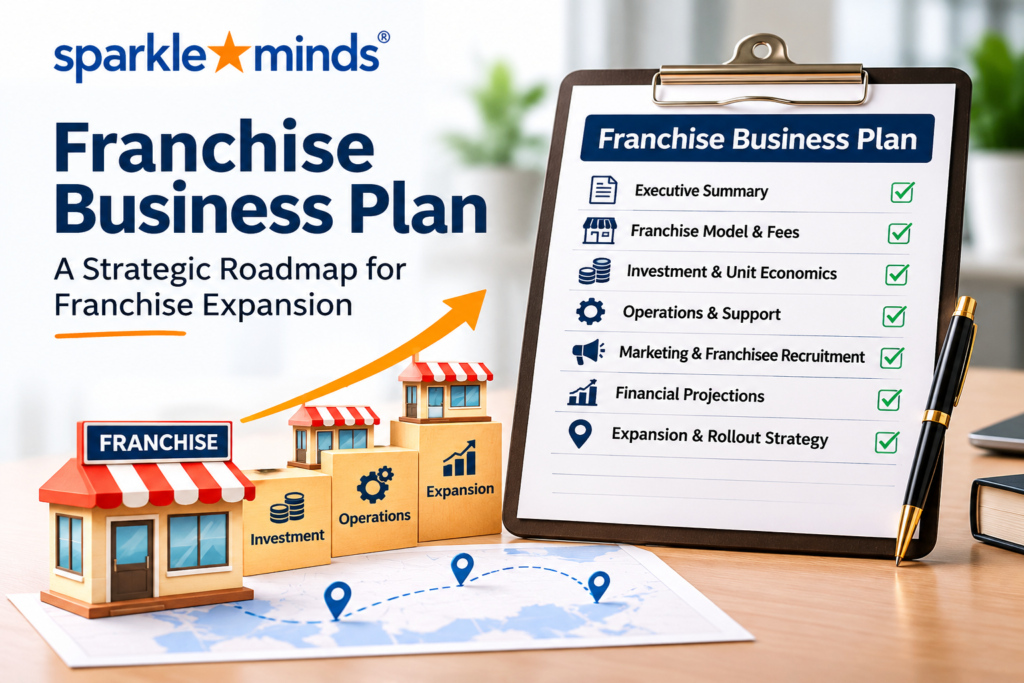
Let’s look at the seven essential components of a franchise business plan.
7 Essential Components of a Franchise Business Plan
1. Executive Summary
The executive summary provides a concise overview of your business and its proposed franchise model. Although it appears at the beginning of the document, it is often easier to prepare after completing the other sections.
It should introduce the business, explain its franchise opportunity and highlight the key information a potential investor or franchise partner needs to understand.
Your executive summary should address:
- What products or services does your business offer?
- What customer need does the business address?
- What makes your brand different from competitors?
- Why is the business suitable for franchising?
- What franchise model are you planning to offer?
- What investment will a prospective franchisee require?
- What support will franchise partners receive?
- What are your short-term and long-term expansion objectives?
Keep this section clear and focused. Its purpose is to help readers understand the business opportunity and encourage them to explore the detailed plan.
2. Business Overview and Company Description
This section explains the background, structure and operations of your company. It gives prospective franchisees and other stakeholders a better understanding of the business they may be investing in.
Include the following information:
- Company background and history
- Business ownership and legal structure
- Mission, vision and business objectives
- Products and services
- Target customers
- Existing business locations and operational experience
- Management team and key responsibilities
- Current business performance and growth plans
You should also explain why the business is ready for franchise expansion. For example, does it have a proven operating model, consistent product or service quality, documented processes and the ability to support franchise partners?
Set practical and measurable objectives for the business. These may include the number of franchise outlets planned, target markets, expansion timelines and operational milestones.
3. Market and Competitive Analysis
Market research helps establish whether there is sufficient demand for your products or services and whether the proposed franchise model can compete effectively.
A strong market and competitive analysis should cover:
Target market: Identify your ideal customers, their preferences, purchasing behaviour and geographical locations.
Industry overview: Explain the market conditions, industry developments and factors that could influence demand for your products or services.
Competitor analysis: Identify direct and indirect competitors. Compare their products, pricing, positioning, customer experience and marketing strategies with your own.
Competitive advantage: Explain what makes your brand different. This could include product quality, service standards, operational efficiency, brand positioning or a distinctive business model.
Location and territory potential: Identify suitable markets for franchise expansion. Consider customer demand, local competition, accessibility and the availability of suitable commercial locations.
This analysis helps you make informed decisions about franchise territories, expansion priorities and the type of franchise partners you want to attract.
4. Franchise Marketing and Sales Strategy
A franchise business plan should explain how you will attract customers to individual outlets and recruit suitable franchise partners.
These are two different activities, and your strategy should address both.
Customer marketing strategy
Explain how franchise outlets will generate customer awareness and sales. Include:
- Digital marketing and social media campaigns
- Local advertising and promotional activities
- Brand positioning and customer acquisition
- Sales strategies and customer retention
- Marketing support provided by the franchisor
Franchisee recruitment strategy
Explain how your company plans to identify and attract potential franchise partners.
Consider:
- Target franchisee profiles
- Franchise marketing channels
- Lead generation and enquiry management
- Franchise partner evaluation and selection
- Sales presentations and franchise discussions
- Onboarding and pre-launch support
Also clarify whether franchisees will contribute to a common marketing fund and how brand-level marketing activities will be managed.
A clearly defined marketing and sales strategy helps maintain brand consistency while supporting the growth of individual franchise outlets.
5. Franchise Management and Operations Plan
The operations plan explains how the business will function on a day-to-day basis and how franchise outlets will maintain consistent standards.
A franchise model needs more than a successful product or service. It requires documented systems that franchise partners can follow and the franchisor can monitor.
Include the following areas:
- Franchise outlet setup and infrastructure requirements
- Standard operating procedures (SOPs)
- Staffing structure and employee responsibilities
- Product sourcing and supply chain management
- Inventory and quality control
- Technology and operational systems
- Franchisee training and onboarding
- Customer service standards
- Performance monitoring and operational support
You should also define the responsibilities of the franchisor and franchisee.
For example, the franchisor may be responsible for brand development, training, operational guidance and marketing support, while the franchisee manages the daily operations of the outlet in accordance with the agreed standards.
A well-documented operations plan makes it easier to replicate the business across different locations.
6. Franchise Investment and Funding Plan
The financial section explains the investment required to establish the franchise model and the funding needed to support its expansion.
It should provide a realistic picture of the financial commitments involved for both the franchisor and prospective franchisees.
Franchisee investment requirements
Depending on the business model, include:
- Initial franchise fee
- Store or outlet setup costs
- Equipment and furniture
- Interior design and fit-out
- Initial inventory
- Licences and other applicable approvals
- Working capital
- Launch marketing expenses
Franchisor funding requirements
Explain the funds needed to develop and support the franchise network. These may include:
- Franchise model development
- Operations manual preparation
- Training infrastructure
- Franchise marketing and recruitment
- Technology and management systems
- Ongoing franchise support
Also explain the proposed franchise fee, royalty structure and any other recurring charges. Clearly distinguish one-time payments from ongoing expenses.
The financial assumptions should be supported by realistic estimates and relevant business data rather than unsupported projections.
7. Financial Projections and Pro Forma Statements
Financial projections help evaluate whether the proposed franchise model is financially viable. They also help prospective franchisees understand the possible costs, revenue and profitability of operating an outlet.
A franchise business plan should include relevant financial statements and projections, such as:
Projected Profit and Loss Statement: Estimates revenue, operating expenses and potential profit over a defined period.
Cash Flow Projection: Shows expected cash inflows and outflows, helping assess whether the business can meet its financial obligations.
Projected Balance Sheet: Provides an estimate of the business’s assets, liabilities and owner’s equity.
Unit Economics: Explains the financial performance of an individual franchise outlet, including expected sales, operating costs, margins and potential break-even point.
Investment and Payback Analysis: Explains the estimated investment required and the assumptions used to calculate the time needed to recover that investment.
The projections should clearly state their assumptions, including sales estimates, pricing, operating expenses, royalty payments and other relevant costs.
Remember that financial projections are estimates, not guaranteed returns. They should be based on realistic assumptions and available business performance data.
Franchise Business Plan Format: What Should It Include?
If you are preparing a franchise business plan from scratch, the following outline can help you organise the document.
| Section | What to include |
|---|---|
| Executive Summary | Business overview, franchise opportunity and expansion objectives |
| Company Description | Business history, ownership, products and services |
| Market Analysis | Industry research, target customers and competitors |
| Franchise Model | Franchise format, investment, fees and royalty structure |
| Marketing Strategy | Customer acquisition and franchisee recruitment |
| Operations Plan | SOPs, training, staffing and franchise support |
| Financial Plan | Investment requirements, projections and unit economics |
| Expansion Strategy | Target territories, rollout schedule and growth milestones |
The exact structure may vary depending on the size, industry and complexity of your business. The most important thing is that the plan explains how the franchise model will operate and grow.
How to Create a Successful Franchise Business Plan
Preparing a franchise business plan is not just about writing down your business goals. You need to evaluate whether your existing business can be replicated successfully through franchise partners.
Follow these steps:
- Evaluate your existing business: Review your business performance, customer demand, profitability and operational systems.
- Define your franchise model: Decide how the franchise will operate, what the franchisee will invest and what support the franchisor will provide.
- Research the market: Identify suitable customer segments, locations, competitors and expansion opportunities.
- Prepare the operational framework: Document the processes, training requirements and quality standards needed to operate franchise outlets.
- Develop the financial model: Estimate franchisee investment, outlet expenses, revenue assumptions, royalties and franchisor costs.
- Plan franchise marketing and recruitment: Identify how you will attract suitable franchise partners and support their launch.
- Set expansion milestones: Establish realistic targets for franchise recruitment, outlet openings and network growth.
Professional franchise consulting support can help connect these areas into a practical and commercially viable expansion strategy.
How Sparkleminds Can Help You Develop a Franchise Business Plan
Creating a franchise model from an established business involves several interconnected decisions. You need to define the franchise structure, investment requirements, operational processes, financial assumptions and long-term expansion strategy.
Sparkleminds helps businesses plan and develop their franchise expansion journey through services such as:
- Franchise feasibility assessment
- Franchise business model development
- Franchise investment and financial planning
- Franchise documentation and operations manuals
- Franchise marketing and franchisee recruitment
- Franchise expansion strategy
Our approach focuses on developing a franchise structure that reflects the business’s objectives, operating capabilities and growth potential.
If you are planning to expand your business through franchising, contact Sparkleminds to discuss your requirements.
Franchise Business Plan Examples
To make things easier for you to understand, you can view the image below, which is an example of how to make a franchise business plan, as well as all the contents it requires, as stated above.

Franchise Business Plan Sample PDF
The franchise business plan is a core document to understand what you want to do. So, how to prepare a business plan and what the objective is is part of the document.
- How will you do it?
- How long will it take?
- How much does it cost to franchise your business?
- How will the payback happen?
Thus, it is a strategy document that will elaborate your entire journey into franchising and will be a forecast of how the entire business will pan out.
Furthermore, it provides absolute clarity in terms of what is the capital and other resources that would be required to execute your franchising. The time that it will take and also specific goals set within those timelines.
A franchise business plan is also of great use when it comes to dealing with investors. Banks and other private investors study this plan in detail and determine your net worth.
For a franchisee who is interested in your business, this business plan is created to understand what your business profile is.
- What types of franchisees would be suitable?
- What is your net worth?
- How much could you afford
- What is the risk you could take?
However, the main point here is that this plan is primarily a blueprint for your internal use. It is to be shared with franchisees only in cases where both parties deem it necessary.
What is generally shared with the franchisees is a Franchise Proposal PPT or a Franchise Package Template that is built specifically for prospecting franchisees.
Frequently Asked Questions About Franchise Business Plans
1. Do I need a business plan for a franchise?
Yes. A franchise business plan is useful when you want to establish a new franchise outlet or expand an existing business through franchising. It helps define the business model, investment requirements, operations and financial objectives.
2. What is a franchising plan?
A franchising plan is a structured document that explains how a business intends to expand through franchise partners. It covers the franchise model, investment structure, operational support, marketing strategy and expansion objectives.
3. What is a franchise business plan?
A franchise business plan explains how a business will operate and expand through franchising. It includes the business overview, market research, franchise structure, investment requirements, operations plan and financial projections.
4. How do I make a franchise business plan?
Start by evaluating your existing business and defining your franchise objectives. Then prepare the franchise model, market analysis, investment structure, operations plan, marketing strategy and financial projections.
5. What should a franchise business plan include?
A franchise business plan should generally include an executive summary, company description, market and competitor analysis, franchise model, marketing strategy, operations plan, investment requirements and financial projections.
6. Why is a business plan important for a franchise?
A business plan provides a framework for evaluating the franchise opportunity, estimating investment requirements, planning operations and setting expansion objectives. It also helps prospective franchisees and lenders assess the business model.
7. How much does it cost to create a franchise business plan?
The cost depends on the complexity of the business, the research required, financial modelling, franchise structure and professional consulting support involved. A customised plan may require a different level of work depending on the business’s expansion requirements.
8. Can a small business create a franchise business plan?
Yes. A small business can prepare a franchise business plan if its business model is suitable for franchising and it has the operational systems, financial viability and support capabilities needed for expansion.
9. Should financial projections be included in a franchise business plan?
Yes. Financial projections help estimate expected revenue, operating expenses, profitability, investment requirements and the financial structure of the franchise model. All projections should be supported by clear assumptions.
10. Can Sparkleminds help create a franchise business plan?
Yes. Sparkleminds helps businesses develop franchise strategies, structure franchise models, prepare operational frameworks and plan the commercial aspects of franchise expansion.
Conclusion
Developing a franchise model from an established business requires careful planning. A successful business does not automatically become a successful franchise. The model must be financially viable, operationally consistent and capable of being replicated across different locations.
A well-prepared franchise business plan connects the key elements of expansion, including market research, franchise structure, investment requirements, operational systems and financial projections.
If you are considering franchising your business, the right planning and professional guidance can help you identify potential challenges and build a stronger foundation for expansion.
Ready to explore franchise expansion for your business? Get in touch with Sparkleminds to discuss your franchise business plan and growth objectives.