What is Prototype Development Assistance mean? Prototype development, put simply, is the process of creating a functioning copy of a product. A product must be ready to meet both market standards and user criteria for a business to succeed in the market.
Acquiring the right prototype development assistance and then refining it involves not only a thorough understanding of the business. Additionally, it entails thoroughly comprehending franchising before building the business concept on franchising your current company.
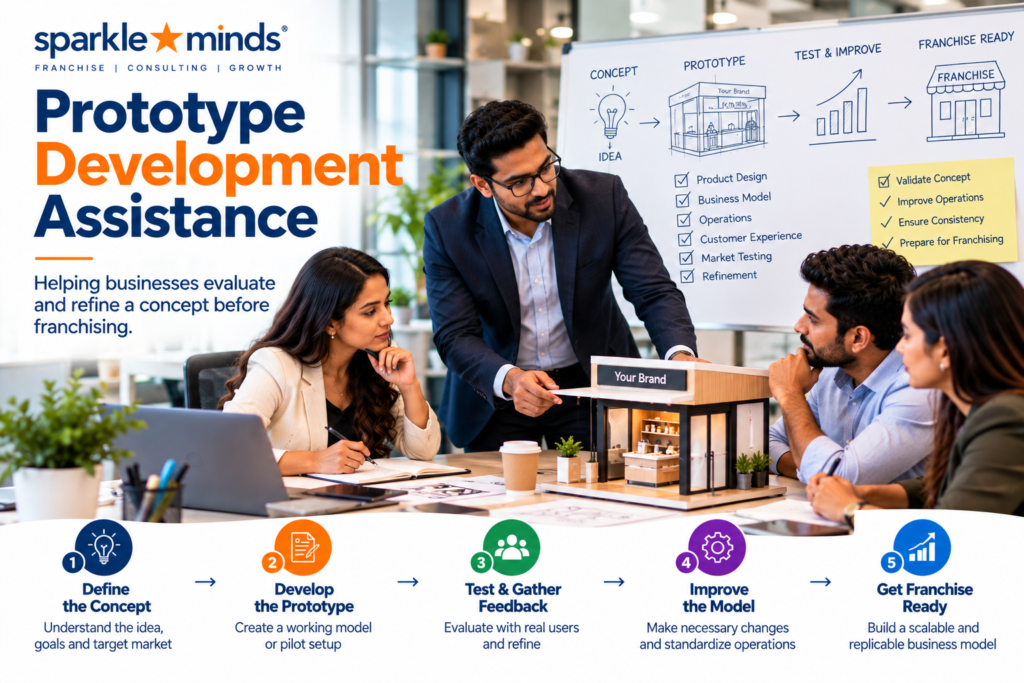
Prototype Development Process
Product development is the subject of prototype development. A prototype, which depicts how the product will look, function, and do a variety of other things during the early phase of development, is necessary for creating a product.
To expedite the process and determine the final product’s appearance, teams working for product development companies will design prototypes.
In short, the majority of prototypes will go through five separate stages, regardless of the required fidelity: defining, concentrating on features, production, testing, and presenting.
Prototype development helps businesses examine a product or business concept before committing to a wider launch or franchise expansion. The process should reflect the product, customer requirements and objectives of the pilot business.
Step 1: Define the Business Concept
Clarify the product or service, target customers, intended use, business objectives and the problem the concept is designed to solve.
Step 2: Identify the Key Features
Determine which features and operating processes need to be tested. Prioritise the elements that are most important to customer experience, product performance and business feasibility.
Step 3: Build the Prototype
Create an appropriate representation of the concept. Depending on the business, this may involve sketches, paper interfaces, storyboards, role-play exercises, physical models or user-driven prototypes.
Step 4: Test and Gather Feedback
Evaluate the prototype against its intended objectives. Collect feedback from relevant users, identify operational issues and assess whether the concept meets the required standards.
Step 5: Refine and Evaluate the Concept
Use the findings to make improvements, address identified weaknesses and decide whether further testing or development is needed.
For a business preparing to franchise, prototype evaluation should also consider whether the business model can be operated consistently, documented clearly and adapted to additional locations.
Prototype Development techniques are:
- Sketching
- Paper interfaces
- Story-Boards
- Role Plays
- Physical Models
- User-Driven Prototypes
Why Prototype Development Matters Before Franchising
A successful pilot operation can help a business owner understand how the concept performs before expanding through franchising. Prototype evaluation should examine both the customer offering and the systems required to deliver it consistently.
Key areas to evaluate include:
- Product or service quality: Check whether the offering meets customer expectations and defined quality standards.
- Customer response: Gather feedback to identify improvements to the product, service or customer experience.
- Operational consistency: Assess whether key activities can be documented, repeated and taught to other teams.
- Cost and resource requirements: Review staffing, equipment, materials, premises and other operating expenses.
- Training and documentation: Identify the procedures, manuals and training resources required to reproduce the business model.
- Marketing and local adaptation: Evaluate which elements of the concept should remain consistent and which may need to adapt to local markets.
- Expansion readiness: Identify weaknesses that should be addressed before replicating the concept across additional locations.
Prototype evaluation does not guarantee that a franchise will succeed. It helps business owners identify potential issues, improve the model and make more informed expansion decisions.
Importance of Prototype Development Assistance for Businesses in India

- Customers can see the product more easily in this way during the product’s initial launch phase.
- Additionally, it is thoroughly checked during the initial stage to make sure the consumers’ product is suitable and meets their needs.
- This approach makes it simple to incorporate design changes. Utilizing product prototype creation services will make the modifications quite simple.
- This aids businesses in identifying and fixing product ad errors.
- By doing this, the company can find problems and errors before the product hits the market.
- The layout also allows for adaptability.
- The developer, who can assist with related projects in the future, can also reuse the design.
- A product’s functionality may be easily checked, and any missing functionality can be quickly found and remedied before the product is released onto the market.
How Sparkleminds Works With Franchisers in Prototype Development Assistance
- Before appointing a franchise, put the franchise development strategy into action and evaluate the prototype in light of numerous variables.
- Looking to expand into fresh areas and improve on their current models.
- Looking to increase the Pilot’s profitability before considering franchising it?
- Acquiring, disposing of, or combining a franchise business.
- Seeking to comprehend their advantages, disadvantages, dangers, opportunities, markets, rivals, and other general issues about the growth of their firm.
We primarily focus on the following prototyping development areas. The best franchise consultants in India will adapt the prototype to your particular needs.
The franchisor must accomplish the goals listed below. This is by no means conclusive and, depending on the needs that a franchise company organisation has, might not be exhaustive.
Key Pointers for Prototype Development Assistance
- Optimizing the goods and services the company provides by seeking out, experimenting with, and incorporating new or improved goods and services.
- Working to improve the franchise’s operational consistency and simplicity while making sure the image and brand are properly managed.
- More security, reevaluating or establishing checkpoints, and making sure the appropriate surveillance technologies are in place.
- Delivering training and manual creation using cutting-edge technology.
- Working on various marketing initiatives that the franchise system’s unit levels would need. Consequently, franchisee involvement in marketing initiatives.
- At several levels, the franchise business has been automated and systematised.
- The franchise industry’s adaptation at the local, state, and worldwide levels.
Frequently Asked Questions
1. What is prototype development assistance?
Prototype development assistance helps businesses evaluate and refine a product, service or business concept before wider implementation. For businesses planning to franchise, it can also involve assessing the pilot operation, identifying improvements and determining whether the concept can be replicated consistently.
2. Why is prototype development important before franchising a business?
Prototype development and pilot evaluation can help business owners assess customer response, operating costs, product or service quality and operational consistency. These findings can reveal improvements needed before the business model is replicated through franchising.
3. What are the different prototype development techniques?
Depending on the concept, techniques may include sketches, paper interfaces, storyboards, role-play exercises, physical models and user-driven prototypes. The appropriate method depends on what needs to be tested and the type of product, service or business process being evaluated.
4. How does prototype evaluation help improve a franchise business model?
Prototype evaluation can identify weaknesses in operating procedures, customer experience, resource requirements and service delivery. Business owners can use these findings to improve the model, document repeatable processes and identify training needs before expanding.
5. When should a business develop a prototype before franchising?
A business should evaluate its concept and pilot operation before committing to wider franchise expansion. The timing depends on the maturity of the business, evidence of customer demand, operational readiness and the amount of testing still required.
6. How can Sparkleminds help with prototype development for franchising?
Sparkleminds describes support that includes reviewing a pilot business, conducting an internal assessment and suggesting improvements to the prototype. The scope of support should be confirmed with the consulting team based on the business model and its expansion objectives.
To Conclude,
For the pilot business, Sparkleminds will undertake an internal audit. After analysis, we’ll suggest any modifications the prototype needs. external research and market analysis to enhance the services and products
To learn more about how you could use our services for the aforementioned, please chat with one of our senior franchise consultants.
Reference Links:
Recommended Reads
Explore these resources to understand franchise strategy, business model development and expansion readiness.
- Franchise Consultancy Services — Explore consulting support for businesses preparing to develop or expand a franchise model.
- Fast Forward Your Franchising — Learn about franchise development and the importance of standardised operations.
- Franchise Development Plan — Explore the role of franchise strategy and development planning in preparing a business for expansion.