Company-owned outlets give you full control of the customer experience and keep the whole margin, but every new outlet consumes your capital. Franchising uses the franchisee’s capital and local knowledge, so it scales faster, but you earn a royalty rather than the full margin and you control the experience through the system rather than directly. Most Indian brands end up with a mix.
Franchises are based in various areas and are owned by franchisees. Franchises typically grow more quickly and cheaply than corporate-owned firms. Let’s examine the conflict between franchise vs company owned growth business opportunities.
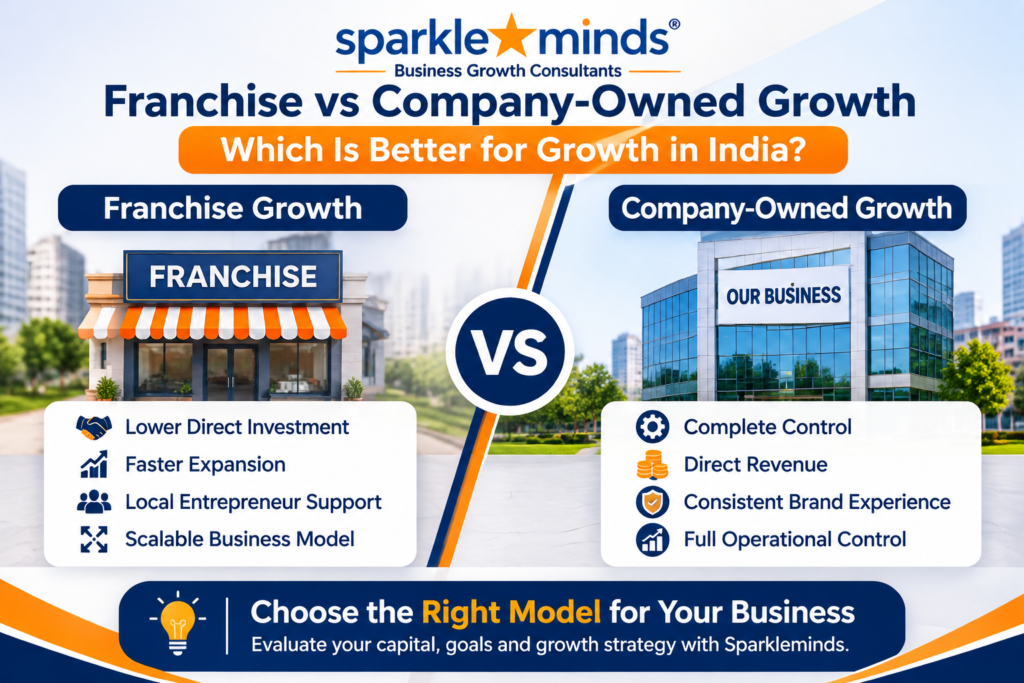
Franchise vs Company-Owned: Key Differences
| Franchise | Company Owned |
| You are investing in a solid business plan and a tested business concept. You will be in charge of your daily operations, purchases, and employee management. | Contracts with suppliers, profit and loss, and hiring and firing decisions are all in the company’s control. |
| You obtain the right to utilise a well-known brand name along with the training and continuing support required to uphold its integrity in exchange for your franchisee fee and initial investment. | In a company store, the business manages every aspect of operations and even contracts for supplies. |
| The money you make after paying the ongoing franchise fees is your own. | The business makes all management choices, including who gets hired and who gets fired. |
Advantages of Company-Owned Outlets
Company-owned outlets allow businesses to retain direct ownership and control over their operations. The company manages the investment, employees, customer experience, daily activities and business decisions.
Some advantages include:
- Greater operational control: The company can directly manage pricing, service standards, staffing and customer experience.
- Direct revenue ownership: The business retains the revenue generated by its outlets, subject to operating expenses.
- Consistent brand experience: Centralised management can help maintain consistent products, services and operational standards.
- Direct market feedback: Company teams can monitor customer behaviour, local demand and outlet performance.
However, company-owned expansion generally requires the business to fund new outlets and manage their operations. This can increase capital requirements and operational responsibilities as the network grows.
Advantages of Franchise Growth
Franchising allows a business to expand by working with franchise partners who invest in and operate outlets under an agreed franchise arrangement.
Some advantages include:
- Lower direct capital requirements: Franchise partners generally contribute the investment required to establish their outlets, depending on the franchise model.
- Faster geographical expansion: Working with multiple franchise partners can help a brand enter new markets without directly operating every location.
- Local entrepreneurial involvement: Franchise partners may bring local market knowledge and operational involvement.
- Scalable business development: A structured franchise system can support expansion across multiple locations.
However, franchisors must invest in franchise development, partner selection, training, operational support and quality control to maintain brand consistency.
Capital, Control and Risk Compared
The choice between franchising and company-owned expansion depends on the business’s available capital, desired level of control, operational capabilities and long-term growth objectives.
| Comparison factor | Franchise growth | Company-owned growth |
|---|---|---|
| Initial outlet investment | Generally contributed by franchise partners, depending on the model | Funded by the company |
| Operational control | Shared according to the franchise agreement and operating standards | Directly managed by the company |
| Revenue structure | Franchise fees, royalties and other agreed income | Revenue generated by company-operated outlets |
| Operational responsibility | Shared between franchisor and franchisee | Primarily managed by the company |
| Expansion funding | Can reduce direct outlet investment by the franchisor | Requires greater direct capital from the company |
| Brand consistency | Requires training, monitoring and franchise standards | Managed through internal teams and processes |
| Expansion potential | Can support multi-location growth through partners | Depends on available capital and management capacity |
Neither model is automatically better for every business. The right approach depends on the company’s financial position, operating capabilities and expansion strategy.
Which Model Fits Your Business?
A company-owned model may be suitable for businesses that have sufficient capital and want direct control over every outlet. It can also be useful when the business needs to test a new market or maintain centralised operations.
A franchise model may be suitable for established businesses with a repeatable operating system, a recognisable brand and the ability to train and support franchise partners.
Before choosing an expansion model, business owners should evaluate:
- Available investment capital.
- Profitability and operational consistency.
- Brand strength and market demand.
- Management and staffing capabilities.
- Desired level of operational control.
- Ability to recruit and support franchise partners.
A professional franchise evaluation can help business owners determine whether their business is ready for franchising or whether company-owned expansion is more appropriate.
Sparkleminds’ View: Why Franchising Scales Faster

We assist clients in conducting comprehensive analysis and decision-making regarding the future of their companies so that they may weigh the merits of company-owned vs franchised operations.
Expanding the business across different geographies
- Through franchising, businesses with one or a few sites can frequently build a national presence within a few years and grow their networks at a rate that would be impossible with company-funded development.
- The resources required to build a franchised outlet will be significantly lower than if you were opening a company-owned store because the franchisee would pay for the leasing, interior design, hiring and training of personnel, and local marketing initiatives.
- As a result, you can establish a small management team that is dedicated to helping several franchisees launch their businesses at once. Instead of gradually opening each business and obtaining additional startup funding.
- In order to assist the expansion of the company as the franchisor, this makes sure that you concentrate on the back end. Your franchisee will next interact with the customer and provide for them. Consequently, identifying explicitly 2 distinct business purposes being carried out by skilled individuals intended to perform the same.
Entrepreneurial Management
By issuing a franchise licence, you transfer ownership of your franchise to a person with an in-depth understanding of the local market who is, in essence, his or her boss.
The success of their efforts has a direct impact on their income. Unlike a manager receiving salary, whose pay (except bonuses) is not in sync with performance.
The Franchise Agreement also always prevents the Franchisee from quitting. to establish yourself in competition for an extended length of time using your business concept and systems.
A staff member, however, is not subject to this restriction and is always free to move on to the competition. Aside from that, the entrepreneurial management that acquires the franchise benefits the most.
When in practise correctly, this gives the services a competitive edge and benefits the organisation greatly.
Revenues & ROI – Franchise Vs Company Owned
A franchise is purchased by a franchisee after making an initial investment. The majority of which will go toward defraying the costs of franchisee recruitment, education, and launch assistance.
The recurring royalty or your portion of the profit included in the price of the good or service sold would be your true return. Consequently, what proportion of the franchisee’s revenue is used to pay for ongoing support?
includes the price of national marketing efforts and product research & development. Additionally, offer a reasonable compensation for the use of your intellectual property and continuous work. Your profits are more on a considerably lesser capital investment due to the less capital utilise.
Despite the fact that the revenue from franchise units is logically lower than that from outlets that are 100% company own. Actual profit makes up a larger portion of the revenue.
Franchise vs Company-Owned – FAQs
Q1. What is the difference between franchise and company-owned growth?
Franchise growth expands a business through independent franchisees, while company-owned growth involves opening and operating new locations directly under the business.
Q2. What is franchise growth?
Franchise growth allows a business to expand through franchise partners who operate locations using the brand’s business model, systems, and standards.
Q3. What is company-owned growth?
Company-owned growth involves the business funding, establishing, managing, and operating its own new locations as it expands.
Q4. Which model requires more control from the business owner?
Company-owned growth generally gives the business direct control over its locations and operations, while franchise growth involves sharing operational responsibility with franchisees.
Q5. How does investment differ between franchise and company-owned growth?
With company-owned growth, the business generally bears the investment required to establish and operate new locations. In franchising, franchisees typically make the investment required to establish their locations under the franchise arrangement.
Q6. Which model can help a business expand faster?
Expansion speed depends on factors such as available capital, business systems, market demand, location strategy, and the ability to recruit and support franchisees.
Q7. What are the risks of franchise growth compared with company-owned growth?
The risks differ between the two models. Franchising requires effective franchisee selection, training, support, and brand standards, while company-owned expansion requires the business to manage the financial and operational requirements of each new location.
Q8. How do I decide between franchise and company-owned growth?
Consider your available capital, desired level of operational control, business model, expansion objectives, management capacity, and readiness to support franchise partners.
Q9. Can a business use both franchise and company-owned growth?
Yes. A business can use a combination of company-owned locations and franchised locations as part of its overall expansion strategy.
Q10. Which factors should I consider before choosing a franchise growth model?
Consider your business model, available capital, operational resources, desired level of control, market expansion goals, and ability to support franchise partners.
Which Model Fits Your Business?
Your company network gains greater economies of scale early by hastening its expansion. Stronger brand recognition can challenge national contracts considerably sooner as a result.
It is in a much better position to seize early market leadership in the case of a developing market or economic collapse. Consequently, to gain an advantage over its rivals.
Here is a brief summary of the reasons you should choose to franchise over-owned unit expansion. But first, let’s talk in-depth about your current company. give you our specialised professional opinion on the benefits and drawbacks of franchising your business.
Reference Links:
Recommended Reads:
Planning to Expand Through Franchising?
Not sure whether franchising or company-owned expansion is the right strategy for your business? The right approach depends on your investment capacity, operational structure, brand strength and long-term growth objectives.
Connect with Sparkleminds to evaluate your business and explore a suitable franchise expansion strategy.
Talk to Our Franchise Consultants
Share your business requirements with our team to discuss your expansion goals.