A distributorship lets you sell an established brand’s products in a defined territory, buying stock at a trade price and earning the margin on resale. Investment depends on the sector and the credit terms the principal offers. This page covers which sectors are actively appointing, what brands screen for, and how the appointment process runs.
So, to explore new distributorship opportunities for entrepreneurs who are in search of reliable companies, therefore, we have created this common platform for them where they can share their requirements and enter into profitable ventures.
What Is a Distributorship?
Before understanding the distributorship opportunities in India, we need to understand what is a distributor.
Between a manufacturer, who creates a product, and a later entity in the supply chain or distribution channel, a distributor serves as a link. The downstream firm can also be a wholesaler, but it is most frequently a retailer or value-added reseller (VAR).
Role of a Distributor in Franchise Business
Distributors also referred to as stockists, work in collaboration with manufacturers to buy products, store them, and then resell them through a distribution channel. They serve as the intermediary between producers and either consumers or merchants.
An organisation known as a distributor buys non-competing products or product lines and then sells them directly to customers. Most distributors also offer a variety of services, such as customer service, technical assistance, and warranty insurance.
Distributors are crucial in helping firms enter markets they otherwise wouldn’t be able to. A local company is frequently chosen as a distributor by businesses because it already has clients, relationships, and contacts there and is more familiar with the market there.
Thus, for potential customers, the distributor acts as the manufacturer’s primary point of contact.
Best Distributorship Opportunities in India by Sector
A corporate leader or a business owner is constantly looking for new strategies and approaches to support, expand, and improve their firm.
There are many reasons to use distributors for your business as they will help you in getting your products and goods into the ideal marketplace, even though selling products and direct sales of items to consumers, clients, and prospects may appear like a practical and efficient strategy to increase corporate revenue.
Consider the distribution team’s advantages and benefits to see if it will fit into your business and company strategy.
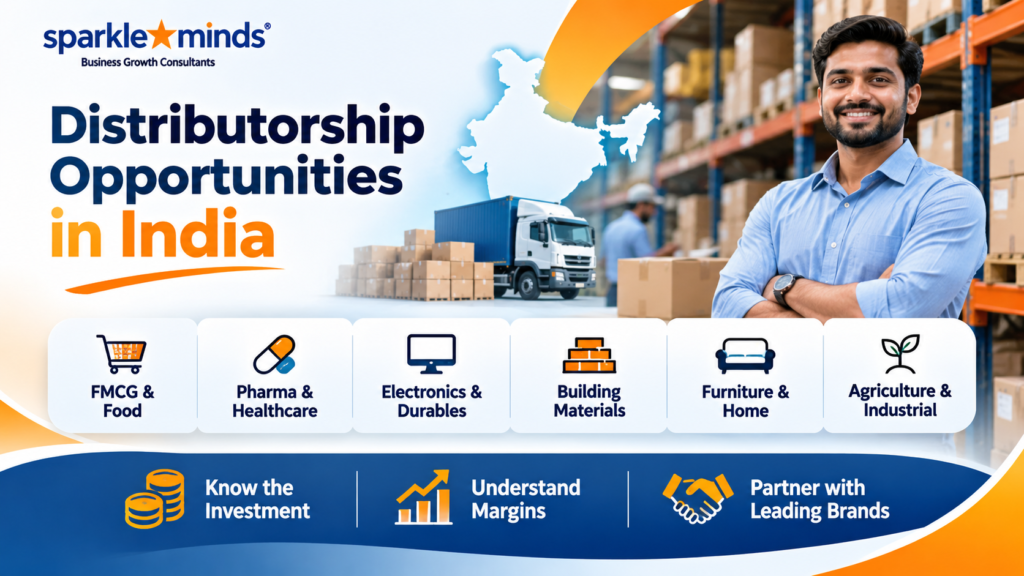
Distributorship Opportunities in India by Sector
Distributorship opportunities in India are available across several industries. The right sector depends on local demand, product availability, competition, investment capacity and the brand’s distribution requirements.
Some sectors to explore include:
1. FMCG and Food Products
FMCG distributorships involve supplying everyday products such as packaged foods, beverages, personal care products and household essentials to retailers.
2. Pharmaceuticals and Healthcare
Pharmaceutical distributorships involve supplying medicines and healthcare products to pharmacies, hospitals and other authorised buyers. This sector requires compliance with applicable licences and regulations.
3. Electronics and Consumer Durables
Distributors supply electronic products, appliances and accessories to retailers and commercial customers. After-sales support and product warranties may be important responsibilities.
4. Building Materials and Construction Products
Cement, tiles, paints, electrical products and other construction materials offer distribution opportunities where there is demand from contractors, dealers and retailers.
5. Furniture and Home Furnishing
Furniture, furnishings and home improvement products can be distributed through retail networks, dealers and regional sales partners.
6. Agriculture and Industrial Products
Agricultural inputs, machinery, equipment and industrial supplies may offer opportunities in markets with relevant business and customer demand.
Before selecting a sector, research the brand’s requirements, local demand, competition and expected investment.
Investment and Margins in a Distributorship
The investment required to start a distributorship in India varies according to the product category, brand, territory, inventory requirements and scale of operations.
Potential investment components include:
- Initial stock: Money required to purchase the first batch of products.
- Warehouse or storage: Rent, security deposit and storage infrastructure, where required.
- Transportation: Delivery vehicles, fuel, logistics and distribution expenses.
- Staffing: Salaries for sales representatives, warehouse workers and delivery personnel.
- Working capital: Funds needed to manage daily operations, outstanding payments and inventory replenishment.
Distributor margins also vary by industry, brand, product category, sales volume and commercial agreement. There is no single standard margin applicable to every distributorship.
Before signing an agreement, clarify the purchase price, selling price, applicable discounts, payment terms, credit period, sales targets, territory rights, return policy and other operating expenses.
How to Become a Distributor in India
Starting a distributorship requires careful planning and an understanding of the brand’s distribution requirements.
Follow these steps:
- Select your industry: Identify a product category based on your experience, investment capacity and local market demand.
- Research brands: Shortlist companies that appoint distributors in your preferred location.
- Assess investment requirements: Understand the initial stock purchase, infrastructure, working capital and operating expenses.
- Prepare business details: Keep your business registration, applicable licences, financial information and infrastructure details ready.
- Contact the brand: Submit your distributorship enquiry and discuss territory availability and commercial terms.
- Review the agreement: Examine pricing, margins, payment terms, sales targets, exclusivity and termination conditions.
- Set up distribution operations: Arrange storage, transportation, staff and retailer connections as required.
The exact requirements depend on the brand and the products being distributed.
What Brands Look for in a Distributor
Companies generally evaluate distributors based on their ability to represent the brand and manage product distribution efficiently.
Common selection factors include:
- Financial capacity and working capital.
- Relevant industry or distribution experience.
- Warehouse and storage facilities.
- Transportation and logistics arrangements.
- Existing retailer and market connections.
- Knowledge of the local market.
- Ability to meet agreed sales and distribution targets.
- Compliance with applicable business requirements.
Meeting these expectations can improve your suitability when applying for a distributorship.
Find Distributorship Opportunities on FranchiseBazar
FranchiseBazar helps entrepreneurs explore business and distribution opportunities across different sectors. You can research available opportunities, understand brand requirements and identify businesses that may be suitable for your preferred location and investment capacity.
Before approaching a brand, prepare your business profile, investment range, preferred territory and relevant experience. This information can help make your enquiry more useful and focused.
How to Become a Distributor in India

At FranchiseBazar a list has been generated, comprising prominent distributors and companies dealing in comprehensive business domains such as
- consumer goods
- automobile
- machinery
- brass hardware & components
- chemicals
- consumer electronics
- food & beverage
- furniture
- gifts & crafts
- health & beauty
- home supplies
- home textiles and also furnishings
- hospital & medical supplies
- hotel supplies & equipment
- industrial supplies
- jewellery & gemstones
- fabrics
These are just a few from the list that will help you get quick access to relevant information and discover new opportunities.
What Brands Look for in a Distributor
- Financial strength.
- Prior experience.
- Infrastructure.
- Good market reputation a well as good contacts.
- Market knowledge.
- An understanding of the latest technology.
- A good attitude.
- Plans.
One of the most trusted ways to start a business is by becoming a distributor. We have distributorship opportunities all over India. Hence, call us today to know about numerous distributorship opportunities in any part of India.
Find Distributorship Opportunities on FranchiseBazar
Q1. What are distributorship opportunities in India?
Distributorship opportunities allow entrepreneurs to sell and distribute products from established manufacturers or companies within an assigned market or territory.
Q2. How does a distributorship business work?
A distributor purchases or receives products from a company and supplies them to retailers, businesses, or other customers according to agreed terms.
Q3. How much investment is required to start a distributorship?
Investment depends on the product category, territory, warehouse requirements, inventory, transportation, and working capital.
Q4. What are the benefits of starting a distributorship business?
A distributorship can provide access to established products, supplier support, recurring business relationships, and opportunities to expand within a target market.
Q5. How do I choose the right distributorship opportunity?
Evaluate product demand, company reputation, profit margins, territory rights, investment requirements, supply terms, and market competition.
Q6. What are the requirements to become a distributor in India?
Requirements may include business registration, suitable storage facilities, working capital, distribution infrastructure, and compliance with the company’s appointment terms.
Q7. What is the difference between a distributorship and a franchise?
A distributorship generally focuses on product supply and sales, while a franchise usually involves operating under an established brand’s business model and systems.
Q8. How can I find reliable distributorship opportunities?
You can explore opportunities through manufacturers, industry networks, business consultants, and verified distribution business platforms.
Q9. Can a small business start a distributorship?
Yes. A small business may start a distributorship if it meets the supplier’s requirements and has sufficient resources for inventory, operations, and customer servicing.
Q10. Can Sparkleminds help me explore distributorship opportunities?
Sparkleminds can help entrepreneurs understand business models, evaluate expansion opportunities, and explore suitable distribution-related business options.
Q11. What investment is required to start a distributorship in India?
The investment depends on the product category, brand requirements, initial inventory, storage facilities, transportation and working capital. Contact the brand to understand its specific investment criteria before applying.
Q12. How much margin does a distributor earn in India?
Distributor margins vary depending on the industry, product category, brand, sales volume and commercial agreement. Calculate the expected margin after considering logistics, staffing, storage and other operating expenses.
Q13. How can I find companies looking for distributors in India?
You can explore distributorship listings, contact manufacturers directly, attend industry trade events and use business opportunity platforms such as FranchiseBazar to identify potential brands.
Q14. What documents are required to become a distributor?
Requirements vary by company and industry. Common documents may include business registration details, PAN, GST registration where applicable, address proof, financial information and relevant licences.
Q15. Is distributorship different from a dealership?
A distributor generally supplies products to dealers, retailers or other business buyers across an assigned territory. A dealer typically sells products directly to end customers. The exact responsibilities depend on the company’s commercial arrangement.
Distributorship Opportunities – FAQs
We have a plethora of options for entrepreneurs that want to own a distributor business in India. With no fuss, you can start your own business easily and efficiently make money.
Furthermore, we provide you with options that you can choose to reap more profits in a short timeframe. Our never-ending list brings exceptional dealership franchise opportunities for all.
Anyone, who wants to have great support to start his entrepreneurial journey, can check out the options available on our website.
So, if you find yourself suitable for taking a distributorship, consult India’s most experienced professional. At FranchiseBazar you will find hundreds of distributorship opportunities available for you.
Looking for the Right Distributorship Opportunity in India?
Are you planning to start a distributorship or connect with brands looking for distribution partners? Explore opportunities based on your preferred industry, investment capacity, location and business experience.
Connect with our team to discuss suitable business opportunities and distribution requirements.
Share your requirements with Sparkleminds to explore the next step in your business journey.