Franchise model development is the process of creating a structured business system that allows a company to expand through franchising. It involves evaluating the existing business, designing the franchise structure, defining franchise fees and royalties, establishing operational processes, and preparing the systems required to support franchisees.
A well-developed franchise model helps business owners maintain brand consistency, manage operations, and build a sustainable franchise network. It also ensures that the business can be replicated across multiple locations without depending entirely on the original owner. Sparkleminds supports businesses in developing franchise models aligned with their operational capabilities and expansion goals.
Franchise model development is not simply about selling franchise rights. It is about turning a successful business into a repeatable system that can operate effectively through franchise partners. Decisions around unit investment, franchise fees, royalty structures, territory allocation, and ongoing support all contribute to the long-term success of the franchise network.
What Is Franchise Model Development?
Franchise model development involves converting an established business into a structured system that can be replicated across multiple locations. It includes defining the business format, franchise structure, financial arrangements, operational standards, and responsibilities of both the franchisor and franchisee.
The objective is to identify the factors that have contributed to the success of the original business and create a system that allows franchise partners to follow the same operating approach.
A successful franchise model should include comprehensive documentation, standard operating procedures (SOPs), training programmes, brand guidelines, and ongoing operational support. These elements help franchisees understand how to operate the business while maintaining consistency across locations.
Franchise model development can be relevant to businesses across different sectors, including restaurants, retail stores, hospitality, education, healthcare, and service-based industries. However, the suitability of a business for franchising depends on its existing operations, profitability, scalability, and ability to maintain consistent standards.
What Is a Franchise Business Model?
A franchise business model is a commercial arrangement between two parties: the franchisor and the franchisee.
The franchisor is the business or individual that owns the brand, trademarks, business format, and operating system. The franchisee receives permission to operate under that brand and follow its established business processes in exchange for an agreed fee and other contractual payments.
This relationship allows the franchisor to expand its business through franchise partners while enabling franchisees to operate using an established brand and business system.
Franchise Business Model for the Franchisor
The franchisor is responsible for developing and managing the franchise system. Its responsibilities generally include:
- Granting franchise rights to qualified business partners.
- Expanding the company’s operations and brand presence.
- Providing access to the brand name, trademarks, and business format.
- Offering initial training and operational guidance.
- Establishing brand standards and operating procedures.
- Developing marketing strategies and promotional guidelines.
- Providing ongoing assistance to franchisees.
- Supporting location selection and business setup, where included in the franchise arrangement.
Franchise Business Model for the Franchisee
The franchisee operates a business using the franchisor’s brand and established business system. Its responsibilities generally include:
- Operating the business according to the franchise agreement.
- Following the franchisor’s operational standards and brand guidelines.
- Managing day-to-day business activities.
- Paying the initial franchise fee and applicable ongoing royalties.
- Maintaining the required service and product quality.
- Participating in training and operational programmes.
- Using the franchisor’s established business processes and brand recognition.
What Are the Key Components of a Franchise Business Model?
A franchise business model should clearly define the commercial, operational, and management structure of the franchise system.
The key components include:
- Franchise structure: Defines the ownership arrangement, franchise format, and responsibilities of the franchisor and franchisee.
- Initial franchise fee: Establishes the initial payment required to obtain franchise rights.
- Royalty structure: Defines the ongoing payments franchisees are required to make under the franchise agreement.
- Territory allocation: Specifies the geographical area in which a franchisee can operate.
- Location requirements: Establishes the criteria for selecting suitable business locations.
- Brand standards: Provides guidelines for maintaining brand identity, customer experience, and service quality.
- Operational guidelines: Includes SOPs, operating manuals, and processes required to run the business.
- Training and support: Defines the training, guidance, and ongoing assistance provided to franchise partners.
- Marketing responsibilities: Clarifies the marketing and promotional responsibilities of both parties.
- Franchise agreement: Documents the contractual terms, rights, obligations, and responsibilities of the franchisor and franchisee.
- Performance monitoring: Establishes systems for reviewing franchise performance and maintaining operational standards.
These components help create a structured franchise system that supports consistent operations and planned business expansion.
Benefits of a Franchise Business Model in India
A properly developed franchise model can create opportunities for business expansion while establishing a structured relationship between the franchisor and franchisee.
Benefits for the Franchisor
- Business expansion: Expand into new markets through franchise partners.
- Brand recognition: Increase brand visibility across different locations.
- Capital-efficient growth: Expand through franchisee investment rather than funding every new location entirely through the company.
- Standardised operations: Maintain consistent business processes through SOPs and operational guidelines.
- Stronger market presence: Build a wider network and reach new customer segments.
- Structured management: Establish clear responsibilities, reporting systems, and performance standards across franchise locations.
Benefits for the Franchisee
- Established brand: Operate under an existing brand with established market recognition.
- Proven business format: Access an established business model and operating processes.
- Training and guidance: Receive support and operational training from the franchisor, as defined in the agreement.
- Standardised systems: Follow established processes for managing daily business activities.
- Marketing support: Benefit from the franchisor’s brand marketing and promotional framework, where provided.
- Business guidance: Access the franchisor’s experience and operational knowledge.
How Do You Develop a Franchise Model?
Developing a franchise model requires careful planning, business assessment, financial evaluation, and operational preparation. The following steps help business owners understand the process.
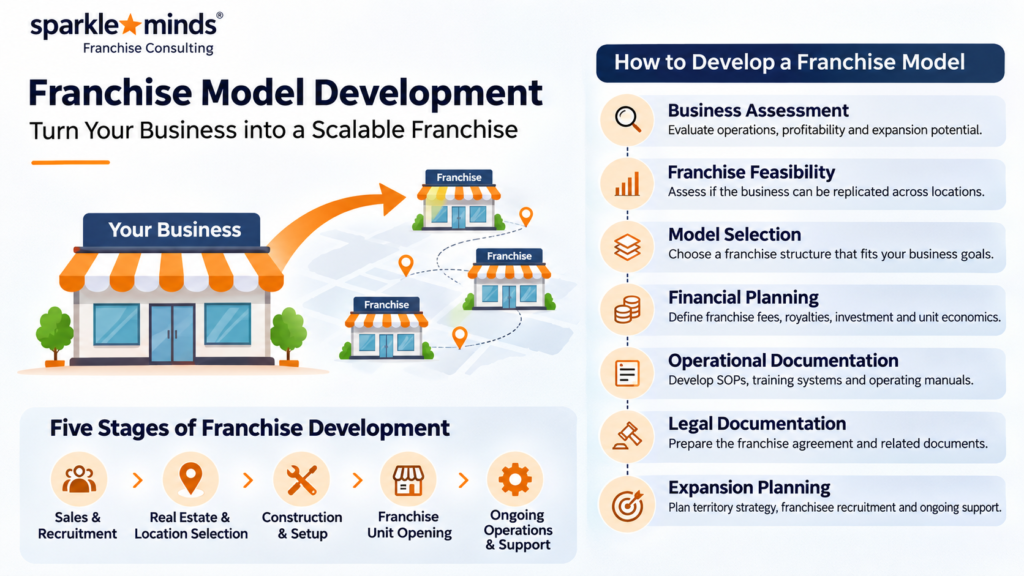
1. Conduct a Business Assessment
Start by evaluating the existing business, including its profitability, operational performance, market position, customer demand, and expansion potential.
The objective is to understand whether the business has a repeatable format that can operate successfully across multiple locations.
2. Evaluate Franchise Feasibility
Not every successful business is automatically ready for franchising. A feasibility assessment helps determine whether the business can be replicated while maintaining its quality, customer experience, and operational standards.
This stage also helps identify potential challenges before the franchise expansion process begins.
3. Select the Right Franchise Model
Choose a franchise structure that aligns with the business’s operational requirements, investment capacity, and desired level of control.
The selected model should clearly define the responsibilities of the franchisor and franchisee and establish how each franchise unit will operate.
4. Develop the Financial Structure
Financial planning is an important part of franchise model development. It involves defining:
- Initial franchise fees.
- Ongoing royalty arrangements.
- Estimated franchise unit investment.
- Setup and operational expenses.
- Expected revenue and profitability assumptions.
- Financial responsibilities of both parties.
The financial structure should be commercially viable for both the franchisor and franchisee.
5. Prepare Operational Documentation
Develop the systems and documentation required to replicate the business across locations. This may include:
- Standard operating procedures (SOPs).
- Franchise operations manuals.
- Training programmes.
- Brand guidelines.
- Quality control processes.
- Customer service standards.
Proper documentation helps franchisees understand how to operate the business consistently.
6. Prepare Legal Documentation
The franchise relationship should be supported by appropriate legal documentation. This includes defining the rights, responsibilities, payment terms, territory arrangements, and other contractual obligations of both parties.
Franchise agreements and related documents should be prepared with appropriate legal guidance.
7. Create an Expansion Strategy
The final stage involves planning how the franchise network will grow. This includes identifying target markets, defining territory strategies, establishing franchisee selection criteria, and preparing recruitment and ongoing support processes.
A structured expansion strategy helps the business approach franchise growth with clear objectives and operational readiness.
When Should Business Owners Opt for Franchise Model Development?
Business owners should consider franchise model development when they have established a business and want to expand through a structured franchise network.
You may be considering franchise model development if you have questions such as:
- How do I start a franchise business model?
- How do I create a franchise model for my existing business?
- How can I design a scalable franchise model?
- What franchise fees and royalties should I charge?
- How can I maintain consistent operations across franchise locations?
- What systems and documentation are required before franchising?
Before moving ahead, it is important to evaluate whether the business is suitable for franchising. This requires more than simply having a successful outlet or a recognised brand. The business should have repeatable operations, a clear value proposition, suitable financial arrangements, and the ability to support franchise partners.
Important Decisions to Make Before Developing a Franchise Model
As a business owner planning to become a franchisor, you will need to make several important decisions, including:
- What initial franchise fee and royalty structure will be commercially appropriate?
- What will be the duration and renewal terms of the franchise agreement?
- How large will each franchise territory be?
- Which cities, regions, or markets should be prioritised for expansion?
- What type of initial and ongoing training will franchisees receive?
- Will franchisees be required to purchase products, equipment, or supplies from the franchisor?
- What financial resources and business experience should potential franchisees have?
- What marketing support and promotional responsibilities will each party have?
- Should the business expand through individual franchise owners, area franchisees, or master franchise arrangements?
Addressing these decisions early helps establish a clear foundation for franchise operations and long-term expansion.
What Is the Franchise Development Process?
The franchise development process involves transforming an existing business into a structured franchise system that can support expansion through franchise partners.
It goes beyond creating a franchise agreement or identifying potential franchisees. The process involves evaluating the business, developing the franchise structure, preparing operational documentation, establishing financial arrangements, and creating an expansion strategy.
A well-planned franchise development process helps businesses prepare for the practical requirements of operating and managing a franchise network.
What Are the Five Stages of Franchise Development?
Franchise development involves several activities, from planning the franchise system to opening and managing individual franchise units. The following five stages provide a broad overview of the process.
1. Franchise Sales and Recruitment
This stage focuses on identifying and evaluating potential franchise partners. It involves defining the franchisee profile, communicating the business opportunity, and assessing whether prospective partners meet the business’s requirements.
2. Real Estate and Location Selection
Location selection plays an important role in franchise expansion. The business needs to establish suitable location criteria based on its target customers, operating requirements, market potential, and territory strategy.
3. Construction and Setup
Once a suitable location is identified, the next stage involves preparing the site for business operations. Depending on the business format, this may include layout planning, infrastructure, equipment installation, branding, and other setup requirements.
4. Franchise Unit Opening
This stage focuses on preparing the franchise location for launch. Activities may include staff training, operational checks, inventory preparation, marketing coordination, and ensuring that the franchisee is ready to begin operations.
5. Ongoing Operations and Support
Franchise development does not end when a unit opens. The franchisor needs to establish systems for ongoing operational support, performance monitoring, training, and maintaining brand standards across the franchise network.
These five stages help businesses understand the activities involved in franchise expansion. The exact process may vary depending on the industry, business format, and franchise structure.
How Can Sparkleminds Help with Franchise Model Development?
Developing a franchise model requires a clear understanding of the business, its operational capabilities, financial structure, and long-term expansion objectives.
Sparkleminds supports businesses in planning and developing franchise models based on their individual requirements. This may involve evaluating the existing business, defining the franchise structure, developing the commercial framework, planning operational systems, and preparing for franchise expansion.
The objective is to help business owners establish a structured franchise system that can be replicated across locations while maintaining brand consistency and operational standards.
If you are planning to expand your business through franchising, developing the right model is an important first step.
How Franchise Business Model Development Works?

The development of a franchise business model benefits both the seller and the buyer. The ability to use entrepreneurs’ money to build the brand more quickly than they could on their own or through investors or lenders is the main advantage for franchisors.
Without giving up control to outsiders or feeling the strain of repaying loans, franchisors may develop their brand thanks to the initial franchise fee as well as subsequent royalties they receive.
The fee and royalty are used to finance corporate operations, franchisee training and assistance, brand marketing and advertising, product or service quality improvement, also brand development in the target market.
Why Is Franchise Model Development Important for Business Expansion?
A properly developed franchise model helps businesses establish consistent operating standards, define responsibilities, protect brand identity and prepare for expansion. It also gives potential franchise partners a clear understanding of the business structure and the support they can expect.
Frequently Asked Questions About Franchise Model Development
1. What is franchise model development?
Franchise model development is the process of creating a structured business system that allows a company to expand through franchise partners while maintaining consistent brand identity, operational standards and service quality. It involves developing the franchise structure, financial framework, operational processes and support systems required for expansion.
2. Why is franchise model development important?
Franchise model development helps businesses establish clear operating procedures, financial structures, franchisee responsibilities and expansion strategies before launching a franchise network. It creates a consistent framework that supports business growth while maintaining brand standards across different locations.
3. What are the key components of a franchise model?
The key components of a franchise model include the franchise structure, investment requirements, revenue model, franchise fees, royalty arrangements, operational procedures, training systems, brand guidelines and franchisee support. These elements help establish a clear and replicable business system.
4. How long does franchise model development take in India?
The time required for franchise model development in India depends on the business’s existing systems, operational complexity, documentation requirements and expansion goals. A realistic timeline can be determined after assessing the business and identifying the requirements for developing a structured franchise system.
5. Can any business develop a franchise model?
Not every business is immediately suitable for franchising. Businesses with a proven concept, consistent operations, clearly defined processes and expansion potential may be suitable for franchise development after a detailed feasibility and readiness assessment.
6. What is the role of SOPs in franchise model development?
Standard Operating Procedures (SOPs) provide clear guidelines for carrying out daily business activities. In franchise model development, SOPs help franchisees follow consistent processes, maintain product and service quality, protect brand standards and ensure uniform operations across franchise locations.
7. How much does franchise model development cost in India?
The cost of franchise model development in India depends on the scope of consulting, business complexity, documentation requirements, operational planning and expansion objectives. The overall cost may vary depending on the services required to prepare the business for franchising. Businesses should obtain a detailed proposal outlining the scope of work and associated fees.
8. How can Sparkleminds help with franchise model development?
Sparkleminds helps businesses develop structured franchise systems through franchise structure planning, operational system development, commercial framework design and expansion strategy. Its consulting support is tailored to the business’s requirements and goals for building and expanding a franchise network.
To Conclude,
To sum up, we provide professional consulting services for developing franchise models in India for all types of businesses. We have a variety of franchise model development templates as well as franchise model types. Therefore, call us right away to create your franchise model business strategy!
Reference Links:
- Franchise Quiz
- Franchise Expansion Form
- Franchising Services at Sparkleminds
- Franchise Development Plan
- Expand your brand
Connect with Sparkleminds to explore franchise model development for your business and plan your next stage of expansion. Franchise Expansion Enquiry Form