7 Powerful Franchise Models for Business Growth: FOCO vs FOFO vs COCO vs COFO

Written by Sparkleminds
franchise models

Introduction

Your first few outlets are doing well. Then the messages start: “Can we open your brand in Pune?” “My cousin wants to run one in Jaipur.” You can say yes in four different ways, and the one you pick decides how much cash you burn, how much control you keep and how fast you grow. Those four ways are FOFO, FOCO, COFO and COCO franchise models. This guide is written for you as the brand owner: what each one costs you, what you earn, what can go wrong, and how to choose.
franchise models

The short answer

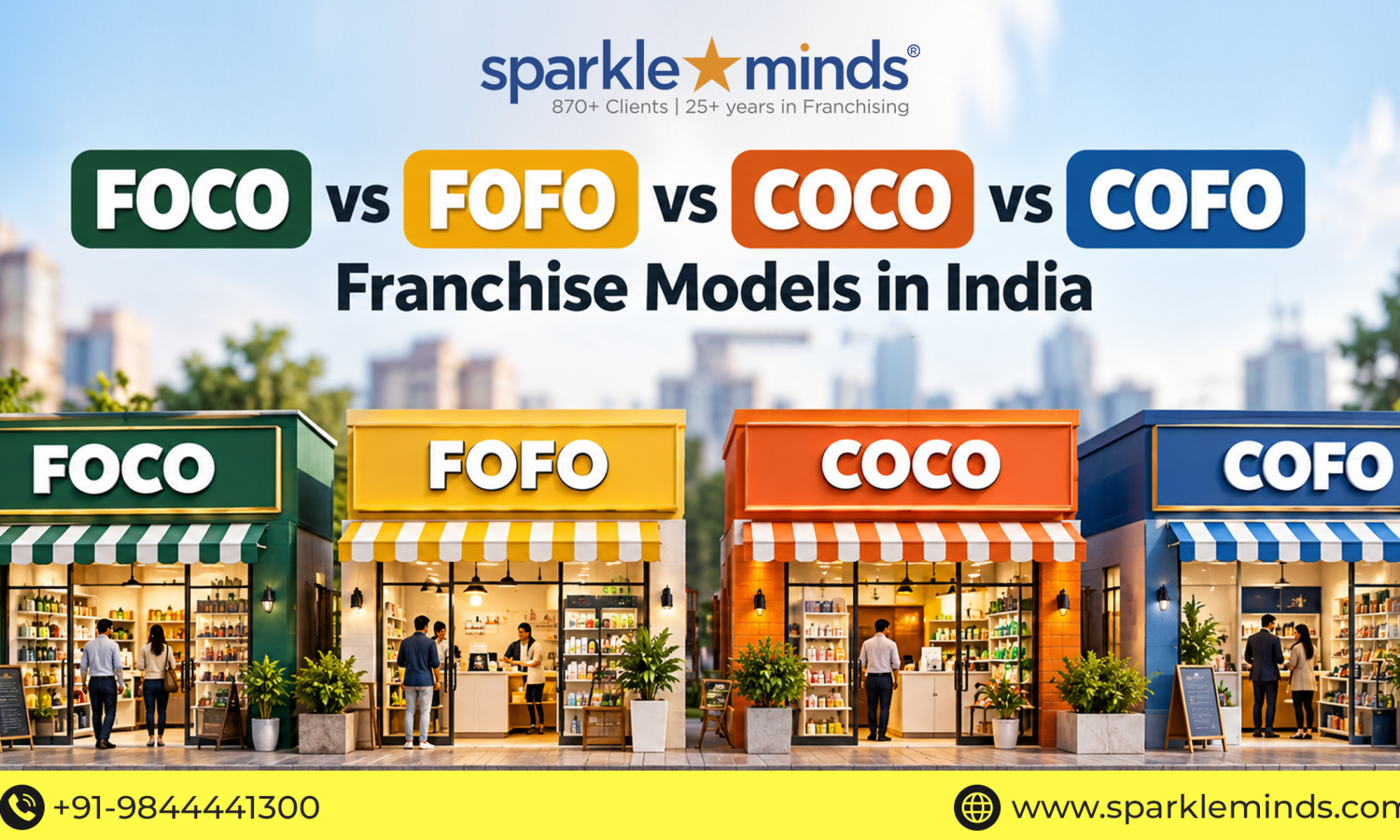
Each acronym says who owns the outlet (first word) and who runs it (second word). Franchisee means your partner. Company means you.


Franchise Models

Stands for

Who puts in the money

Who runs it daily

What it means for you

FOFO

Franchise Owned, Franchise Operated

Partner

Partner

Fastest growth, least capital, least control

FOCO

Franchise Owned, Company Operated

Partner

You

Partner funds it, you run it. Heaviest on your team and on trust

COFO

Company Owned, Franchise Operated

You

Partner

You fund it, partner runs it. More control than FOFO, much more capital

COCO

Company Owned, Company Operated

You

You

Total control, slowest and most expensive growth

Quick pick: short on capital with solid systems, FOFO. Heavy stock or a premium experience to protect, COFO or COCO. New format, not proven yet, COCO first.

What each franchise models asks of you


Franchise Models

FOFO

FOCO

COFO

COCO

You earn from

Joining fee, royalty, often product margin

Operating fee or share of revenue

Sales, after paying the operator

Whole store profit

Partner earns from

Profit after royalty

An agreed share

Commission or fee

n/a

Capital you need per outlet

Low

Low

High

Highest

Staff on your payroll

None at the outlet

All of them

None at the outlet

All of them

Control of the customer experience

Lowest

High

Medium

Highest

Speed of spreading

Fast

Fast

Medium

Slow

What goes wrong

One careless owner hurts the brand

Payout disputes, legal exposure

Operator quality and attrition

Cash runs out before the map fills up

FOFO: Franchise models where partner pays, partner runs

  • How it works: Your partner finds the space, signs the lease, hires the team and runs the outlet. You supply the brand, systems and training. They pay a joining fee and royalty.
  • Why brand owners choose it: The person whose savings are at stake is the one at the counter. JumboKing’s founder Dheeraj Gupta argues in Global Franchise that FOFO networks scale faster and earn better returns on capital than company-run chains, partly because COCO costs climb steeply as you add stores. He sells franchises, so read it as an operator’s view.
  • What it costs you: Almost no capital per outlet, but a real cost in support: training, audits, supply, a field team.
  • Where it breaks: One careless partner can make ten good outlets look bad, and you don’t control their staff or their Tuesday afternoons. If your systems aren’t documented well enough for a stranger to follow, FOFO will expose that fast.
  • One Indian example of the numbers: Big Mart Digital, an electronics brand, lists a FOFO structure on Smergers where the brand charges 10% of net sales as royalty. That’s one listing, not an audited benchmark, so don’t copy it blindly.

COCO: Franchise models you do everything

  • How it works: No partner. You lease, staff and operate the outlet.
  • Why brand owners choose it: Pricing, service and customer experience stay exactly as you designed them.
  • What it costs you: Setup, rent, salaries, stock and management time, for every single store.
  • My take: Open a few COCO stores before you franchise one. You can’t write a decent operations manual for a business you haven’t run yourself, and your first franchisees will ask questions you can only answer from experience.
  • Where it breaks: Making COCO the whole plan. Each new store eats cash and management attention, and both run out sooner than founders expect.
  • Who actually does it: Brands with heavy capex and stock. One breakdown of the Zudio franchise search trend says Zudio grows by leasing space and funding its own company-operated stores.

COFO: Franchise Models you pay, they run

  • How it works: You put up the investment and own the outlet. A local partner runs it for a commission or fee.
  • Why brand owners choose it: You get a local person with real market knowledge, but the stock, the fit-out and the asset stay on your books.
  • What it costs you: Capital, similar to COCO, plus the risk that your operator doesn’t care as much as an owner would.
  • Where it breaks: Operator quality and turnover. If the partner leaves, you’re suddenly running a store you didn’t plan to run.
  • Where you see it: Heavy-stock formats like jewellery. ICRA‘s September 2025 note says large stores with high capex and inventory tend to be COCO or COFO.

FOCO: Franchise Models, they pay, you run

  • How it works: A partner funds and owns the outlet. You staff and operate it, and pay them a share of revenue or profit as the agreement defines.
  • Why brand owners choose it: Growth without your own capital, plus control over the customer experience, which FOFO can’t give you.
  • What it costs you: Operational load. Every FOCO outlet means your staff, your stock and your management, with someone else’s money on the line and a payout you’ve promised.
  • Where it breaks: Payout disputes, and legal exposure (see the next section). Some guides quote 8 to 20 percent as a typical partner share. That comes from marketing material, so don’t use it as a benchmark.
  • One Indian example: The same Big Mart Digital listing shows a FOCO option where the partner receives 10% of net sales as commission and the company appoints the store manager at its own cost. Again, one listing.
  • My view: FOCO sounds like free growth. It’s the most demanding model to do honestly, because you’re running the outlet and answering to the person who paid for it.

The legal catch with FOCO franchise models

  • India has no franchise law, but there are rules about pooling money from the public.
  • A scheme that collects money from investors and runs it for them can count as a collective investment scheme, which needs SEBI registration. LiveLaw’s explainer says permitted ones can’t promise assured returns.
  • A franchise isn’t automatically one of those. But if you pitch FOCO as a fixed monthly income, or let several people pool money into one outlet, get a lawyer’s opinion in writing before you advertise it.
  • Wording matters: describe the share formula and the risks, never a guaranteed return.

The numbers: what your capital does

A made-up example, for illustration only. Say each outlet costs ₹40 lakh to set up, and you want ten of them.


Franchise Models

Setup capital you need

Who funds it

COCO

About ₹4 crore

You

COFO

About ₹4 crore

You

FOFO

₹0 for setup

Partners

FOCO

₹0 for setup

Partners

That gap is why so many Indian brands franchise. ICRA’s gold jewellery note says the franchise models allows faster market entry and growth without significant upfront investment from the brand, and that asset-light FOCO and FOFO are mostly used by regional brands and new entrants wanting a faster scale-up.

But the zero isn’t really zero:

  • You still need a support team: trainers, an audit visit schedule, supply and a helpdesk.
  • You still carry brand risk when a partner underperforms.
  • In FOCO you also carry the staff and the daily operations.

Your real question is: what am I trading, capital or control?

Which franchise models should you start with?


If your business is…

Look at

Why

New format, unproven in 1 to 3 outlets

COCO first, then FOFO

Prove it before others bet money on it

Proven and documented, short on cash

FOFO

The partner brings capital

Heavy on stock or a premium experience

COFO or COCO

You need control, and you pay for it

Strong operations team, no capital

FOCO, only with legal advice

Partners fund, you run, and the rules are strict

Entering a city you don’t know

FOFO or COFO with a local operator

You need local knowledge

A flagship or test store

COCO

You want to learn, not delegate

A sensible path many networks follow: a few COCO stores to prove the franchise models, then FOFO in nearby cities to spread, then COFO or COCO for flagships and key locations.

ICRA’s note also says the franchise route has worked well in North, West and East India but hasn’t caught on as much in South India, so check how your sector behaves in the cities you’re targeting.

Are you ready to franchise? A checklist

  • [ ] Your own outlets are profitable, and you know the real unit economics.
  • [ ] Your operations are written down so a stranger could follow them.
  • [ ] Your trademark is registered (more on this below).
  • [ ] You have a supply chain that works at 10 outlets, not just 2.
  • [ ] You can train people consistently, not just personally.
  • [ ] You have a way to see partner sales and quality, such as reporting or audits.
  • [ ] Your franchise agreement has been drafted by a franchise lawyer.
  • [ ] You know your territory plan: who can open where, and what happens online.
  • [ ] You can afford a support team before the first fee comes in.

If you ticked fewer than seven, work on those before you sell a single franchise.

What Indian law means for you as the brand owner

India has no dedicated franchise law. Deals run on general legislation:

  • Indian Contract Act, 1872
  • Trade Marks Act, 1999
  • Specific Relief Act, 1963
  • Competition Act, 2002 and FEMA, in some cases
  • Sector and state rules, depending on your business

For you that means:

  • Register your trademark first. Legal guides recommend registering brand names, logos and taglines before you offer franchises.
  • Be transparent. A clear disclosure document reduces the risk of misrepresentation claims under contract law, according to Altacit’s guide.
  • Limit the IP licence to specific territories and terms.
  • Protect confidential information with clear non-disclosure and non-compete clauses, both during the agreement and after it ends.
  • Draft the exit. Termination, stock, deposits and handover should all be in the agreement.

General information, not legal advice. Have a franchise lawyer draft your agreement.

Mistakes brand owners make

Mistake

What happens

Fix


Franchising before the franchise models are proven


Partners lose money and blame you

Run COCO outlets first

Overselling returns

Disputes, bad reviews, legal trouble

Show real numbers, never guarantees

Vague territory rules

Partners fight each other and your online store

Define territory and online sales in writing

Weak audits

Quality drifts, brand suffers

Schedule visits and mystery checks

Mixing up the labels

Partners expect something else

Use the agreement’s own words for the model

No support team

Partners feel abandoned

Budget for trainers and a helpdesk before you sell

Leaving your brand open to fake pitches

Strangers collect deposits in your name

See below

Protect your brand from fake franchise pitches

If your brand gets known, someone will try to sell fake franchises in its name. One breakdown of the Zudio franchise search trend says “FOCO franchise” claims are used as bait, with people paying brokers for a model the brand doesn’t offer. Large brands such as HUL have published caution notices for prospective distributors and partners.

You can do the same:

  • Publish an official franchise page that states how to apply and who to deal with.
  • Say clearly that payments go only to your company’s bank account, and that you don’t use brokers (if that’s true).
  • List your authorised contact details.
  • Add a short “beware of fake franchise offers” notice and keep it up to date.
  • Tell enquirers to verify your company on the MCA portal.

The bottom line

Don’t ask “which franchise models are best?” Ask what you’re short of and what you’re willing to give up.

  • Short on capital? FOFO, with systems strong enough for strangers to follow.
  • Protecting the experience? COFO or COCO, and budget for it.
  • Unproven? COCO first.
  • Tempted by FOCO? Only with a lawyer’s opinion and a team that can run outlets for other people’s money.

Most brands that last end up with a mix. The point is to choose each model on purpose, and to write it down clearly enough that nobody has to guess what they signed.

FAQs

What’s the difference between FOCO and FOFO for a brand owner?

In both, your partner funds the outlet. In FOCO you run it and pay the partner a share. In FOFO the partner runs it and pays you royalty. FOFO needs less from your team, FOCO gives you more control.

Which franchise models is best for a small business in India?

Usually FOFO once your model is proven, because the partner brings the capital. Before that, run a few COCO outlets to learn what you’re asking others to copy.

Is the FOCO franchise models legal in India?

FOCO is a legitimate way to structure an outlet, but pooling money from investors or promising fixed returns can fall under SEBI‘s collective investment scheme rules. Get a lawyer’s opinion before you offer it.

Is there a franchise law in India?

No. General laws like the Indian Contract Act and the Trade Marks Act apply, so your written agreement carries most of the protection.

Is trademark registration a prerequisite for franchising? 

It is advised by legal guides. Partners are paying for something you might not fully own, and it is more difficult to protect your brand without registration.

Updated 12 October 2026 · By [Resham Daswani], [Sparkleminds Editorial Team] · 9 min read

Loading

Choosing Between FOFO and FOCO: My Expansion Dilemma

Written by Sparkleminds

I am a business owner in India, 2026. I am at a crossroads. The retail and F&B landscape is changing quicker than ever and franchising is one of the most attractive methods to scale. But the biggest thing I keep struggling with is do I go FOFO (Franchisee-Owned, Franchisee-Operated) or FOCO (Franchisee-Owned, Company-Operated) franchise model? It’s not just numbers on a spreadsheet. It is about lifestyle, risk, scalability, and at the end of the day, the kind of entrepreneur I want to be.

franchise model

Grasping the Two Models

  • FOFO: I put up the money, I get the location, I operate the business myself. I’m the manager, recruiter, and trouble shooter. Every achievement and loss is mine to claim.
  • FOCO: I give the cash and the venue, but the franchisor calls the shots. They bring trained managers and SOPs and systems. In this capacity I am more an investor than an operator.

At first glance, FOFO feels like the “entrepreneur” choice and FOCO feels like the “investor” decision. But the truth is more complicated.

Profitability: The Numbers and The Hidden Costs between the two franchise model in India

On paper FOFO appears more profitable. Margins can be 25-35% after royalties vs FOCO’s thinner 15-22%. But I’ve discovered numbers don’t convey the complete story.

In FOFO franchise model, those larger margins are often eaten up by:

Staff turnover is a continuous drain on cash and resources in recruiting and training.

Wastage Without centralised mechanisms to manage inventory, wastage of food or products can eat into 5% of your income.

Inconsistency: If the service or quality is poor, it will diminish the number of consumers coming back, and hence reduce their lifetime value.

FOCO might pay me less per outlet, but it scales faster. I could realistically have five FOCO outlets running with skilled management in the time it takes to stabilise one FOFO outlet. The combined ROI of several FOCO units is greater than one high-margin FOFO unit.

Why I’m Into FOCO franchise model

  • Professional Management: No more 3 AM phone calls about malfunctioning freezers or missing cooks. It is managed by management of the franchisor.
  • Brand Protection: The franchisor’s requirements protect my outlet’s reputation. One lousy FOFO operator can destroy a brand. FOCO, on the other hand, has constant quality.
  • Real-time Tech Transparency Let me check sales and earnings wherever.

For a guy like me who wants to build a portfolio, FOCO seems like a safer idea. It’s not only about the money, it’s about the piece of mind.

Why I Still Get Drawn to FOFO

  • Hands‑On Control If I do a good job, I keep the management fee that would otherwise go to the franchisor.
  • Local Nuance: I understand my town better than a corporate office can. I can adapt marketing for festivals or neighbourhood tastes.
  • Reduced Initial Cash Flow: FOFO allows me to sometimes start leaner, without big reserves or deposits.

If I was younger or hungrier to learn the ropes, FOFO would be my proving ground. It is the paradigm for entrepreneurs who wish to be hands-on.

My Decision-Making Process

Here’s how I’m testing myself.


Question

If Yes →

If No →

Do I have 40+ hours weekly for the outlet?

FOFO

FOCO

Is this my primary income source?

FOFO

FOCO

Do I have team‑management experience?

FOFO

FOCO

Am I seeking passive income?

FOCO

FOFO


This modest structure forces me to face my reality. I don’t have 40 hours a week to throw away. I want scale, not daily firefighting. Which, brings me to FOCO.

The Lifestyle Aspect

Profit is not only margins. It’s about quality of life too.

I’m plugged into the outlet in FOFO. My phone is ringing off the hook. All problems are mine to resolve.

In FOCO I am free to focus on strategy, or expansion, or even take a vacation without worrying about operations.

The independence from operational hassles is, for me, worth as much as the profit itself.

The Expansion Vision 

I don’t want to own an outlet. It’s to establish a portfolio. That’s what FOCO is for. ‘Professional management can help me grow faster and have a diversified presence in cities.

But FOFO holds me back. It can take years to stabilise one outlet.” To scale several FOFO channels, I’d have to clone myself.

The Verdict My expansion FOCO wins. It may not guarantee increased margins, but it gives me scalability, trademark protection and piece of mind.

That said, FOFO still has its merits. It’s the appropriate model for first-time entrepreneurs who want to learn business directly, maximise control and generate sweat equity.

Key Takeaways for Fellow Owners 

FOCO is the best choice for investors, NRIs, and professionals looking for secondary income.

First time entrepreneur. You want to study and operate. Choose FOFO.

Watch out for hybrids like FICO that are popping up in capital intensive areas like healthcare and retail.

My Final Thought

At the end of the day, the decision is not FOFO vs FOCO. It’s about what kind of entrepreneur you are. Would you like to operate a business or have a self-running asset?

Well, for me the option is easy. FOCO is in line with my vision of increasing wealth while retaining balance in life.


Loading

Do you know the franchise success story of McDonald’s?

Written by Sparkleminds

McDonald’s is a brand and franchise that’s reached worldwide popularity. Today, the brand is synonymous with burgers, fries, and shakes. Coupled with its iconic logo, anyone can recognize the brand no matter where they are.

Let’s talk about the MC Donald’s franchise success of the brand

In this blog, we’ll discuss the brand’s history, the founder of the brand, some of the business models McDonald’s has used for its franchisees, and its marketing strategies. 


A Brief Introduction to the Brand and Franchise

The McDonald’s corporation is a North American fast-food organization. Its best known for its burgers, cheeseburgers, and fries, but the menu also includes other popular items like its Happy Meal, that’s a hit with its younger customers, the Big Mac, the McFlurry, or even its separate breakfast menu.

And in light of changing preferences, McDonald’s has recently introduced fruit and vegetable choices in its meal packages. By bringing in healthier options the brand hopes to inspire healthy-eating choices in its younger customers.  

A History of McDonald’s

McDonald’s was first established in 1940 by brothers Richard and Maurice McDonald in California, United States. Originally a drive-in, the brothers decided to revamp the business in 1948. The new model was designed to produce huge amounts of food at low prices. To achieve this, the brothers limited the menu, only offering a select few items, and developed a high-Speed Service System.

This system allowed them to introduce a self-service counter and eliminate the need for staff. The burgers were made ahead of time and placed under heating lamps which allowed them to charge 15 cents a burger – almost half the price of competing restaurants at the time.

Ray Kroc

Ray Kroc, the former CEO of McDonald’s was originally a salesman who supplied appliances for the restaurant. In 1954, he visited the shop to see how one small store can sell so many milkshakes and realized the potential the brand held.

Kroc became a franchising agent for the brand and launched McDonald’s System Inc., which later came to be known as McDonald’s Corporations. In 1955, he opened the first franchise east of the Mississippi River in Des Plaines, Illinois. And in 1961, he bought out the McDonald’s brothers for $2.7 million.

The Brand’s Mission and Ethos

McDonald’s mission of “Quality, Service, Cleanliness, and Value”, is what has kept the brand in the business. The McDonald’s franchises focus heavily on five fundamentals – people, products, place, price, and promotion. Along with their business strategy “Plan to Win”.

And the McDonald’s business model depends heavily on three core principles – retaining, regaining, and converting. It focuses on retaining old customers, regaining lost trust, and converting casual customers into regular/loyal ones. Additionally, it’s embraced digital advancements and food delivery. The company has always been open to reshaping its customer experience through innovation and human endeavors.

The McDonald’s Franchise System

Kroc soon realized that franchisees were integral to the success of the brand and launched a franchise system. As he once stated, “McDonald’s can’t be successful unless our franchisees are successful.”

He prepared exact standards of how each McDonald’s was supposed to be run from cleaning to food preparation. And to ensure consistency, he created Hamburger University in 1961, to train franchisees.   

He eventually changed the format of the restaurants by adding counter staff to take customer orders and also added a drive-through. An addition that’s become prevalent in almost all fast-food franchises today.  

What Does Owning a McDonald’s Franchise Look Like?

McDonald’s opened its first international outlet in 1967 in Richmond, British Columbia, Canada. And by the early 21st century the brand had over 34,000 outlets across 115 countries worldwide. Growth was so quick that it became the most popular family restaurant, with its affordable food, separate menu options catered towards children, and flavors that appealed to nearly everyone.

With over 60 years in the business, as a franchise, McDonald’s has a proven framework for success. It’s a classic example of a heavily franchised brand. As of 2021, over 56% of its revenue came from franchised restaurants. While the company owns and operates (COCO model) a small percentage of its restaurants, McDonald’s plans to reduce that number to 5%, with a long-term goal to transition towards 95% of its outlets being franchised (FOFO model) restaurants.

In 2021 the company generated over $23 billion in revenues, of which $9.78 billion was from company-owned restaurants and $13 billion from franchised restaurants. And the success of their overseas franchise models has resulted in the term, “McDonaldization”

Developing McDonald’s Marketing Plan

In less than ten years, after Kroc became the sole owner of the franchise, the number of outlets exceeded 1,000. Through its success, the company began trading publicly in 1965.

The first ever McDonald’s mascot was a burger wearing a cooking cap who was alluded to as Speedee. In 1962 the golden arches were introduced and have continued to be the face of the brand, even today. The logo was inspired by the tall yellow arches that dominated earlier McDonald’s rooftops.

And lastly, in 1965, their newest mascot, Ronald McDonald was introduced. However, the growing negative perception of clowns in the 21st century resulted in them sidelining the character.

The most notable addition to the brand was the introduction of the Big Mac to the menu. The iconic hamburger was an instant hit and the company’s top-selling product, after its French fries. These changes helped the brand grow and gain popularity among the masses.

Criticisms Leveled at the Brand

The success of McDonald’s also brought its fair share of criticism of the brand. A lot of this was concerned with the brand’s association with the global increase in obesity. In the early 2000s, various lawsuits and complaints were filed and registered against the company in the United States, alleging that its food caused health problems. The company also received a lot of negative press from the documentary Super-Size Me (2004), in which the filmmaker documented a decline in his health while on a diet of only McDonald’s foods.

In response, the brand started developing vegan options for its menus, like McVegan, P.L.T., and McPlant. And in 2017 the company released its first plant-based burger. In 2018, the company announced that it had stopped using preservatives in most of its burgers and eliminated its super-sized menu options. And its US and Canadian branches stopped using Trans fats in a number of its food items. However, this did little to curb the health concerns regarding the brand.

Additionally, the company also faced a spike in the number of calls to increase employee wages. The term “McJob” was added to Merriam-Webster to mean a low-paying job. Recently, the company has come under fire, similar to other large corporations for its negative impact on the environment, especially concerning greenhouse gas emissions.

In answer to this, the company increased employee wages and launched initiatives to cut down on its carbon footprint. Like launching programs to move towards using recyclable bags, utensils, and other items. And making moves to be increasingly transparent in their production processes.

The Future of McDonald’s

As of 2022, McDonald’s is still a leading franchised brand in the fast food industry. Frankly, there’s little doubt about the company’s ability to attract customers. Even during a bad year, McDonald’s still makes a profit.

As for the future expansion of the brand, McDonald’s has already been taking steps to improve upon its already successful business model. This can be evidenced by the introduction of automated ordering stations in their outlets, digital or contactless payment options, and more plant-based food items in their menu to cater to a more diverse customer base.

They also plan on remodeling their restaurants to cut down on carbon emissions by either replacing their equipment or altering their practices. McDonald’s plans to fully achieve company-wide, net zero emissions by 2030.

In Conclusion

McDonald’s is a great business model for startups or experienced entrepreneurs to read up on if you’re currently looking up references to start your franchise. It’s got a proven working model and over 60 years’ worth of experience in the industry to back it up. All of which can be evidenced by the franchise’s worldwide success.

So what are you waiting for? Take action now! Your business can be the next global franchise successful brand. Start franchising today with sparkle★minds. Connect with us now!

Loading