Written By: Resham Daswani, Sparkleminds Editorial Team – Updated August 2026
FirstCry Success Story: How This Startup Became India’s Largest Kids Brand
How did FirstCry become one of the biggest baby and kids retail businesses in India? FirstCry succeeded by recognising a clear vacuum in the Indian market, developing strong category expertise, earning consumer trust and then scaling thru an omni-channel business strategy integrating online shopping, physical locations, private labels and smart acquisitions. The greater message for business owners is simple: a healthy business doesn’t need to remain in one place. With the correct expansion plan, systems and partners it may be a scalable national brand.
So FirstCry’s transition from an online baby-products firm to a huge omnichannel store is more than an inspiring Indian startup success tale. It’s a real-world example of how companies may establish a repeatable expansion model. And for entrepreneurs who are thinking, “How can I expand my business in India?”, FirstCry has some good responses.
The FirstCry Success Story Began With A Simple Problem
Supam Maheshwari and Amitava Saha launched FirstCry in 2010. The creators saw a need that many Indian parents were struggling with at that time – there weren’t many places where you could buy a wide variety of trusted baby and children’s products.
Rather than building another generic e-commerce portal, they decided to focus on one category – babies, children and maternity. That was a big decision. The company began as an online platform providing baby-care, maternity and children’s products. And the proposition was simple:
- a whole range of products in one easy destination for parents.
- It wasn’t a strategy of selling everything to everyone.
- It was about being so pertinent to one segment of customers.
That category-centric approach became one of the cornerstones of the FirstCry business model.
From Online Startup to Omnichannel Brand
A big part of the FirstCry success story was its expansion beyond only internet retail.
The company understood that for Indian consumers, brick-and-mortar stores would remain important, especially for categories related to babies and children. Parents want to view things, compare sizes, understand quality and shop in person. So, FirstCry came up with an omnichannel retail strategy.
Its internet platform provided ease and variety, while physical shopfronts offered exposure, accessibility and an in-person shopping experience.” The company also entered offline retail thru franchised outlets in 2011. Strategically, this was a big step, as franchising allowed the brand to grow its physical footprint without having to rely only on the cash and operations from company-owned stores.
This is where the FirstCry success story is very relevant to owners of existing Indian businesses. This does not mean that a successful business has to create and operate every new outlet. A good franchise model allows a business owner to partner with local entrepreneurs that contribute investment, market expertise and operational engagement while the brand brings the business plan, systems, branding and support.
That’s the power of franchise business expansion when it’s done right.
Why the Omnichannel Model Succeeded
FirstCry does not consider online commerce and retail shopfronts as two independent business lines. Rather, the two channels complemented one other. “Customers can find products online, visit a store, purchase offline and continue to interact in the digital space. Physical stores also helped increase brand identification in regions where online buying was still growing.
Its physical retail base became an important aspect of the company’s multichannel approach, complementing its digital platform, the company said in its disclosures. This is a lesson for Indian Entrepreneurs to take a cue from. If you have a thriving retail, food, education, healthcare, beauty or service business, the question of whether to go all offline or all online may be the wrong one.
The proper question is:
- How can the various channels collaborate to make my brand more accessible?
- And that approach can produce a lot larger scalability.
FirstCry Created a Network of Over
The FirstCry success story was also because it was able to break the boundaries of being just a marketplace. The company expanded its product ecosystem and created private brands such as BabyHug. The private labels let FirstCry have greater control over product positioning, pricing and customer experience, while enhancing the broader brand ecosystem.
The corporation also grew thru smart acquisitions. In 2016, FirstCry bought BabyOye from Mahindra Retail to boost its footprint in the baby and maternity segment. It later branched out into neighbouring parts of the parental ecology.
This demonstrates a key principle of corporate growth:
- And expansion doesn’t have to imply additional outlets.
It might also signify:
- Expanding to new cities
- Expanding Product Categories
- Producing private-label products
- Acquiring related businesses
- Establishing distribution relationships
Franchise network building –
- Going global
- Build a stronger customer ecosystem
- These are various roads to advancement for the aspiring business owner.
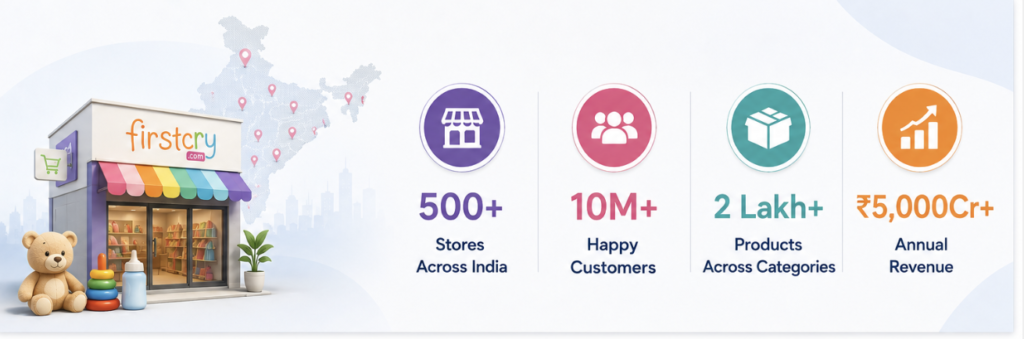
The numbers show what scale can be. FirstCry’s growth has also resulted to tremendous operating scale.
According to its financial reports, FirstCry’s parent firm Brainbees Solutions has announced that its consolidated revenue for FY2024-25 rose 18% to almost ₹7,659 crore compared to the previous year. Its India multichannel business accounted for ₹5,278 crore.
- As of March 2025, the company operated 1,156 modern outlets including corporate-owned stores under the labels FirstCry and BabyHug. Its own brands accounted for more than 55% of revenues.
- The corporation still issues quarterly earnings and financial reports, giving investors and business watchers a glimpse of its operating outcomes.
These numbers key because they tell a story entrepreneurs typically underestimate: It’s not simply ambition that creates scale, but systems. One successful outlet is one success. But coming up with a business strategy that can be copied across hundreds of locations is a whole different challenge.
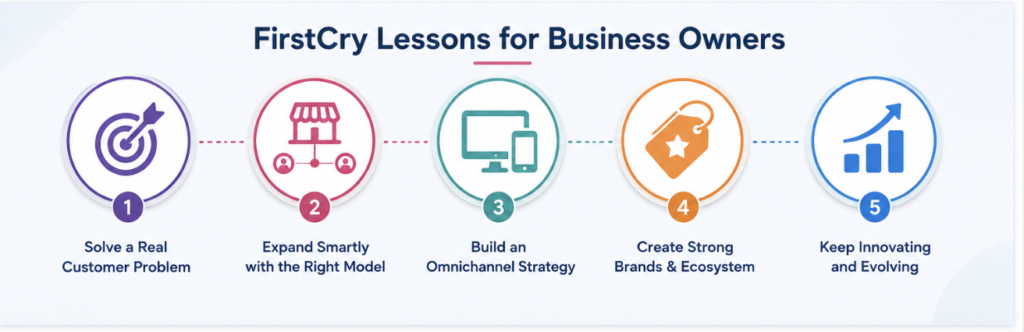
FirstCry Lessons for Business Owners
1. Address an actual customer concern
FirstCry did not start with the query, “What business can we start? It identified an issue for parents and went about solving it. That’s equally vital for existing business owners. Before expanding, question:
- What makes my business different from the competition and why would clients seek the same experience in another city?
If the answer is obvious, you could have the ingredients for a scalable business.
2. Create a scalable business model
It’s hard to grow a business model that depends wholly on its creator. Opening ten extra shops can create ten times the complexity if the owner has to be involved in every decision, customer interaction, supplier negotiation and operational procedure. The opposite strategy is required for franchising.
The business needs established processes for topics like:
- Store operating (
- StaffTraining
- Customer support
- Purchasing
- Marketing Technology
- QC (Quality control)
- Finance accounting
- Brand guidelines
This turns the business from a founder-dependent operation to a replicable franchise model.
3. Physical expansion must not be underestimated
At times, the growth of e-commerce gives the sense that traditional stores are becoming irrelevant. But FirstCry’s experience is a more complex story. It has run an online platform and a physical retail network side by side as part of a multi-channel strategy.
Many Indian firms still believe in the power of physical presence to build trust, visibility and local market penetration. Franchise networks can expedite that presence.
4. Look beyond your home cities
Many successful Indian firms get complacent once they have established themselves in one city. The founder understands the customers, suppliers, employees and the market firsthand. But that comfort can be a hindrance to advancement.
FirstCry’s expansion is a case in point of the possibilities of moving away from a specific business offering to many markets rather than being geographically concentrated.
The question should eventually become for a business owner:
- Can my business operate anywhere else?
to:
- What do I need to modify for my business to work elsewhere?”
Now that’s a far more strategic expansion.
5. Leverage franchise partners as local growth drivers
A franchise partner is not just a source of money. The appropriate franchisee may offer:
- Knowledge of local market
- Real estate know-how
- Local relations:
- Staff management
- Customer intelligence
- Money for expansion
- Entrepreneurial Dedication
This can be especially helpful for a company that wishes to penetrate many cities without having to bear the full financial and operational burden itself. This is why the early utilisation of franchise-owned outlets by FirstCry is one of the most important portions of the company’s journey to entrepreneurs considering franchise business opportunities in India.
Why FirstCry Is More Than a Startup Success Story
Looking at FirstCry, it is tempting to think that e-commerce was the reason for its success.
This would be to miss the point.
The corporation didn’t just erect a website and wait for clients.
- It created a brand category specialist.
- It created a vast product ecosystem.
- It also incorporated a physical retail store.
- It employed franchising as a way of expanding.
- It created private labels.
- It made purchases.
- It grew internationally.
- And it kept investing in the client experience.
That was the beginning of a much more powerful business than just an online store. That is an essential distinction to entrepreneurs. Technology can assist a business to grow but it is a scalable business strategy that allows for continued expansion.
Implication to Indian Business Owners
Suppose you already have a profitable business.
- You have clients.
- You have a product or service with a market demand.
- Your brand is known in your city.
But it’s beginning to slow down since you can’t personally oversee another location. This is where franchising can be worth looking at for growing your firm.
Don’t have all your personal capital invested into every new store. Create a franchise opportunity that has a structure where partners who qualify invest in and operate locations under your brand. But franchising should not be considered just the sale of franchise rights.
Before creating a franchise model a business owner must consider:
- Is the company financially sound?
- Are the unit economics compelling?
- Can the operations be reproduced?
- Is it a different brand?
- Can new franchisees get a good return?
- Are the processes written down?
- What will franchisees get?
- What lands should be proposed?
- What is the correct fee/royalty structure for franchises?
- What are the legal agreements and compliance requirements?
These questions will establish if a business is truly ready to franchise.
Key Takeaways From the FirstCry Success Story
Perhaps the most essential lesson from FirstCry is not about the number of stores, its income or even its technology. It’s the ability to take a strong business idea and convert it into a repeatable growth engine.
The founders noticed a gap in the market.
- They specialised.
- They created trust with their customers.
- They increased their product line.
- They blended internet and offline channels.
- And they built systems that gave the brand the opportunity to reach customers beyond what the founders could accomplish themselves.
That’s entrepreneurship, scalable, literally.
Should I Franchise My Business or Not: Is It the Right Decision for You?
If your firm has reached a point where clients are begging for your brand in other places, your unit economics are established and you can reproduce your operations, franchising could be the next natural stage of expansion. But it should not only be “get more franchisees.”
The aim should be:
- Create a franchising structure that is mutually beneficial for the brand, the franchisee and the customer.
- FirstCry’s story is a case study on how a business may evolve from solving a local need to developing a national ecosystem.
That’s the actual lesson for Indian entrepreneurs.” You don’t need to develop another FirstCry. You have to understand why FirstCry was able to scale and what of those concepts can you apply to your firm.
Final Thoughts
At the end of the day, the FirstCry success story is a narrative about scaling.
- A niche idea turned into a niche brand
- A speciality brand become an omnichannel enterprise.
- An omnichannel business created a physical presence.
- And a scalable approach paved the way for national and international expansion.
The message to Indian business owners is simple. If you have a business with established demand, excellent unit economics and a replicable operating model, then expansion thru franchising can help you reach markets that would be difficult to win thru company owned growth alone.
The next important question for the ambitious entrepreneur might not be “Should I continue to grow?”
It could be:
“Is my business ready to be a brand that other entrepreneurs can grow with?”