How to draft a franchise business plan for a food and beverage outlet

Written by Sparkleminds
franchise business plan

Profitability at the unit level should take precedence over volume in a franchise business plan in the present ₹6 Trillion Indian food services market. Integrating AI-driven inventory management, establishing ONDC interoperability, reducing aggregator commissions to 3-5%, and negotiating Perpetual FSSAI Licensing are the three pillars upon which success in 2026 will rest. An 18–22% net profit margin and a 14–20 month payback period are the goals of a workable plan.

franchise business plan

The Strategic Basis: An Executive Summary

This investor is well-versed in technology. Make sure your franchise is seen as more than simply a kitchen in your overview. Show how it’s a fuelled by data asset.

  • Mission Statement: Write down your “North Star.” For example, “To give urban commuters carbon-neutral, gourmet coffee experiences.”
  • Differentiating Factor (USAP): Find a need in your particular area of expertise. This is commonly referred to as “Hyper-Personalized Nutrition” or “Grade-A Hygiene” in the year 2026.
  • Summary of Financial Situation: Make it crystal clear that you are “seeking a capital commitment of ₹45,00,000 to attain a 22% Net Profit Margin by Year 2.”
  • The “Expert” Validation: > “In 2026, the era of ‘burn cash for growth’ is over. Successful franchisees use AI not as an expense, but as a margin-protection tool. If your plan doesn’t account for AI-driven wastage control, you’ve lost 5% profit before Day 1.”Sanjay Kumar, F&B Analyst.

Brand Identity & Franchise Model

You aren’t just selling food; you are selling a proven system. This section proves you understand the Brand DNA.

  • Defining and expressing details on how the brand bloomed successfully
  • Option 1: 
    • F. O.C.O: Most appealing for those looking to take the backseat. Franchising, often known as FOFO, is ideal for entrepreneurs who like to get their hands dirty.
    • FOCM (Franchise Owned Company Managed): The 2026 “middle ground” for quality control.

Detailed Market Analysis: The “India-First” Methodology

Google rewards “Information Gain”—providing data that isn’t just a copy-paste.

A. Macro-Environment (PESTEL Analysis)

  1. Political: Compliance with “Sugar Taxes” and “PLI Schemes” (Production Linked Incentives).
  2. Economic: Managing “Inflationary Menu Pricing” (6% annual dairy inflation in 2026) without losing volume.
  3. Social: The shift toward “Solitary Dining” (solo-booths) and “Photo-First” plating.
  4. Technological: Integration of ONDC to bypass the 25-30% “Aggregator Tax” of traditional platforms.
  5. Zero-waste targets and obligatory eco-packaging are implemented for environmental reasons.
  6. Adhering to the “Perpetual Validity” reforms that were implemented by the FSSAI in 2026.

B. Competitive Intelligence Table

Factor

Your Franchise

Local Competitor (Independent)

Global QSR Chain

A-O-V

₹450

₹350

₹600

Digital- Maturity

High (ONDC + App)

Low (Phone only)

High (Closed Ecosystem)

Hygiene Rating

Grade-A (FSSAI)

Unverified

Grade-A

Sustainability

100% Plastic-Free

Low Priority

80% Reusable


The Operational Franchise Business Plan Blueprint

This is where you prove you can run the “Machine.”

  1. Location & Site Selection
  • Using cell-phone ping data, heat maps can be created to substantiate footfall.
  • Foe 2026, the fastest and rapidly growing sectors are those that are mostly consisting of kiosks ideally placed in airport hubs and metro stations.
  1. Supply Chains & Tech
  • Inventory AI: Describe software that alerts you when “Paneer” stock is low based on predicted weekend weather.
  • ONDC Integration: Detail how you will list on the Open Network for Digital Commerce to reduce delivery commissions from 25% down to 3-5%.

2026’s F.S.S.A.I Regulation Compliant Framework

There is a noticeable change in the regulations landscape of India.Thus, Your plan must be compliant:

  • Perpetual Licensing: FSSAI licenses no longer require annual renewal; they are valid indefinitely subject to annual fee payments.
  • Turnover Thresholds: * Basic Registration: Up to ₹1.5 Crore.
    • State License: ₹1.5 Crore – ₹50 Crore.
    • Central License: Above ₹50 Crore (or at Airports/Seaports).
  • Mandatory FSDB: All outlets must display “Food Safety Display Boards” (A3 size for licensed outlets).

Marketing & Digital Dominance

To rank for “franchise business plan for food & beverage business,” you must address SEO for the Physical World.

  • Hyper-Local SEO: Dedicating to weekly updates on Google Business Profile to engage the 70% of diners searching “near me.”
  • WhatsApp Commerce: Leveraging a WhatsApp Business API bot to streamline direct orders and establish a private customer database.
  • The “Influencer” Tier: Partnering with hyper-local “City Foodies” (5k–10k followers) rather than national celebrities for better ROI.

Financial Projections: The “Truth in Numbers” (INR)

A. Cap-Ex

Category

Approx. Cost (I.N.R)

2026 Reason

Franchises Fee

₹10,00,000

Initial brand rights

Kitchen & Equipment

₹15,00,000

AI-enabled ovens, IoT chillers

Interiors & Fitments

₹20,00,000

Ecofriendly supplies

FSSAI & GST

₹1,00,000

Perpetual validity fees

Working Capital

₹10,00,000

6-month buffer

Total Investment

₹56,00,000

Excluding Rent Deposit

B. Op-Ex

  • C.O.G.S: Estimated 28–32%.
  • Labor Cost: 12%–15% (Optimized via kiosks).
  • Delivery Commission: 5% (Targeting ONDC/Direct).
  • Rent: 15% (High-street avg).


Managing Risks & Relatable Success Stories

Build the clientele trust alongside addressing hard truths. 

  • The “Aggregator” Risk: Plan B for delivery if commissions rise.
  • Staff Attrition: Implementation of “Skill-based Incentives.”


Conclusion: 

In order to develop a franchise business strategy for the food and beverage sector in 2026, it is necessary to strategically align a global or national brand with localised insights. By prioritising sustainability, optimising ONDC efficiency, and implementing AI-driven management of waste, you are not merely establishing a restaurant; you are also establishing a robust economic asset for the future.


FAQs: 

Q1: What exactly is meant by the term “Perpetual-F.S.S.A.I. License”?

With its existence in 2026, it means your license never expires. You simply pay an annual fee and maintain hygiene standards. 

Q2: Why does O.N.D.C have an pros over Zomato and Swiggy?

Despite the fact that they offer significant visibility, aggregators charge commissions of up to thirty percent. ONDC is an open network where you pay only 3-5%, significantly boosting your net profit margins.


Q3: In the Indian market, what is a reasonable return on investment?

A The repayment period of 14 to 20 months is the goal for a well-managed quick-service restaurant or cafe franchise in the year 2026. There is a possibility that premium casual dining will take between 24 and 36 months.


Loading

Process To Draft A Restaurant Franchise Agreement in India 2025

Written by Sparkleminds

A Complete Guide to Creating a Restaurant Franchise Agreement in India for 2025.

India is experiencing a surge in the popularity of franchising, notably in the food industry.. As we look ahead to 2025, it’s exciting to see how the sector is gearing up for some serious growth. Entrepreneurs are diving into franchising opportunities to expand their brands.

The cornerstone of a prosperous relationship between franchise owners and their franchisees is a carefully crafted restaurant franchise agreement. In this article, we will go over the fundamentals of creating a strong franchise agreement in India, including the necessary components, legal factors, and best practices.

Why the need for a restaurant franchise agreement when franchising in India?

A Restaurant Franchise Agreement is a contract that lays out the terms and conditions between the franchisor, who owns the brand, and the franchisee, who runs the restaurant. It lays out what both parties can expect from each other, making sure everyone knows their rights and responsibilities for a clear and safe agreement.

Essential elements to include when drafting a Restaurant Franchise Agreement in India 2025

When putting together a solid franchise agreement, it’s a good idea to think about adding these important sections:

#1. Getting Started and Key Concepts

  • Give definitions for important phrases such as “Territory,” “Franchisee,” “Franchisor,” and “Confidential Information.”
  • Briefly explain the agreement’s aim and business plan.

#2. Distribution of Franchise Rights

  • Give the franchisee specific rights, like the ability to use intellectual property and trademarks.
  • Receive exclusive recipes, training resources, and operational guidelines.
  • Let’s talk about what kind of territory we’re looking at for the franchise—whether it’s going to be exclusive or non-exclusive.

#3. Duration and renewal clauses

  • Typically, the duration of the agreement is anywhere from five to ten years.
  • Let’s go over the renewal terms, like the conditions for renewal, any fees involved, and the performance benchmarks we need to meet.

#4. Payments & Fees for Franchises

  • Let’s talk about the financial obligations, starting with the initial franchise fee.
  • The regular payment of royalties (either as a fixed sum or a percentage of sales).
  • Contributions to marketing and advertising.
  • Let’s make sure to add in the payment schedules and what happens if payments aren’t made.

#5. Training and ongoing assistanc

  • Let’s talk about what the franchisor needs to do when it comes to training, both at the start and as time goes on.
  • Specify the methods for managing the supply chain, ensuring quality, and providing operational assistance.

#6. Standards for Operations

  • Among the requirements for preserving the reputation of the brand should be the following: Menu uniformity.
  • Guidelines for hygiene and safety.
  • Let’s talk about customer service benchmarks.

#7. Promoting and Advertising

  • It should be made abundantly clear that the franchisee is responsible for participating in both regional and national advertising campaign initiatives.
  • Let’s talk about how we’ll gather and use the funds for advertising.

#8. Protecting Intellectual Property

  • Specify in detail who may use what of the franchisor’s intellectual property, including trademarks and logos.
  • Make sure to add rules about using it without permission.

#9. Sections Regarding Confidentiality and Non-Compete

  • Safeguard confidential information like business plans, training manuals, and recipe books.
  • Make sure the franchisee can’t start any competing businesses while the agreement is in effect and for a set time after it ends.

#10. Strategies for Termination and Exit

  • Specify the circumstances that will allow one party to terminate the agreement, for example:
  • Breaking a contract.
  • Not hitting those sales targets.
  • Provide the franchisee with a plan for leaving the business, such as selling or transferring the franchise.

#11. Resolving Disputes

  • Indicate if arbitration or mediation will be used to settle disputes.

#12. Additional provisions

  • To handle unanticipated circumstances, discuss force majeure clauses.
  • Add provisions for severability, notices, and changes.

Understanding the Legal Considerations in India for 2025

#1. Following Indian Franchise Laws

Although India does not have any particular regulations pertaining to franchises, franchise agreements need to adhere to:

  • The Indian Contract Act, 1872.
  • The Competition Act, of the year 2002
  • The Trademarks Act, 1999 (for IP protection).

#2. The Consequences of Taxation

  • Examine the effects of GST on royalties and franchise fees.
  • Make sure both sides understand their tax responsibilities clearly.

#3. Privacy and data protection

  • Due to the Digital Personal Data Protection Act, 2023, include terms about client data handling in the agreement.

How To Franchise Your Restaurant Business Successfully in India 2025

Here are some important tips if you follow, you will be able to successfully grow your restaurant business across the country.

  • Tailored Services: Keep away from one-size-fits-all templates and instead make the agreement work for your restaurant chain.
  • Being clear and open: Make sure to use straightforward language to prevent any misunderstandings that might cause conflicts.
  • Get in touch with legal experts: Team up with legal pros who know Indian franchise law inside and out to make sure you’re compliant and steer clear of any loopholes.
  • Consistent Updates: Whenever there is a change in legislation, market circumstances, or company objectives, it is important to review and revise the agreement.
  • Shared Advantages: Create an environment where you and franchisees may work together in harmony by dividing up their respective interests.

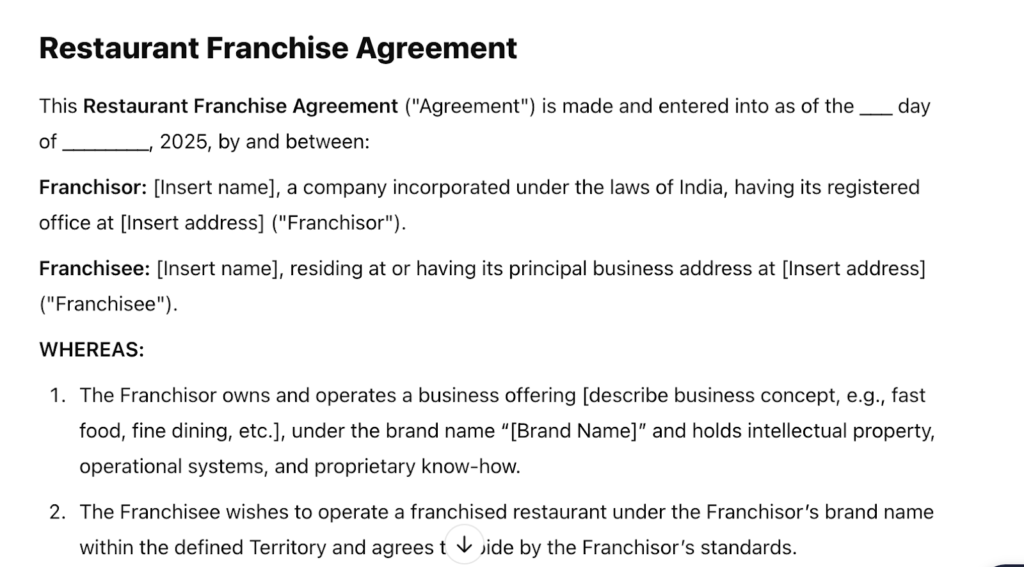
Restaurant Franchise Agreement Template in India

This template is just the beginning. To make sure your agreement is legally binding and enforceable, it’s a good idea to have a professional who knows Indian franchising laws take a look at the document. They can help customise it to fit the unique needs of your restaurant brand.

To Conclude,

A solid Restaurant Franchise Agreement is key to safeguarding your brand and building an effective collaboration in India’s vibrant restaurant scene. If franchisors and franchisees focus on the essential elements, stick to the legal guidelines, and embrace best practices, they can create a business model that’s both sustainable and profitable.

If you’re thinking about franchising your restaurant in 2025, it’s a good idea to chat with legal experts at Sparkleminds. They can help make sure your agreement is in line with the latest trends and regulations in the industry. A strong franchise agreement serves as your success’s road map and is more than just a written document.

Loading