How Cloud Kitchen Owners Demonstrate Fast, Low‑CAPEX Growth

Written by Sparkleminds

Overview: The Growth of Cloud Kitchen Business

India’s food business has seen a paradigm shift with the development of cloud kitchens. These delivery-only kitchens, without any dine-in area, have moreover, formed the backbone of modern food entrepreneurship. The benefit to investors is they can grow fast with little capital expenditure (CAPEX).
cloud kitchen business

Nonetheless, the phrase cloud kitchen company expansion is not just a buzzword, it is a new age of food service growth. Also, in this article, we look at how cloud kitchen operators deliver fast, low-CAPEX growth that makes them attractive to investors and partners.

What is the Cloud Kitchen Model?

Cloud kitchens are set on efficiency. They do not incur the expenses associated with fantastic real estate, decor, or front-of-house staff, in contrast to conventional restaurants.

  • A strategy that prioritises delivery involves concentrating on online orders through the use of programs such as Swiggy and Zomato.
  • Shared kitchens: Rent the facilities as well as lower overhead.
  • Multi-brand operations: Operate multiple cuisines under one roof.

This lean model offers a platform for quick growth.

Low CAPEX Advantage

Conventional eateries require large upfront investments. Therefore, cloud kitchens invert the equation.

  • Low infrastructure costs: No need for fancy décor or also vast eating space.
  • Flexible locations: Kitchens are proper in industrial zones, or residential clusters.
  • Cost effective scalable units: Each kitchen unit is scalable.

For investors, the low-CAPEX model of the cloud kitchen business for expansion offers quicker profits as well as less risk.

Technology as a Driver of Growth

Cloud kitchens are by technology.

  • POS Integration. Easier order handling.
  • Data analytics – Track your customers’ preferences and also refine your menus.
  • For delivery logistics, it is an advice to collaborate with aggregators.

The use of automation tools can help reduce errors caused by human intervention and also increase productivity.

Multi Brand Strategy

One of the most exciting things about cloud kitchens is running numerous brands off of one kitchen.

  • Cross-cuisine options Pizza, biryani as well as healthy bowls under one roof
  • Targeted marketing: Each brand targets a particular audience.
  • Shared resources: Shared staff, ingredients as well as equipment help minimise expenses.

This technique enhances the growth of cloud kitchen business by optimising the income streams.

Evidence of Growth

Investors want to see some client momentum. This is an illustration by the cloud kitchen owners through:

  • High order volumes: Steady demand on delivery systems.
  • Repeat customers: Subscription models and loyalty schemes.
  • Good reviews: Swiggy, Zomato and Google ratings.
  • Social media engagement: A strong presence generates brand trust.

Demonstrated demand lowers investor risk and guarantees scalability.

Transparency of Finances

Understand the financials. The owners of cloud kitchens say,

  • Unit economics – Cost per order, margins, breakeven timelines.
  • Revenue growth: Growth month-over-month.
  • Cash flow management – Efficient payment of receivables from vendors.
  • Scalability: Profitability is easily replicable in new kitchens.

Cloud kitchen business expansion needs transparency to create investor confidence.

Efficient Operations

Scalability is driven by operational excellence.

  • Standardised recipes Outlets consistency.
  • Stable sources of raw materials are essential to the resilience of supply chains.
  • Training for staff: Qualitative results are achieved by skilled teams.
  • Decrease the amount of waste produced and decrease costs through inventory management.

Investors are reassured that growth would not compromise quality due to efficient operations.

Compliance and Monitoring

Regulatory compliance is required.

  • Licenses: GST registration, FSSAI registration.
  • Certifications such as HACCP or ISO, as well as food safety laws.
  • The reporting of transparency and ethical procurement are both aspects of corporate governance.

In the progression of the cloud kitchen business, compliance not only indicates professionalism but also reduces the risk of legal complications.

Models of Scalability

Cloud kitchen owners have clear avenues for expansion.

  • Franchise opportunities: Partner models with ROI clarity.
  • Expansion to multi-city: Tier 1 and Tier 2 cities.
  • Product diversification : Packaged foods, ready-to-eat meals.
  • Aggregator partnerships: Partnerships with delivery platforms

Scalability models indicate long term growth potential.

Investor Friendly Documentation

Professional documentation lends credibility.

  • Business plan: Vision, strategy and plan of action
  • Market opportunity, financials, scale. Pitch deck.
  • Case Studies: Success Stories from Kitchens Today.
  • Franchise Disclosure Document (FDD): Terms and obligations for partners

The paperwork is serious and demonstrates that the organization is prepared to receive investment.

Environmental Sustainability and Innovation

Contemporary investors prioritise sustainability.

  • Sustainable packaging incorporates reduced plastic content.
  • Waste management encompasses appropriate disposal and recycling practices.
  • Energy conservation: Intelligent appliances diminish expenses.
  • The innovation pipeline encompasses forthcoming product launches and service improvements.

The justification for extending the cloud kitchen enterprise is reinforced by sustainability.

Future vision

Investors want to see beyond the short-term gains.

  • Indian Food Concepts Going Abroad: Global Ambitions.
  • Exit tactics include initial public offerings (IPOs), acquisitions, and buyouts.
  • The continuous development of products and services is known as the innovation roadmap.
  • Creating long-term relationships with clients is the key to customer loyalty.

When investors are given with a long-term vision, they become more confident that the growth will continue.

Conclusion

Cloud kitchens are the future of food entrepreneurship in India. They are appealing to investors because they can demonstrate rapid, cheap CAPEX growth. The owners of cloud kitchens demonstrate market fit, financial transparency, operational excellence, compliance, scalability and sustainability to prove to be ready for expansion.

For entrepreneurs, cloud kitchen business expansion is not only about growth – it’s about building investor confidence, raising funds, and scaling sustainably.


Loading

Is Cloud Kitchen the Answer to Your Food Business Growth?

Written by Sparkleminds
Cloud Kitchen for Food Business Growth Sparkleminds

The economy of the country has already been graphing down the line due to lockdown and people have lost their jobs, their investments, and savings, yet it has been quite difficult for the middle-class and the poor section of the society to cope up with the current situation. But the Business scenario has also been grim with core sectors like food and beverage being hit hardly by the pandemic. Not only has there been increasing cost of raw materials and manpower but also technology and changing consumer preferences have forced all the traditional food businesses either to shut down or align themselves with the changing time.

Nevertheless, the lines quoted by Gerg Kincaid – “No matter how much falls on us, we keep plowing ahead. That’s the only way to keep the roads clear.” literally gives a sense of hope to overcome the quandary we are becoming resigned due to the current situation people are facing. Despite such a scenario, the new kind of ideas and innovations with the help of upgrading technology have smartly been coming up to vanquish and defeat the negative impact on the economic condition of the pandemic which has been pretty strenuous. Looking at the miserable condition of the food and beverage sector, with the highest expectations on hygiene, safety the burdensome regulations and now the pandemic has threatened the restaurant industry and traditional business models are all now looking up to shining armour their saviour and that is the cloud kitchen

Cloud Kitchen a new change-

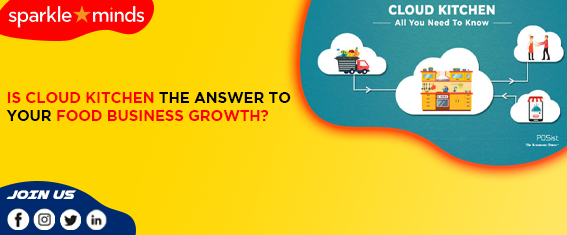
A new concept introduced in the food industry as Cloud kitchen also referred to as ghost kitchen, virtual kitchen commissary kitchen or dark kitchen they have different names but they refer to a new model where it is a delivery-only restaurant that has no physical space for dine-in. As the global cloud kitchen market size was valued at $0.83 billion in 2019 and is anticipated to reach $2.23 billion by 2027 with a CAGR of 13.4% from 2021 to 2027. The market is expected to see the highest demand share coming from China and India, which currently hold more than 50% market share. The main focus of the Cloud Kitchen is in food preparation and delivery rather than anything else. There is no perturbation about table management, location, decor, etc, which further saves your business running cost with lesser space and staff. One of the biggest advantages and fact is the ability to target multiple segments of markets simultaneously. You could be running multiple brands out of the same kitchen, and serving various demographics at the same time, while benefiting from economies of scale you can also run into brands out of the same kitchen. It is also very flexible and assessing to the leads to lower costs, better efficiency, and reduced risks. The lack of a physical storefront makes it toilsome to build a natural customer. There is also a major dependency on aggregators to facilities delivery making it crucial to develop an independent digital presence. The curator’s desire to deliver the experience in a box is also a challenge as it depends not only on the packaging but also on the caution with which the food is delivered.

Metrics aside, much of the hype around cloud kitchens is being driven by changing preferences. For long, delivery was synonymous with pizza, or Chinese.

Now, with cloud kitchen companies rapidly expanding their portfolios, customers have a bigger plate to choose from.

Revenues of Cloud Kitchen Vs Traditional Restaurant Models

If you are a restaurateur looking to make comparable revenue from a cloud kitchen model, there needs to be the recognition that revenue per store at a cloud kitchen is typically much lower than the revenue generated by one 50 seated dine-in restaurant. It may take about 4 or 5 successful cloud kitchens to attain a similar top-line as that of one dine-in restaurant. Or you need to be able to have a very strong digital marketing program and spend intelligently to keep the audience engaged in your catchment area, when this is done, the top line can surely soar to different levels Even if you run a multi-brand format from one cloud kitchen, the revenue generated from those individual brands will not be comparable to the revenue of one dine-in restaurant if the digital activity is not done correctly. The stagnation in revenue has meant that even high-street restaurants, once dismissive of cloud kitchens, are willing to change tack. A successful restaurateur understands the importance of both and uses them both for driving revenue.

Cloud Kitchen- Pre COVID and Post COVID.

An obligation to reduce non-essential outdoor activities, and an increased supply of cloud kitchens in both existing brands and new entrants will accelerate the pre- Covid trend of ordering in and takeaways, and become a permanent shift post-crisis,

With the coronavirus lockdown keeping restaurants closed and would-be diners at home, takeaway meal options have been booming in India. And there are signs that the shift toward home-delivered food is here to stay. Cloud kitchen has better suited to the needs of socially distanced customers than traditional dine-in restaurants. They’re also able to minimize some costs, such as rent, and without wait staff require fewer people on the payroll.

Demand for cloud kitchens will emanate from fatigue with home-cooked food and the need to order once in a while, though frequency will reduce due to income effect. Working professionals will use the options very frequently as it gives them the independence to focus on other activities beyond the kitchen.

Earlier, the contribution by cloud kitchens was estimated to be 20 percent of the food delivery market. However, this percentage is changing and will undergo drastic changes in the favour of cloud kitchens.

As the food industry has undergone a tectonic shift which is likely to continue in the near future, the option of ordering food through apps has boosted cloud kitchens.

When the food delivery company, Swiggy started cloud kitchens three years ago, it had been a sideshow in its food delivery business. The concept caught on as restaurant brands that had a following in one area could expand easily into new localities or maybe other cities. Investment in land was reduced because these kitchens might be smaller and didn’t need premium locations, aside from doing away with seating and therefore the staff for serving. And now Swiggy has co-created nearly 200 brands since the launch of this model using existing kitchens of restaurants in February

Various models arose. Some introduced cloud kitchens additionally to restaurants for expansion, like Chennai’s Buhari becoming available in Coimbatore. Others like Rebel Foods created fully virtual brands that only came from dark kitchens. This became a replacement land and services play as restaurants only had to supply cooking staff while everything else, including cleaning and maintenance, might be outsourced.

 The current plot of Cloud Kitchen

It’s a grim reality that many restaurants will go out of business. Every restaurant is currently in survival mode. In the short term, it will become critical for traditional restaurants to pivot to delivery for survival. Even if they do make the pivot, many still will not make it. In the current environment and with the continued uncertainty of the COVID-19 pandemic, cloud kitchens or food and beverages outlets backed by a cloud kitchen network have a better chance of survival and are likely the future of the food industry.

Most research and consulting reports on Indian cloud kitchens suggest that market size is expected to be about $1 billion by 2023 with a healthy double-digit growth rate every year, points out Narendra Singh Dahiya, Founder and Director, Home food, a mobile application for home food made by home chefs. Hence it is imperative for all food business owners to look at franchising their business and pivoting to a cloud kitchen as an extension of their business or maybe as a newer brand serving newer customers with the same old promise of quality and service now at your doorstep.

For the business seeker who is exploring to buy a food franchise in India, you may want to look at brands who are offering a successful cloud kitchen franchising model for sale which hasa strong tech backing and a very robust supply chain in place.

 The restaurant is an old age vintage car, used for showcasing and branding. On the other hand, cloud kitchen is its fast-paced futuristic- high-tech cousin.


Loading