How to determine if your business is franchisable?

Written by Sparkleminds

It takes careful consideration of a number of elements to establish whether or not a firm is franchisable in India. Despite the fact that no two businesses are alike, you can take some measures to determine your business’s potential for franchisability.

Our blog will take you through insights into how to determine if your business is franchisable, steps to franchise your business in India, how to make your business franchisable in India, and more.

Do You Have a Franchisable Business in India?

If you have a successful business and think it is the right time to expand your business in India, there are some key factors to consider which will help you decide if you have a business that is franchisable in India.

9 Crucial Steps to Assess the franchise potential of your business in India.

1. Business Model Evaluation

Consider whether your business model can be easily copied into other settings. Franchises are popular because they offer a tried-and-true business model that can be easily adopted by new owners. Check to see if your company has well-defined procedures, detailed how-to guides, and a proven track record.

2. Conduct a thorough Market Analysis

You need to do a thorough market analysis of the potential and demand for your business in various parts of India. Determine buyers’ availability and the competition’s strength for your goods and services. Think about the tastes of potential customers, the makeup of the general population, the state of the economy, and the influence of local culture.

3. Costs & Benefits of Franchising

Consider the costs and benefits of franchising to see if your firm is ready to expand. Find out how much money you’ll need to get started, how much it will cost you monthly, and how much you could make. Evaluate the franchise model’s potential profitability, considering the franchisor’s and franchisee’s fees and royalties.

4. IP Protection

Think about whether or not your company has any distinctive intellectual property that could be licensed or patented. Protecting one’s intellectual property is essential to any successful franchise system’s upkeep of brand integrity and recognition. Protect your company’s interests by conferring with a lawyer who specializes in intellectual property law.

5. Scalability & Replicability

Think about how simple it would be to expand your company to new places. Determine if your company strategy can be taught to franchisees in a simple and repeatable format. Franchise growth relies heavily on franchisees’ ability to successfully reproduce the business.

6. Consider the Legal & Regulatory Framework

Learn about the franchise system’s rules and regulations in India. Get familiar with the Franchise Agreement, the Franchise Disclosure Document (FDD), and other relevant legal documents. Consult a lawyer for help with franchise agreement drafting and regulatory compliance.

7. Adequate support and training provision

Evaluate your company’s capacity to offer franchisees satisfactory training and ongoing support. Franchisees look to the franchisor for direction, assistance in running the business, and regular training and education. Determine if your company has the resources to create in-depth training programmes and sustain a commitment to its franchisees’ success.

8. Brand Strength and Market Recognition

Think about how popular your brand is and how well-known it is. Potential franchisees and customers can be enticed by a well-known and respected brand. Determine if your company has established a reputable brand name that can be used to win over franchisees and win the trust of customers.

9. Consider Pilot Testing your Business

One viable option for testing the viability of your business concept in multiple markets is to launch a small number of company-owned stores in a variety of locations. Collect information, analyse results, and make any necessary revisions before deciding to expand into a new franchise area.

Nonetheless, Consult with professionals like franchise consultants, lawyers, and industry specialists who are conversant with the franchise business in India. They can assist you figure out if your business is franchisable and guide you through the franchising process.

Is Your Business Franchisable in India?

Companies typically decide to start franchise businesses due to one of three resource constraints: cash, personnel, or time. Let us understand in detail how these three challenges can help you decide if your business is franchisable.

Challenge #1: Lack of capital funding

Today’s entrepreneurs face a significant challenge when trying to grow their businesses: a shortage of funding. Furthermore, companies can grow through franchising with little to no debt or equity expense.

Because franchisees front the money for the business’s expansion at the local level, franchising reduces the burden on the parent company’s coffers.

Challenge #2: Manpower

The second challenge to growth is the difficulty in recruiting and maintaining capable unit managers. Business owners regularly spend months on finding and training a new manager, only to have them quit or, worse, be poached by a rival company.

Many of these challenges can be surmounted through franchising since an inspired franchisee can replace a traditional unit manager.

Since the franchisor receives payment regardless of whether the franchisee is profitable, it is much easier to track spending at the store level.

Challenge #3:  Time

Last but not least, it takes time to open a second site. Seek out locations. Do lease negotiations. Make plans for the design and construction. Safeguard the funding. Recruit new workers and provide them with the necessary training. Get some new tools and supplies.

Because of this, the rate at which new units can be opened is directly proportional to the time invested in doing it correctly.

Companies that are short on time (or on manpower) may find that franchising is the quickest route to expansion. This is due to the franchisee’s role as the primary driver of expansion activities.

Indicators to look out for to determine if your business is Franchise-Ready

The prospect of franchising your business to reach a wider audience is appealing, but only if your company is prepared to take on the challenge. There are various indicators that can help you decide if it’s time to franchise your business in India.

Key Indicators are:

  • Do you have an established business model – Your company needs to use a tried-and-true business model. It needs to be successful financially and demonstrate a history of steady expansion. Potential franchisees looking for security and financial success will be attracted to this.
  • Is your brand well-recognized – The success of a franchise model depends on the strength of the brand. Potential franchisees will be more interested in investing in your company if it has established brand recognition, high customer loyalty, and a solid track record. Invest the time and energy necessary to build brand equity in the Indian market to ensure your product or service is well-known and valued there.
  • Is your business Scalable –To be successful as a franchise, you need to be able to implement your business plan in multiple locations. Think about how simple it would be to duplicate your processes and expand your infrastructure. Included in this category are easily transferable processes, SOPs, and support systems that may be handed over to franchisees.
  • Is there a demand for your product in the market – Determine how much interest there is in your products and services in the Indian market. Think about things like the state of the market, the competitors, and your intended audience. There is substantial consumer interest and opportunity for growth in the Indian market, suggesting success for your franchise there.

Key Takeaways of Franchising Your Business in India

  • Should prove to be a strong franchise business opportunity – If your company doesn’t look like a strong franchise opportunity, it doesn’t matter how profitable it is. A novel fast-food offering or a proprietary method of restoring automotive finishes might make for exciting franchise ideas. Franchises only succeed if they inspire entrepreneurial aspirations in would-be business owners.
  • Superior Products & Services to stand out from Competitors – Your franchise, obviously, needs to make an excellent product or service. No one is interested in buying and running a franchise when the key to success is to have the industry’s lowest production costs. That doesn’t mean your franchise can just sell silk stockings, but it implies you need something to set you apart from the competition.
  • Established Trademark – You won’t have much success with franchising your idea unless you have a product or service that can be easily standardized. If you have a successful offering, a sizable customer base, and a flair for the dramatic, it’s time to find some safety nets. In particular, you need to have or work hard to create a powerful trademark.
  • Easy to replicate – The best franchise ideas can be passed on to others. It should be something you can easily articulate to others and that they can pick up on with little explanation. That can be done if your franchisable firm is well-systematized and its procedures are well-documented. The ability to replicate success is crucial for every franchise. That means you need to create a product or service that can be easily duplicated in several locations.

Conclusion,

Franchising your business in India is a long-term investment, so it’s important to put in the time and effort required to ensure success. Consider consulting franchise specialists or business consultants who are familiar with the Indian market in light of these warning indicators.

To know more about how to franchise your business in India, contact our experts at Sparkleminds.

Loading

Become a franchisor in 2023 – Definitions, advantages & disadvantages – A complete guide

Written by Sparkleminds

Want to become a franchisor?  Heard this term many times but wondering, how you can become one.  Here’s a complete guide that will give you a clear definition of a Franchisor, the pros and cons of becoming a franchisor, how to franchise your business in India today, and more about franchising in India.

Who is a Franchisor?

Franchises are agreements whereby one business grants another the right to use its trademark, business model, and other proprietary assets in order to offer its goods and services.

The original company or one that already exists will be the one selling the trademark. The local entrepreneur who invests in these rights is known as a “franchisee,” and the new enterprise is known as a “franchise.”

Understanding What it Means to Become a Franchisor in India

Typically, three payments are made to the franchisor: the initial franchise fee, an annual fee, and a cut of the branch’s revenues. In addition, it can include additional service fees.

There are benefits and drawbacks to being a franchisor, but overall, it is a viable business option, especially for large, established businesses. A franchisor-franchisee relationship is fundamentally that of an advisor and advisee.

Here’s the role of you as a franchisor:

  • The franchisor offers ongoing advice and assistance with basic business decisions including hiring and training employees, opening a storefront, promoting its wares, securing supplies, and so on.
  • The franchisor’s role as a guide does not end once the partnership has been established and mutual success has been achieved.
  • Some franchisors are more vigilant than others in monitoring their franchisees to ensure that they are upholding the standards, quality, and values of the parent company.

Benefits of Franchisor

Now let us understand what are the benefits of a Franchisor in India are.

1. Opportunities for Growth

Franchising is frequently used by multinational corporations to increase their presence in new markets throughout the world by tapping into the expertise of franchisees in those regions.

The franchisor company entrusts the franchisee with the obligation of regional or international expansion and the right to award additional franchises to other businesses.

In exchange for using the franchisor’s tried-and-true business strategy, market dominance, and brand name, the franchisee bears the cost of opening a location and pays royalties to the franchisor.

2. Increased Market Share

Franchising is a great strategy for a business to expand its presence into new markets while also gaining market share with little to no additional investment. Because franchisees are also business owners, they have a vested interest in the success of their locations and must bear the costs associated with running a business, including payroll.

Even if individual franchise locations generate less revenue than they would if they were part of a larger chain, lower operating costs can nevertheless make franchisees more profitable overall.

3. Scalability

Franchise agreements can be tailored for high-volume national expansion or low-volume regional expansion, depending on the company’s needs, resources, and production goals.

4. Additional Revenue Sources

Ongoing royalties paid by franchisees are an extra source of revenue for a franchisor. Depending on the franchise agreement, royalties might comprise a variety of payments beyond the initial starting fee and monthly charge based on a percentage of the franchisee’s gross sales.

Disadvantages of a Franchisor

Every business comes with its own benefits and risks.  Now that we have seen the benefits of becoming a franchisor in India, now it is time to understand the disadvantages.

1. Capital Investment

It takes a substantial time commitment and financial resources to launch a franchise. Developing the business, opening a flagship location, creating legal documents, developing marketing and packaging strategies, and finding and training franchisees are all essential expenses for every franchisor.

2. Risk of Failure

A franchisee may prove to be a bad fit for a number of reasons, such as being irresponsible, difficult to work with, or unable to successfully operate a firm, even if the franchisor has done its due diligence. There are additional possible scenarios in which the franchise loses money. There is still risk involved in investing in a franchise, even if the business model is tried and true.

3. Loss of control

At the outset, franchisees sign contracts promising to adhere to their franchisors’ guidelines regarding training, behavior, and other matters. However, this may not be the case once the novelty has worn off.

Disagreements are inevitable given that franchisees are people with their own views and temperaments; a franchisee could become stubborn or difficult, or they might not be able to implement changes as easily as the franchisor had intended.

4. Legal and Regulatory Costs Can Be Expensive

Legal action may be required if a franchisee refuses to cooperate or otherwise shows to be a bad option; this can be costly and detrimental to a franchisor’s reputation among other franchisees.

In addition, the Franchise Disclosure Document (FDD) and other regulatory documents necessitate the services of an attorney because of state and federal rules regulating franchisees.

Steps to franchise your business in India – Become a Franchisor in 6 easy steps

The best approach to expand your business across all of India is to franchise it. It’s also a fantastic opportunity to supplement your income. Offering a franchise involves entrusting a portion of your business to an unknown individual. That’s why it’s crucial to research the franchisee’s history.

Here are six easy steps to franchise your business in India.

1. Standardization – The term “standardization” refers to the practice of producing identical results consistently. This will ensure that customers at all of the franchise’s locations have the same consistent product flavor.

2. Ensuring a proper distribution network – Since the franchisor needs to ensure consistency across all outlets, it is important to have a proper distribution network, to ensure the same product/services across all outlets.

3. Have a proper support team – The prospective franchisee has to be assisted by a competent team. They will advise the prospective franchisee on the franchise’s history, past achievements, investment requirements, and potential returns.

4. Marketing Strategy – The franchisor should be actively engaged in online activities and have a strong social media presence. The franchisor must set up some funds for marketing the franchise system.

Key Takeaways – Role of a Franchisor in Franchising Business in India,

  • Franchises are agreements whereby one business grants another the right to use its trademark, business model, and other proprietary assets in order to offer its goods and services.
  • Because franchising allows corporations to leverage franchisees’ in-depth familiarity with local markets, it is frequently used by multinationals to increase their presence around the world.
  • A franchisor must allocate funds for research and development, a flagship location, legal document creation, marketing and packaging strategies, franchisee recruitment and training, and operational costs.
  • Franchises are subject to state and federal rules, which necessitate the use of an attorney to create the Franchise Disclosure Document (FDD) and other regulatory documents.
  • Franchisees are typically not protected against their franchisor’s bankruptcy by the terms of the franchise agreement.

Franchise Your Business FAQs

Q.1. How can I become a franchisor of my own business in India?

Once you have analyzed that your business is successful and are looking to expand it across the country, you can become a franchisor of your business with proper planning and strategy in place.

Q.2. Why would a business choose to franchise in India?

Most business owners choose to franchise because it provides rapid growth with less exposure to debt or the need to use equity financing. Since the franchisee is responsible for raising all startup funds for a location, franchising provides a means for businesses to expand without having to put up their own money.

Q.3. When should a business consider the franchising model in India?

Franchises typically only accept businesses that have been established for at least a year and a half. However, that figure may be higher or lower than stated, depending on the sector. In the first two years of operation, franchising can be helpful for some businesses.

Q.4. Is franchising good for small businesses in India?

Franchises have a higher success rate than other company models, but this does not necessarily translate to better profits. Of course, the higher success rate will cost you more in franchise fees. If you don’t have a lot of expertise in the business world, a franchise may be the best option for you.

To Conclude,

Your level of dedication to the franchising process should be the deciding factor in whether or not you take the plunge.

It would be irresponsible for privately held companies to consider not investigating franchising as a growth and expansion option. However, not every company can benefit from franchising as a means of growth. If you’re an entrepreneur thinking of testing out the franchise market, there are a few things you need to know first.

Get in touch with us at Sparkleminds to know how to franchise your business in India.  Our expertise in franchising has helped various businesses to grow domestically and globally.

Loading

Benefits of Multi-Unit Franchising Your Business in India

Written by Sparkleminds

Multi-unit franchising is a good way to ensure long-term growth for your business. Read this article to know more about the Multi-unit franchise business model for your business, its long-term benefits, and how to prepare yourself for multi-unit franchising in India.

Entrepreneurs are now looking at multi-unit franchise models as a surefire way to grow their businesses and take advantage of the growing number of investment possibilities. Eventually, these groups become independent business models and stand on their own.

Multi-Unit Franchising in India – A Complete Guide

The franchise business is always growing, and franchisees are always choosing to own more than one company. Multi-unit leasing is a great way for a business to grow quickly and increase its holdings.

Multi-unit franchises are like single-unit franchises in many ways, except that they have more than one store in the same area. Investors who want to operate a multi-unit franchise must invest more money upfront and over time than those who want to operate a single-unit franchise, but they also stand to gain more from having a larger profit margin.

Since it can be hard for a single business owner to be hands-on at each of their different sites, many choose to hire unit managers to oversee the daily operations at each franchise location. The owner will oversee their network of businesses and report back to the franchisor.

Key Takeaways,

  • One franchisee manages many businesses, typically in the same location, which distinguishes multi-unit franchising from the traditional franchise model. In the past few years, the multi-unit model has become more and more common.
  • When growing their holdings, franchise partners must think about several things, such as infrastructure, resources, franchise systems, the desire for growth, and the bond between the franchisee and the franchisor.
  • Traditionally, multi-unit owners run multiple units in the same area. But there have been cases of franchise partnerships that went beyond countries and boundaries.
  • There are many good things about the multi-unit franchise model for both the franchisor and the entity in charge. This makes it more appealing, which is why the multi-unit trend is growing.

Benefits of Multi-unit Franchising in India

1. Stability

You can choose this type if you want a steady sense of growth. Here, you also have a better chance of being successful because you can make money from more than one place and won’t be dependent on the success of just one place.

2. Building Strong Ties

One thing a franchisor wants to do is build trusting relationships with his or her partners. Those who want to stick with a certain brand or service under a franchise will only be able to do so if they have built good relationships with the owner over time.

3. Risk Taking

Because the plan has already been tried and tested at your first franchise, it makes sense to copy it, and isn’t very risky so, the best thing about you is that you don’t have to start from scratch. Also, you already have a standard operating procedure, making it easier to copy the model quickly in a new place in the same area, unless you have the skills and knowledge to go multi-regional.

4. Easy Returns on Investment

If you want to go the multi-unit franchise route, you can finance yourself with little risk. This is because if you have a set franchise model, you have already built up your reputation and are a safe bet to get money from a public or private bank. When someone has run a business before, banks are more likely to give them money because they know they won’t lose it.

5. Growth Overall

This is a kind of model that makes it possible for the company, the franchisor, and the franchisee to all grow at the same time.  For a multi-unit franchise model, a franchisor will always look for someone who can inspire a large group of people, has a track record of being a manager, can work and come up with new ideas under pressure, has a history of success, and knows the market in their area very well.

Here are some factors Franchisors need to consider before expanding their business into multi-level franchises in India.

5 Factors to consider before expanding your portfolio in India

1. Finance

While considering expansion across the country, it is necessary for franchisors to ask themselves:

  • Do I have sufficient cash flow to keep my current business running while growing into multi-units?
  • How can I find the right investors who will finance my growth?  Will banks be ready to fund my growth?

These are basic questions that need to be addressed before considering expanding into multi-units.

2. Resource

When moving to a multi-unit plan, the franchised units that are already open need to keep running at the same level. Franchisors need to make sure they have the right team in place to run the current unit well while they work on growing the business. Getting a business to grow means letting go of control and giving your team the power to run things on their own.

3. Losses

It is common knowledge that franchisors can expect their first unit’s business to go down as they open more units. What needs to be thought about is the size of that dip. A big drop can hurt both businesses and change how entities work with their franchisors.

4. Growth Capacity

Getting bigger just for the sake of getting bigger is not enough. Franchisors must determine how much the market wants the brand, look at the competition, and check how much people want the brand’s products. Multi-unit leasing is not about being vain, and the goal is not to have a lot of units.

5. Infrastructure

It is important to build a strong front of the house at the place, but it is also important to build a strong back of the house. To stay ahead of the curve, franchisees need to make sure they have the right people in the right places. This includes administrative and human resources workers as well as loss prevention teams. In the same way, it’s important to have enough resources. A common mistake is to have too many resources, which can cause the business to lose money.

Single-Unit Franchising Vs Multi-Unit Franchising in India

Most people know most about franchising through single-unit businesses. Under this plan, an investor in a single-unit franchise pays a set fee to get training and business help from the franchise parent company.

In exchange, the entity signs a contract saying that it will follow the company’s brand guidelines and business growth requirements.

Most business owners who choose to franchise do so because it gives them the chance to build brand recognition, use tried-and-true methods, and work with customers who already trust them.

The franchise plan is liked by both experienced business owners and people who have never run a business before because it gives more help than an independent business would.

There are many similarities between single-unit and multi-unit franchise models, but investors will pay less upfront for a single-unit franchise than a multi-unit business.

Multi-unit franchising is based on the idea that the more businesses you own, the more likely you are to get more people, make more sales, save money on operations, and make more money.

Is Multi-Unit Franchising Right for your business in India?

Multi-unit franchising can be a good choice for business owners with a lot of experience, but it has more problems than a single-unit franchise. Keeping this in mind, it’s important to be careful in your quest and make sure you have the skills, money, and time to make the jump.

Still, if everything is in place, running a multi-unit franchise is a great way to grow your business, make more money, and leave a lasting memory.

FAQs

Q.1. Are there any disadvantages of multi-unit franchising in India?

Every business has certain risks, so the more units you have, the more the risk.  Unless you have experience in leadership it could be more difficult to manage things effectively.  Keeping in mind that you have more than one unit, you need to ensure having sufficient investment as well.

Q.2. What is the advantage of multi-unit franchising for the franchisor?

Multi-unit franchising gives you the chance to build a bigger management team and use them in more than one business. You can also save money on advertising and marketing for all of your sites and make more money by selling more.

In conclusion,

Multi-unit franchising could be a good choice for you if you have the knowledge, experience, and drive to take on challenges. You can build a large business with the help of people, partners, outsourcing, and hard work.

Contact us at Sparkleminds to know how to franchise your business in India right away.

Loading

Tourism Industry Trends in India – Here’s Why You should grow your travel and tourism business in 2023.

Written by Sparkleminds

Recent years, and 2022, have seen significant shifts in the tourism industry because of worldwide events. The Indian economy showed resiliency and growth even while the rest of the globe struggled with rising inflation, interest rates, and a cost-of-living crisis.

The combination of fewer income shocks, robust local demand, and helpful government policies helped India achieve this outperformance.

The growth of India’s tourist sector is expected to continue. Travel bans and vaccine mandates may remain in effect for some time while the world continues to deal with the consequences of the COVID-19 epidemic.

However, there is reason to be hopeful about the future of tourism in the region, as the Indian economy has shown resilience and growth, and as popular places like the Maldives have seen outstanding recovery.

About Travel & Tourism Industry in India – Significance & Rising Trends

With so many unique sights to see and a long and illustrious history, this country consistently ranks among the top tourist hotspots in the world.  Because of its unique history and culture, as well as its varied plant and animal life, the country’s tourism business has flourished.

The tourism industry is India’s eighth largest contributor to GDP. In 2018, India’s tourist industry brought in US$247.3 billion, up 6.7% over the previous year, and accounting for 9.2% of the country’s GDP.

Let us see the key factors driving the rise of the tourism industry in India post-Covid-19.

1. Vaccination Drive

Immunisation efforts against COVID-19 in India began on January 16, 2021. The primary objective of the campaign was to provide all citizens with free vaccinations. Nearly 200,000,000 doses of vaccination were given out in the first 18 months of this programme, proving its success. This helped open up the Indian economy and attract tourists.

2. Wellness and Health Travel

India has a very affordable healthcare system with access to top-tier medical professionals and cutting-edge technology. The health and wellness sector in this country has gained international recognition. Bringing together Eastern healthcare philosophy with Western medical competence, India has seen a significant increase in medical tourism.

In May of 2022, the government of India launched two initiatives called “Heal in India” and “Heal by India.” The overarching goal of these initiatives is to fortify India’s traditional medicine sector and elevate the country to the position of a global medical value hub.

3. The Growth of Domestic Travel

Domestic tourism in India saw a huge uptick in the wake of the outbreak. Rising disposable income and a larger working class in India are likely driving this expansion. Leisure travellers have spent more money in the country than business travellers have.

Apart from these, there are some Government initiatives that also helped the growth of the travel and tourism industry in India.  These initiatives include:

  • Swadesh Darshan Scheme – The Ministry of Tourism started this flagship programme in 2014–15. The program’s objective is to maximize India’s potential as a tourist destination by promoting theme-based tourism.
  • NIDHI [National Integrated Database of Hospitality Industry] – is geared towards enabling enterprises via the use of technology. The scope, scale, structure, and capability of the global hospitality industry are the focus of this programme. 
  • E-Tourist Visas – This programme was first introduced by the Indian government in October 2014. The goal of this initiative is to make it easier for visitors from other countries to get tourist visas. As a result of this programme, tourism in the country has increased.
  • Advertising via campaigns – Through its ‘Incredible India’ campaign, the Indian government has encouraged international travel and brought international attention to India’s storied cultural traditions. The campaign’s ultimate goal is to increase foreign interest in visiting India.

Future of Travel & Tourism Industry in India – Why 2023, is the right time to grow your tourism business?

The World Travel & Tourism Council (WTTC) predicts that by 2024, the travel and tourism industry in India would have contributed more to the country’s economy than it did before the pandemic began.

The travel industry can expect a number of new developments in 2023 thanks to the restoration of normalcy and the subsequent increase in tourism.

Travel Trends in 2023 – Here’s What to look out for.

1. Indians will make travel a priority.

In 2023, Indian tourists are expected to spend more than any other nationality. In addition, there are still a lot of people at well-liked tourist destinations, and flights are selling out quickly.

Weekend trips will increase in popularity this year as a means of vacationing. Those between the ages of 23 and 40 are the most likely to indulge during their vacations.

2. Currency fluctuations

Currencies are very volatile because ongoing wars, war hysteria, and pandemics all influence economies. Even with advanced reservations, the fluctuating value of the Indian rupee means that travel expenses can easily derail a traveler’s well-laid-out spending plan.

3. Discounts and special offers can really boost traffic

Before committing to a primary service provider, customers investigate available discounts and special offers. Now that money isn’t just a means of payment but also a commodity to be traded, it’s crucial for travel companies to be listed on the platforms of money service businesses if they want to remain competitive.

4. “Save while you spend” is a way to plan a trip

This option will remain popular.  Travelers have grown accustomed to the concept of “travel now, pay later” during the previous two years. Fear of another pandemic-like crisis prevents most people from spending their savings on vacation, even when they wish to do so.

That’s why it’s reasonable to spread out the cost of a trip across several installments. This way, after using the services, people don’t have to worry about spending all their savings.

5. The demand for travel agencies will rise.

The travel industry is expected to grow as a result of rising demand, although the offline segment (bookings made through traditional travel agents) is expected to grow at a faster rate and capture a larger share of the market.

Travel agencies will need to increase their spending on web technologies to make bookings easier for customers if they want to survive. Largely due to POS solutions and technology, this will allow airlines to concentrate on features like self-service, touchless travel, biometrics, and artificial intelligence.  

Also Read: How the travel market globally is also showing rapid growth and the factors driving this growth.

Key Takeaways,

Despite the operational challenges that were faced by the Travel & Tourism Business in India, post-pandemic, travel is back to where it was before the pandemic. Travelers would be expected to go to all parts of the world, even if that means splurging sometimes.

Planning would seem to be a regular theme.  So, doesn’t it look like a promising opportunity to grow your tourism business in India now?

Tourism Business in India FAQs

Q.1. What is the travel industry growth rate in India?

The travel and tourism industry is expected to generate $18.91 billion by the end of 2023. With a compound annual growth rate (CAGR) of 13.47% from 2023 to 2027, the market is expected to be worth US$31.35bn by that year.

Q.2. What is the future of the travel & tourism business in India?

The travel and tourism sector is becoming more forward-thinking as a result of the incorporation of new travel trends into the sector’s ecology, making travel more accessible to the general people. Most transactions now take place digitally, and most users prefer contactless payment options.

Q.3. What is the future of travel agency business in India?

The travel business will always have to adapt to new trends and a changing environment. Online booking has been a big reason why travel agencies have gained so many customers.

Q.4. Is the travel and tourism business profitable in India?

One of the most profitable companies in the tourism business is a travel agency. At the same time, to grow a business in the market, you need a good plan and other things.

Q.5. Why is it important to grow your tourism business in India in 2023?

It makes up 6.23 percent of the national GDP and 8.78 percent of all jobs in India. Nearly 20 million people now work in the tourism business in India.

To Conclude,

The Indian government has invested much in infrastructure improvements to attract more tourists, and this trend is expected to continue. The FICCI predicts that by 2027, India’s tourism industry will be worth US$ 125 billion.

Contact us at Sparkleminds, if you are one of those successful business owners looking to expand your travel & tourism business in India in 2023.

Loading

Complete Guide to Drafting the Perfect Restaurant Franchise Agreement in India

Written by Sparkleminds

There are currently over 3,800 Indian franchisors offering a wide variety of franchise opportunities in the country. Businesses in the food and beverage, academic, retail, health and wellness, and consumer service sectors, among others, often turn to franchising as a means of expansion. One of the largest sectors of the franchise industry is the food service industry and obviously, the search for the perfect restaurant franchise agreement in India sample PDF draft is very high.

Nevertheless, F&B is the largest and fastest growing in the market.  Let us understand Restaurant Franchising in India, how you can draft the perfect Restaurant Franchise Agreement for your business, and all the legalities involved, and create the best food franchise agreement in India for your brand from the best food franchise consultants in India.

Restaurant Franchise Agreement Sample in India

Why do you need a Restaurant Franchise Agreement in India?

In exchange for financial investment, a restaurant might provide another business with the right to utilize its brand, including its name, recipes, design, trademarks, and logo.

Moreover, the agreement specifies the terms and conditions for the franchisee to follow, including those pertaining to the menu, the style and layout, the service, the employees, etc.

Popular Indian brand owners with a sizable client base are pursuing the franchising model, just like their counterparts in the worldwide food industry.

Some of the most well-known Indian franchises are Barbeque Nation, Moti Mahal, Haldiram, Sagar Ratna, and Swagath. These restaurant franchises have established themselves as leaders in India’s food and beverage sector.

Essential Elements of Restaurant Franchising in India

The specifics of franchise agreements vary depending on the company. Nevertheless, these contracts should include the following standard provisions:

1. Scope of the business

The franchise agreement should detail the business, its extent (geographic, temporal, etc.), and the length of the franchise.

Franchise agreements should specify if the business is a fine dining establishment, a cafe chain, a takeaway or fast food restaurant, a pizza shop, a mobile food vendor or a kiosk.

As the agreement’s prologue, this provision is essential since it will be used to determine the parties’ actual intentions.

2. Location

Provision of the franchise location is assigned by the franchisor, using the franchise agreement. The two types of territories are exclusive and non-exclusive.

In an exclusive territory, the franchise cannot sell the products beyond the boundaries specified.  Non-exclusive territory means the franchise can add multiple units within the same territory.

3. Contract Term & Contract Renewal Clause

The duration of a franchise agreement, both during its first term and any subsequent renewal terms, is specified here. A franchisee is granted permission to run the franchised unit during the specified term of the agreement.

The franchisee may, according to the terms and circumstances set forth in the agreement, renew the franchise under its terms and conditions.

4. IPR, Licensing and Confidentiality

The restaurant that is offering the franchise should lay forth the parameters, guidelines, and conditions for the use of IPR. The franchise agreement contains safeguards designed to prevent the franchisee from undermining the brand’s reputation and market value through improper exploitation of the franchisor’s intellectual property.

5. Franchising Fees & Royalty Fees

The franchisee’s initial and ongoing non-refundable franchise fees, as well as any other one-time fees, must be specified. Payment terms, including frequency and method, must also be specified.

It is also important to include royalty clauses that specify the amount (typically expressed as a percentage) of the franchisee’s payment to the franchisor that is non-refundable.

6. Termination Clause

Default and termination provisions for the franchise agreement should also be included in this clause. Defaults such as a major breach of the agreement, a party’s legal inability to implement the agreement, a party’s bankruptcy or insolvency, or a change in the legal or regulatory environment in the country may be grounds for termination.

7. Dispute Resolutions

In the event of a dispute between the franchisor and the franchisee, the parties agree to submit their differences to the court with jurisdiction over their location. In the event of a dispute, the parties should include an arbitration clause outlining the location of the arbitration, the institution that will hear the case, and the procedures to be followed.

Legal Provision to be Included in Restaurant Franchise Agreement in India

There is no overarching law in India that regulates franchising generally. But there are provisions in several Indian companies and industry-specific legislation that can help you out with different parts of running a franchise.

A general principle of good faith and fair dealing is adhered to in place of the absence of any specific requirements for any pre-contract disclosure and any legislative responsibility to offer any information to the potential franchisee under Indian law.

Below are some of the basic cafe franchise agreements and food franchise agreements in India terms and conditions that need to be included.

1. Franchise Agreement Validity and Enforceability

In legal terms, a franchise is a contract between two parties. Therefore, the Indian Contract Act, of 1872 (the “Contract Act”) may apply to franchise agreements depending on the specifics of the deal. The following are some of the requirements for a contract to be valid under the Contract Act:

  • Proposal
  • Offer Acceptance
  • Explicitly permitted by applicable law
  • lawful intent and use;
  • Agreement based on mutual consent;
  • How legally competent the parties are to enter into the agreement;
  • Legality.

For a Franchise Agreement to be enforceable in court, it must comply with the requirements set forth in Section 10 of the Contract Act.

Although the Contract Act does not require a contract to be in writing, it is nonetheless best practice to have a written franchise agreement that specifies the rights and obligations of each party.

2. Protection of IP rights

In most cases, the rights to use a trademark, logo, service mark, or trade dress belong to the franchisor (think McDonald’s or Barista Coffee), and this means that the parties to a franchising agreement must consent to the transfer of these items.

Given the centrality of the intellectual property license to a franchise, intellectual property licensing rules should be carefully considered when drafting a franchise agreement for a food service establishment.

Several laws, including the Trademarks Act of 1999, the Patent Act of 1970, the Design Act of 2000, and the Copyright Act of 1957 address this issue. The franchise agreement’s trademark, patent, design, copyright, etc. are all subject to these laws.

Registration under the Trademark Act safeguards the distinctive symbol used to identify a product or service.

3. Rivalry and unfair business tactics

Production, supply, distribution, storage, acquisition, or control practices that may have considerable adverse effects on competition within India are illegal under the Competition Act, of 2002.

The agreement should be checked for any antitrust or restrictive trade practices that could limit competition in the market and lead to the establishment of a monopoly.

Agreements involving restrictive trade practices in the provision of services or in the production, storage, supply, distribution, or control of commodities are required to be registered with the Director-General under the Monopolies and Restrictive Trade Practices (MRTP) Act, 1969.

The franchise agreement mandates that neither party engage in monopolistic or restrictive behaviour.

4. Responsibility under the Tort Law

Any party to a franchising arrangement (franchisor or franchisee) may be held liable for the other’s (or a third party’s) losses or damages if they breach a duty owed to the franchisee or to the franchisee’s customers.

5. Corporate and tax liabilities

If the franchisor and franchisee are both registered in India as corporations, they must follow all laws and regulations pertaining to corporations in that country, including the Companies Act, 2013.  The company’s directors may be held accountable for their decisions.

6. Consumer Protect Act 2019

The Consumer Protection Act of 2019 provides various protections for consumers against deceptive business practices. Customers have recourse both against the franchisee and the franchisor in the event of a product or service failure.

7. Labour & Property

Real estate and leasehold law play a significant role in the franchising industry. Different labour laws would apply depending on the terms and conditions of the legal connection between franchisor and franchisee regarding franchise business activities.

The franchisees in restaurant franchises are considered independent contractors since they make all the important decisions including who to hire and how much to invest in the business.

8. Arbitration and Conciliation Act, 1996

Any time a disagreement needs to be resolved, the Arbitration and Conciliation Act of 1996 comes into play. If a dispute arises between the Franchisee and the Franchisor, arbitration is an option for resolving the problem.

Also Read: How Sparkleminds can help in solving disputes through Mediation and Arbitration

Types of Restaurant franchise agreements in India

These include:

  1. Master Franchise Agreement
  2. Single Unit Franchise Agreement
  3. Multi-Unit Franchise Agreement
  4. Company-Owned Franchise Agreement

Each of these franchise agreements has a different purpose but will have some common terms applicable to the other party.

Conclusion,

Even without corresponding legislative or regulatory reforms, the restaurant franchising industry has grown rapidly over the past three decades. Despite the restaurant franchise industry’s meteoric rise and bright future in India, we lack sector-specific legislation and regulation.

There are no rules governing the establishment and operation of franchise restaurants, so the agreement between the parties must be comprehensive, including provisions from all applicable laws.

The costs and delays associated with protracted litigations can be avoided with the help of a thorough agreement that includes all the relevant clauses in the event of a conflict of interest.

Get in touch with our experts at Sparkleminds to know how to draft a franchise agreement for a restaurant in India.

Loading

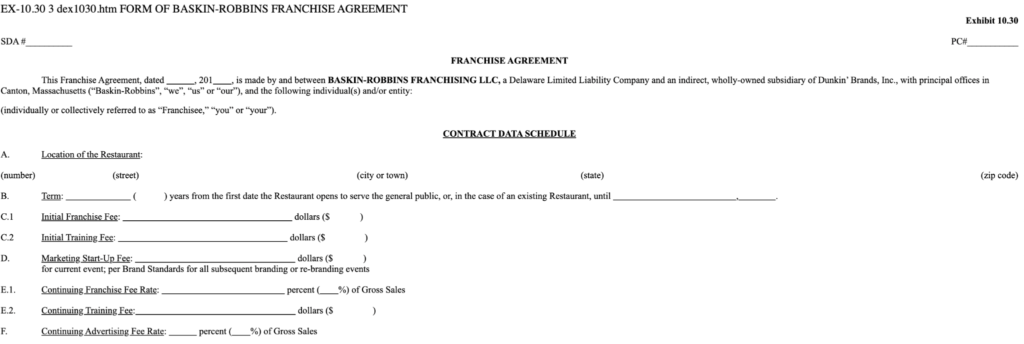
How to draft an Indian Franchise Agreement?

Written by Sparkleminds

This article will lead you in learning about the creation of a franchise agreement in India and what to look for in one. Do you want to own a franchise in India, first and foremost? If the answer is yes, you should know roughly what to anticipate in a franchise agreement before establishing your business. You won’t be able to run the franchise without any glitches or hurdles at all until you know what to anticipate from an Indian franchise agreement or contract.

How to draft an Indian Franchise Agreement?

To create a strong franchise agreement, you must hire a lawyer. A solid franchise agreement also serves as a safeguard for the franchisor and the franchisee and establishes the groundwork for the success of the franchise. The franchise agreement is one of the most crucial legal documents when it comes to franchising in India because it formally establishes the partnership between the franchisor and the franchisee. In the absence of this agreement, many business-related risks, hiccups, or system breaches could occur accidentally or on purpose by all parties, harming the brand’s reputation. In short, the franchise agreement describes and defines the franchise relationship, outlining the duties and responsibilities that are set forth by both the franchisor and the franchisee.

Who Writes the Franchise Agreement?

Although the franchisor prepares the franchise agreement, the franchisee is also permitted to review the terms before signing. As a result, the franchisee must carefully study the agreement and comprehend the entirety of the contract. They should also obtain guidance from a reliable lawyer during the verification process to gain peace of mind. But if a change is necessary, the franchisee must seek permission from the franchisor. The partnership will be officially established once all the agreements have been agreed upon by both parties.

How long does it take to write a Franchise Agreement?

There are two stages to creating a franchise agreement: ideation and preparation, followed by planning and actual writing. The initial effort begins with figuring out the costs and writing the specifics of the contract, such as the terms, renewal conditions, and transfer of ownership. Consider both parties’ preferences while choosing these dates. Data and figures in the franchise agreement should be carefully considered benefiting the franchisor.

A franchisor shouldn’t think about charging a reduced cost of 2% to distinguish his brand and make it more marketable when it comes to settling the royalties in the franchise agreement. The fees and percentages are necessary to adequately cover the costs and services such as store opening, staff salaries, store visits, and more, therefore franchisors should take this into account if other businesses are charging a 3% royalty.

The preparation of the franchise agreement typically takes up to a month, giving the lawyer time to thoroughly review all the specifics before the deal is signed. Although the franchisor may have a lawyer represent them throughout the entire process, it is also advisable to consult a franchise expert or a specialist in this area. Sparkle minds can aid and support you in this situation.

What should be included in the Franchise Agreement?

Different types of businesses can add more information based on the nature and demands of the firm, however, it often contains the fees and payment structure, duration and renewal terms, training, and transfer of ownership. Overall, the information provided in the document should have value to both parties and should be carefully examined before being signed. Once all the facts are known, the relationship between the franchisor and franchisee will function effectively, and both parties will be satisfied, as this is an efficient way to ensure a solid legal contract and a long-term association.

Fundamentals in Franchise Agreement

10 introductory provisions to include in all franchise agreements.

Location Site / Region

The franchise agreement should mention the area in which your business will be functioning, along with defining the company’s exclusive rights.

Operations

This is a section in the contract which will explain how the concerned franchisee will run and operate the business.

Training Support

Generally, most franchisors offer training followed by training plans to the franchisee.  Usually, the first training for the franchisee is conducted at the Head office or corporate office and then on-site.  Furthermore, the agreement would also highlight managerial as well as methodological support information.

Duration

How long the franchise agreement or contract is valid, will be stated in the franchise agreement.

Franchise Remuneration / Investment

The first initial fees also known as the preliminary franchise fees are mainly charged to the franchisee in advance.  This grants the rights to the franchisee to use the brand and the operating system of the franchisor.  Such costs will be outlined in the franchise agreement itself.

Royalties / Ongoing Fees

Most franchisors charge ongoing royalty fees, which are mostly a fraction of the entire sales, charged monthly.

Trademark / Signage / Patent Rights

This defines the terms on how the franchisee is allowed to use the trademark or brand signage.

Advertising / Promotion Activities

An advertising contract is part of this legal document which defines what amount would the franchisee needs to pay for advertising or marketing the brand.

Renewal / Termination / Cancellation Policies

All of these would be expressly stated in the agreement, including how the contract would be renewed, the reasons for contract termination, and what would happen if the franchisee decided to terminate the policy. This is a crucial clause that the franchisee must carefully examine. If a dispute is likely to arise, the franchisor may also include an arbitration clause that must be taken into account by the arbitrator before proceeding to court.

Exit Clause / Strategies

Reselling policies vary by franchise. Some let franchisees sell the franchises they want. Other agreements have repurchased or first refusal clauses. These enable franchisors to repurchase franchises at predetermined prices or to compete with offers from interested buyers.

To Conclude,

The steps involved in creating the necessary documents and content buckets for a franchise agreement have been addressed. In addition, we discussed who is qualified to write a franchise agreement and how long it takes to do so. You should thoroughly study the final agreement before signing it if you want to keep this connection going, whether you’re the franchisor or the franchisee. You can get assistance and support from sparkle★minds with the essential paperwork for your venture.

Loading

Franchise marketing plan for your business for 2022

Written by Sparkleminds

Every franchisor would love to see their business flourish across markets. More the number of franchises, the better the results in terms of the success of the brand and returns. Franchising establishment is just one part of the story. To grow your franchise from time to time, it is important to market your business accordingly. To attract franchisees constantly, it is a good practice to market the brand constantly.

Marketing has changed dynamically. In today’s world, getting to your target audience has become easier than ever. With tech advancements, marketing has transformed the way people connect with each other.

Before we plunge into a franchise marketing plan, we should characterize a couple of key terms. Franchise marketing is how the franchise as a whole promotes the brand to the public and customers.

•             Advertising: which means to support your image

•             Publicizing: which is paid advertising that advances your image or offering

•             Deals advancement: which offers arrangements to bring deals to a close

•             Sales: which is advertising designated at a particular individual or business

•             Individual selling: which is the point at which a salesman offers a thing to a client

Franchise marketing plan is split into the following:

Franchise Development Marketing

Franchisors participate in this kind of marketing to assemble a business that potential franchisees in new business sectors will need to put resources into.

1.            Build a solid brand that clients will perceive and need in their location

2.            Establish trust and validity as a business that franchisees need to collaborate with

3.            Convey the skill and information your business has so new franchisees have a solid sense of reassurance contributing

Operational Franchise Marketing 

Both franchisors and franchisees utilize functional franchise promotion. To start with, it plans to win new leads and clients for the business. Advertisers utilize special techniques like Paid-Per-Click (PPC) publicizing, nearby Search Engine Optimization (SEO) crusades, and disconnected showcasing systems like TV promotions for this objective. It expects to keep clients connected so they make a recurrent buys. Advertisers use methodologies like email promoting, designated virtual entertainment crusades, faithfulness clubs, and selective proposals for this objective.

It also plans to increment brand mindfulness so individuals come out as comfortable (and hence OK) with the brand. However, there are many ways of building brand mindfulness, numerous organizations center around advertising, neighborhood SEO, informal exchange promoting, local area-based showcasing, and audits.

Healthy Google business page

Whenever shoppers are searching for a neighborhood business, they frequently start their purchasing venture with a hunt. 46% of all Google looks have neighborhood expectations, as a matter of fact. Subsequently, it’s important that your business positions high in the list items – on the off chance that you don’t, individuals will struggle with tracking down you. They’ll probably pick a contender who positions higher.

Probably the least demanding method for positioning higher for neighborhood search is to make Google Business Profiles for every one of your business locations. At the point when shoppers run a nearby inquiry, Google Business Profile postings are frequently among the top outcomes. These postings give a speedy outline of your business on the SERP, including its location, active times, Google rating, and a tick to-call button. Clicking into the singular postings gives extra data like audits, photographs, headings, and a connection to your organization’s site.

To guarantee your Google Business Profile postings rank well in neighborhood look, you want to incorporate data that is exact, finished, and supportive. In the first place, ensure your addresses, active times, and telephone number are modern. Moreover, including engaging photographs on your profile can assist you with recounting the narrative of your business and increment commitment. At long last, you’ll have to have a solid audit of the executive’s procedure set up (to a greater degree toward this next) – your star rating and a number of surveys are key positioning elements for your Google Business Profile page.

Manage Your Online Reputation 

To ensure your brand’s online presence is credible and trustworthy, you should employ a reputation management strategy. Below are some quick tips you can use to manage your online reputation:

Your web-based presence can significantly affect purchasing patterns – particularly since customers read a normal of 10 web-based surveys prior to feeling trust for a business. In the event that your image picture doesn’t meet the imprint the initial time around, individuals are probably not going to allow you a subsequent opportunity. Also, as referenced above, surveys are one of the main positioning variables for Google Business Profiles and other nearby posting destinations.

To guarantee your image’s web-based presence is tenable and dependable, you ought to utilize a standing administration methodology. The following are a few speedy tips you can use to deal with your web-based standing:

•             Review your present surveys to get what individuals are talking about your business

•             Execute an internet-based audit technique and answer each survey straightforwardly and truly

•             Urge fulfilled clients to leave a survey

•             Screen your image’s web-based entertainment channels

•             Own page one of the list items for marked terms

•             Foster an advertising procedure that lines up with your image values

•             Use of knowledge from telephone discussions to forestall negative surveys

•             Offer exceptional support that gives clients motivation to survey you

Send Your Audience Local Campaigns Targeted to Their Geographic Region

As organizations get lots of individual information, purchasers anticipate customized experiences consequently. At the point when you convey consistent encounters that spread the word, you’re bound to procure their business. Truth be told, close to 100% of advertisers say personalization helps advance client connections, with 78% asserting it has a “strong” or “very impressive” sway.

For multi-location and franchise marketers, it can be especially impactful to give customers ads personalized to their nearest franchise location. This is because buyer personas can differ across locations. People face different problems in different geographical regions and their cultures and idioms can differ as well. Targeting everyone with the same value proposition and language, therefore, can cause your message to come across as inauthentic or tone-deaf.

To execute the franchise marketing plan in neighborhood campaigns through email, you ought to section your contact list by their “home” area. You can then convey designated email lobbies for every area – this will permit you to feature neighborhood specials and advancements as well as occasions that might happen close by. To focus on your crowd with neighborhood search or show ads, you can connect your fragmented email list or basically utilize your promotion stage’s geo-focusing on highlights.

Whenever you follow up on discussion insight information, you can rapidly address experience issues at your establishment areas before they influence more clients. This will permit you to increment transformation rates, guarantee a steady brand insight across all areas, and advance one stage beyond bad audits on your Google Business Profile and other posting locales.

A good franchise marketing plan can you wonders for your business. From getting the right franchisee to creating brand awareness and recognition. There are various channels through which your business can benefit from marketing the brand to the right audience.

Loading

Electronic showroom franchise in India

Written by Sparkleminds

Indian appliance and consumer electronics (ACE) market reached Rs. 76,400 crore (US$ 10.93 billion) in 2019. The appliances and consumer electronics industry is expected to double to reach Rs. 1.48 lakh crore (US$ 21.18 billion) by 2025. Electronic showroom franchise is ruling the markets in every city with high demand for new technology at high volumes. As far as consumption, India’s hardware market is one of the biggest on the planet.

According to the Retailers Association of India (RAI), sales of consumer electronics and appliances in the third quarter of FY21 increased by 23.5%, as compared with the same period in the last fiscal year. Electronics hardware production in the country increased from Rs. 4.43 trillion (US$ 72.38 billion) in FY19 to Rs. 5.47 trillion (US$ 89.38 billion) in FY20. Demand for electronics hardware in India is expected to reach US$ 400 billion by FY24.

The ‘National Policy on Electronics 2019’ is targeting the production of one billion mobile handsets valued at US$ 190 billion by 2025, out of which 600 million handsets valued at US$ 100 billion are likely to be exported. According to a report by Care Ratings, consumer electronics and appliances manufacturers are set to increase their production by 5-8% in FY22. The government anticipates that the Indian electronics manufacturing sector will reach US$ 300 billion (Rs. 22.5 lakh crore) by 2024–25.

There is a lot of scope for growth from the rural market with consumption expected to grow in these areas as penetration of brands increases. Demand for durables like refrigerators and consumer electronic goods is likely to witness an increased demand in the coming years, especially in the rural areas as the Government plans to invest significantly in rural electrification.

There is a great deal of extension for development from the rural market, with consumption expected to fill here as the entrance of brands increments. Customer need for electronic merchandise is probably going to see an expanded interest. Growing awareness, easier access, and changing lifestyles have been the key growth drivers for the consumer market.

The scope of electronics franchises for sale makes it easy for techies, gamers, and hobbyists alike to get electronic stores franchised to expand and grow the business. If you’re a business owner with an eye for tech hardware, franchising your electronic store would be perfect for you.

From communications to cell phones, franchising can help you surpass your dream and expectations.

Whatever sector of the electronics industry you’re into, franchising gets the added benefit of brand recognition, it helps to enter new markets without much capital expenditure as a franchisor. A recognized chain can be the leverage to support your growing business. It helps in building trust and creates goodwill in the minds of the consumer.

As mentioned earlier, the huge potential in the Tier II & Tier III markets for electronic showroom franchise. With the rise in income, many are able to afford electronics for their households. Franchising is the most efficient and lean way to expand your electronic showroom. Starting a franchise provides a simple yet effective solution. A franchise helps you multiply your marketing, advertising, and sales efforts as well, which serves in increasing your customer base and loyalty. 

The biggest advantage to electronic showroom franchise is that you can enjoy the amount of risk that is reduced. Since the franchisee will own the showroom legally, it is their responsibility to ensure that the franchise is working properly while following the protocol set by the franchisor lawfully. They take up a franchise with the role of a leader/entrepreneur.

Lastly, starting your own business definitely has its own advantages, but that’s not the only way to make your way into the world of business. The idea of franchising has gained the interest of both business owners and aspiring entrepreneurs for many reasons.

Loading

How to not get your franchise destroyed

Written by Sparkleminds

Franchisors carry the responsibility of creating a path for entrepreneurs who can bank on their business model to invest and make returns. This can be done only if the foundation and culture of the franchise are rock solid. Wrong decisions ultimately get the franchise destroyed.

With more the two decades of franchising, we know what works and what doesn’t.

Good help has always been available. It’s good management that’s in short supply. Too many people are in leadership roles without leadership skills. This is the biggest conflict that arises. Let’s say you are the best in your

There are several times, mistakes can be from either party. However, in this article, we will be focusing on mistakes that a franchisor does that ultimately gets the franchise destroyed.

  • Not much capital

Too many arrangements can drive off potential franchisees without giving the franchisor a significant advantage. Numerous over oppressive terms won’t ever be upheld, and some, if the franchisor attempted to uphold them, would be viewed as unreasonable. Alternately, franchisors should survey the arrangement frames consistently, assess which branches of knowledge address genuine dangers for the organization and framework, and specifically fortify those arrangements.

Why does a franchise crash and burn? Franchisors who don’t have sufficient resources, can’t screen franchisees, play out the administration and pass the assistance expected for the structure to succeed. In like manner, the nonappearance of resources makes the association show monetary imperfections. These franchisors are constrained to agree to what is the most advantageous choice and can’t validate to the franchisees. The absence of capital can be unpleasant to a franchise structure.

  • Growing way too fast!!!

The opportunity to grow is inebriating as it gives the presence of accomplishment to the brand and framework. Be that as it may, moving excessively quick, or having too many franchises early, before the franchisor has framework, emotionally supportive networks, and comprehension of issues in various settings leaves the franchisor incapable of appropriately making due, regulating and helping franchisees. This error can annihilate even a decent franchise idea.

  • No proper profiling and training

The bait of beginning expenses and new areas entices franchisors to settle for the easiest option for new franchisees and not commit sufficient consideration regarding preparing. This outcome in franchisees who are difficult to manage and address the brand ineffectively.

Franchisors ought to foster a profile of their favoured franchisees, tending to instruction, experience, inspiration, participation, monetary and different qualities, and adhere to that profile in enlisting and in assessing possible transferees of diversified units. Critical interest in foundation checking, getting to know potential franchisees and giving exhaustive preparation to new franchisees in the framework’s set of experiences, objectives, and tasks, will work on the possibilities for everybody’s prosperity.

  • Bad location

This is actually a variation of growing excessively quick. Compromising guidelines concerning the areas of franchises bring about fruitless areas, conflicts and site failure. This takes up a greater amount of the franchisor’s time, costs cash, and stains the brand.

  • Hasty agreements

Changes to the franchise agreements and quickly planning corrections and changes can bring about mistaken assumptions, ambiguities and accidental infringement of franchise regulations, all of which can prompt costly questions. It is less exorbitant to permit the time expected for smart drafting of alterations.

  • No real value

An excessive number of franchisors come to underestimate their existing franchisees, partaking in the income they deliver and not giving the value consequently. Franchisors ought to convey constant worth and administration, including promoting, supporting, refreshing of items. A current franchisee should feel that they get esteem equivalent to or surpassing the share of income they pay, so they stay fulfilled and thankful to be important for the franchise framework.

For a franchise framework to work, franchisees should be productive and profitable. Franchisee productivity and profits ought to be as much an objective as the franchisor’s own. When the franchisee does well, automatically the franchise does better. It always is a win-win situation when the franchises succeed.

A franchisor’s image and classified strategies are among its most important resources. Inability to safeguard these degrades the framework. The organization’s licensed assets ought to be distinguished and safeguarded both legally, and in working systems expected of franchisees and inside the franchisor organization.

Use the above tips in order to create a proper franchise structure. With our help, you can benefit tremendously from not getting your franchise destroyed. Think before all of the above before you start expanding using the franchise route.

Loading

2022: Year of Franchising

Written by Sparkleminds

Subsequent to going into endurance mode for 2020 and rebound mode for 2021, many franchise brands are growing in the year 2022. Never ever, has there been such countless individuals who have been dislodged because of covid. Whether it has been repetitiveness, a way of life change, or the sensation of needing more than have now, yet how might franchising profit by this today, let us talk about certain choices in this short article

The last two years of the pandemic have been challenging for some organizations, however as we head into 2022, the information shows the franchise business is flourishing. After almost two years of financial vulnerability, an ever-increasing number of individuals are following their innovative dreams and assuming responsibility for their fate through business possession. Picking a franchise brand assists with lightening a portion of the feelings of trepidation and the questions of beginning another idea without any preparation. It gives a gauge of starting an ongoing venture, ways of finding and holding workers, marking and neighbourhood advertising that drives development, notwithstanding a plan of action that has been tried. Accordingly, interest in diversifying is arriving at a remarkable high, and 2022 is set to be an extended time of significant franchise development.

In 2022, franchisors need to zero in their endeavours on speaking to the developing pool of prospective franchisees. Whether it is making a solid market plan, putting resources into advertising, refining a franchise website or getting a special group, franchisors need to guarantee they have the frameworks and materials set up to effectively arrive at new competitors.

For instance, an ever-increasing number of brands are encountering expanded same-store deals and normal unit volumes because of a pandemic-energized repressed interest for labour and products. Franchisors need to get the message out about these patterns and the trend in nature of their diversified plan of action.

As indicated by a report entitled The Value of Franchising from International Franchise Association (IFA) and Oxford Economics, franchise brands: “drive 1.8 times higher deals than tantamount non-establishment foundations; give 2.3 times as many positions than their non-establishment partners; give their prosperity to representatives as higher wages and advantages and offering a more prominent chance for headway” – regularly paying 2.2% to 3.4% higher wages and establishing a more assorted workplace.

As well as seeing higher deals, many franchise brands have been adding new individuals to their administration groups and working out their associations as a feature of their rebound procedure throughout the most recent year. These leaders and industry experts need to see the brand develop and are there to assist extend the business with new thoughts and viewpoints.

These pioneers and industry specialists need to see the brand create and are there to help expand the business with novel insights and perspectives.

As these colleagues track down their balance and begin to assume control in their new job, franchise ideas in all cases are situated for significant development moving into 2022. The year of franchising is going to your wonders.

Generally, franchisors have assembled unquestionably solid associations with their inner groups, their franchisees and their clients throughout recent years as they cooperated to beat the difficulties of the pandemic. Presently, the franchise business is more grounded than at any other time, Franchisors have the chance to use the strength of the business and take their image to a higher level.

Loading