Franchising your business in India typically costs between Rs 7 lakh and Rs 60 lakh depending on how many cities you launch in and how much of the work you outsource. The spend breaks into five parts: feasibility and model design, the legal documentation set, operations and training manuals, brand and sales collateral, and franchisee recruitment. Most single-city launches complete for under Rs 15 lakh over four to seven months.
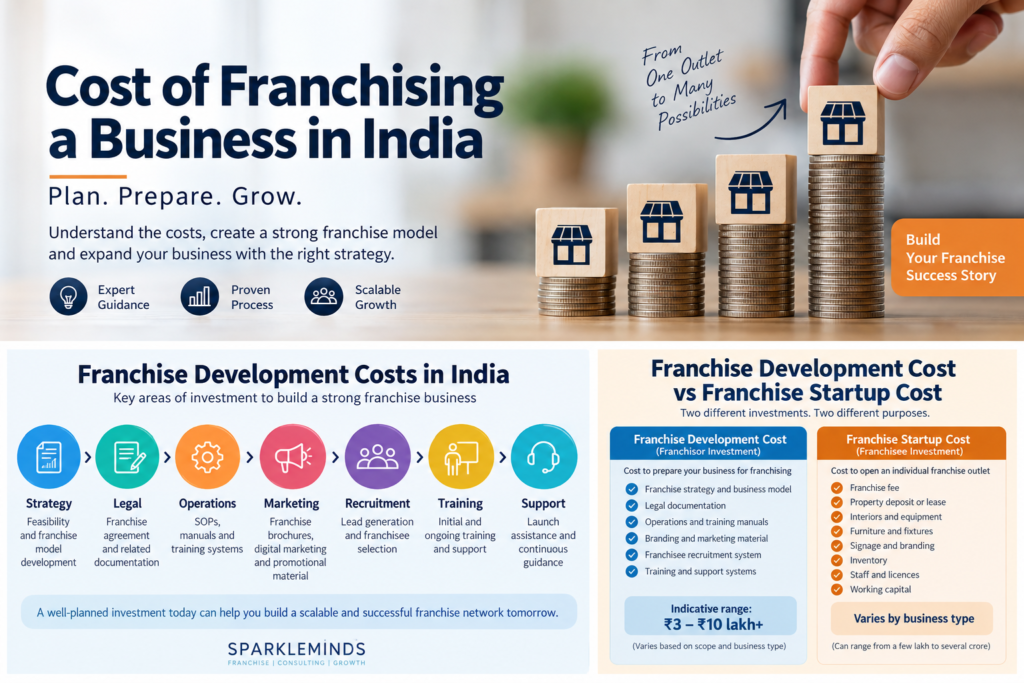
If you are considering franchising your business, the first step is to distinguish between the cost of developing a franchise system and the cost a franchisee will need to open an individual outlet. These are separate investments and should be planned separately.
How Much Does It Cost to Franchise a Business in India?
There is no single fixed price for franchising a business in India. The total cost depends on the size of the business, its existing systems, the number of locations you want to expand into, the franchise model, and the level of professional support required.
For a business owner, franchise development expenses may include:
- Franchise strategy and feasibility
- Franchise business model development
- Legal documentation
- Operations and training manuals
- Franchise branding and marketing material
- Franchisee recruitment
- Training and onboarding
- Franchise marketing
- Ongoing franchise support
At Sparkleminds, franchise development programmes can range from a few lakh rupees to around Rs. 10 lakhs or more, depending on the scope of work and services required. These figures should be treated as indicative consultancy and franchise-development costs, rather than the total investment required to open a franchise outlet.
What Are the Main Costs of Franchising a Business?
Before deciding how much to invest, business owners should understand where the money goes. The major costs involved in developing a franchise generally fall into the following categories.
1. Franchise Strategy and Business Model Development
The first step is determining whether the existing business can be converted into a scalable franchise model.
This may involve evaluating:
- Business profitability
- Scalability
- Target markets
- Franchise format
- Revenue model
- Franchise fees
- Royalty structure
- Territory structure
- Franchisee profile
- Expansion strategy
A strong franchise model should work for both the franchisor and franchisee.
2. Legal and Franchise Documentation
A franchise requires appropriate legal documentation to establish the relationship between the franchisor and franchisee.
Depending on the business, this may include:
- Franchise agreement
- Disclosure-related documentation
- Intellectual property documentation
- Territory and operational clauses
- Franchise fees and royalty terms
- Renewal and termination conditions
- Franchisee obligations
- Confidentiality and non-compete provisions where legally appropriate
The exact legal cost will depend on the complexity of the business and the documentation required.
3. Operations and Franchise Manuals
A franchise cannot depend entirely on the founder’s personal knowledge.
The business needs documented systems that allow a franchisee to understand how the business operates.
This may include:
- Operations manuals
- Standard operating procedures
- Training manuals
- Customer-service standards
- Quality-control procedures
- Staff guidelines
- Reporting systems
The more structured the business is, the easier it becomes to replicate the model across different locations.
4. Franchise Branding and Marketing
A franchisor needs professional marketing material to present the franchise opportunity to prospective franchisees.
This may include:
- Franchise brochures
- Franchise presentations
- Franchise website content
- Digital marketing
- Lead-generation campaigns
- Franchise opportunity listings
- Promotional material
- Franchise exhibition participation
The actual marketing budget depends on the expansion objectives and target market.
5. Franchisee Recruitment
Finding the right franchisees is one of the most important parts of franchise development.
The cost may involve:
- Franchise lead generation
- Advertising
- Franchise portals
- Franchise exhibitions
- Lead qualification
- Franchise sales support
- Franchise recruitment personnel
Recruiting a franchisee should not simply be about finding someone willing to invest. The franchisee should also have the right financial capacity, skills, location and commitment to operate the business.
6. Training and Ongoing Support
The franchisor also needs to budget for franchisee training and ongoing support.
This can include:
- Initial training
- Operational training
- Location setup support
- Launch assistance
- Marketing guidance
- Business reviews
- Quality control
- Ongoing hand-holding
Strong franchise support can make a significant difference to franchisee performance and brand consistency.
What Is the Average Cost of Franchising a Business?
The average cost of franchising a business cannot be represented by one fixed number because every business requires a different level of franchise development.
For example, a small business with an established operating system may require less development work than a growing business that needs its entire franchise model, documentation, manuals, marketing system and recruitment process created from the ground up.
At Sparkleminds, a basic franchise development programme may start around ₹3 lakh–₹5 lakh, while a more comprehensive franchise growth programme can reach approximately ₹10 lakh, depending on the services and scope involved.
These are indicative programme ranges, not a universal franchise-development price. Your actual cost should be determined after assessing your business, franchise model and expansion requirements.
Indicative Franchise Development Cost Breakdown
| Area | What It May Cover |
|---|---|
| Franchise strategy | Feasibility, model selection and expansion planning |
| Legal documentation | Franchise agreement and related documentation |
| Operations | SOPs, manuals and operating systems |
| Branding | Franchise presentation and marketing material |
| Recruitment | Franchise lead generation and candidate qualification |
| Training | Initial franchisee training and onboarding |
| Marketing | Franchise promotion and lead generation |
| Support | Launch assistance and ongoing hand-holding |
Note: The actual cost varies according to the business, industry, number of locations, franchise model and scope of professional services required.
What Is the Difference Between Franchise Development Cost and Franchise Startup Cost?
This is an important distinction for anyone researching the cost of franchising a business.
Franchise development cost
This is the money spent by the business owner/franchisor to prepare the business for franchising.
It can include:
- Franchise strategy
- Legal documentation
- Manuals
- Franchise marketing
- Recruitment systems
- Training systems
- Franchise support systems
Franchise startup cost
This is the money required by the franchisee to establish and operate an individual franchise location.
It can include:
- Franchise fee
- Property deposit or lease
- Interiors
- Equipment
- Furniture
- Signage
- Inventory
- Staff
- Licences
- Working capital
- Local marketing
Therefore, a business owner should not assume that a ₹3 lakh or ₹10 lakh franchise-development programme represents the complete investment required to open a franchise outlet.
How Much Money Do You Need to Start a Franchise in India?
The amount required to start a franchise depends heavily on the type of business and franchise format.
A low-investment service-based franchise may require considerably less capital than a restaurant, retail outlet, education centre or large-format business.
A franchisee may need to budget for:
- Initial franchise fee
- Location costs
- Professional fees
- Contractor and installation costs
- Furniture and fixtures
- Equipment
- Inventory
- Signage
- Employee costs
- Marketing
- Working capital
The franchisee should also maintain sufficient working capital rather than using the entire available budget on the initial setup.
What Factors Affect the Cost of Franchising a Business?
Several factors influence the final cost of franchise development.
Business Type
A food, retail, education, healthcare or service business can have very different operational and documentation requirements.
Existing Business Systems
If your business already has documented SOPs, financial processes and training systems, less development work may be required.
Franchise Model
FOCO, FOFO, COCO and other operating structures can create different responsibilities and investment requirements.
Number of Locations
A business planning nationwide expansion may require a more extensive recruitment, support and marketing system than a business initially targeting a few locations.
Level of Professional Support
The cost will also depend on whether you need support for only franchise documentation or a complete franchise development and recruitment programme.
Franchise Marketing Budget
A business that wants aggressive franchisee recruitment may require a larger marketing and lead-generation budget.
What Does It Take to Franchise a Business?
Franchising is more than creating a franchise agreement and finding investors.
A successful franchise system needs a business model that can be replicated while maintaining the quality and identity of the original brand.
Before franchising, ask yourself:
- Is my business profitable and scalable?
- Can another person operate the business using documented systems?
- Do I have a clear franchise model?
- What investment will a franchisee require?
- What support will franchisees receive?
- How will I recruit suitable franchisees?
- How will I maintain quality across locations?
- How quickly do I want to expand?
- Do I have sufficient resources to support the franchise network?
If the answer to these questions is unclear, the business may need additional preparation before actively recruiting franchisees.
How Do You Start Franchising a Business in India?
A business owner should avoid rushing into franchise sales simply because there is interest from potential investors.
A practical franchise-development process generally involves:
Step 1: Assess Franchise Readiness
Evaluate whether the business is profitable, repeatable, scalable and suitable for franchising.
Step 2: Develop the Franchise Model
Determine the franchise format, investment structure, fees, territory, responsibilities and support system.
Step 3: Create the Required Documentation
Develop the appropriate franchise agreements, operating documentation and other legal and business documents.
Step 4: Document the Operating System
Create SOPs, manuals and training systems so the business can be replicated consistently.
Step 5: Prepare Franchise Marketing
Create the material required to present the franchise opportunity professionally.
Step 6: Recruit the Right Franchisees
Generate and qualify franchise leads rather than accepting every potential investor.
Step 7: Train and Support Franchisees
Provide the initial training and ongoing support required to help franchisees operate according to the brand’s standards.
For professional assistance with franchise development, you can explore Sparkleminds Consultancy Services.
Can You Franchise a Business With a Small Budget?
Yes, but the answer depends on what you mean by a small budget.
A business owner may be able to start the franchise-development process with a relatively modest professional-services budget, particularly if the business already has strong systems and documentation.
However, trying to franchise a business without investing in the necessary model development, legal documentation, operating systems and franchisee support can create problems later.
The objective should not simply be to spend less. It should be to create a franchise system that is practical, legally appropriate, financially viable and replicable.
Is Franchising a Self-Funding Growth Strategy?
Franchising can help a business expand using franchisee investment rather than funding every new location entirely from the franchisor’s own capital.
However, franchising is not completely cost-free for the franchisor.
The business still needs to invest in:
- Franchise development
- Systems
- Documentation
- Recruitment
- Training
- Marketing
- Franchisee support
- Quality control
Franchising can therefore reduce the capital burden associated with opening company-owned locations, but the franchisor still needs sufficient resources to build and support the franchise network.
Why Work With a Franchise Consultant?
Developing a franchise without understanding the legal, operational, financial and recruitment requirements can lead to expensive mistakes.
A franchise consultant can help a business owner evaluate the existing business, develop an appropriate franchise model, document the operating system, prepare franchise marketing material and establish a process for franchisee recruitment and support.
Sparkleminds has been working in the franchise consulting space for more than two decades and states that it has assisted 500+ clients. If you use this claim on the page, make sure it remains accurate and current.
How Much Does a Franchise Consultant Charge in India?
Franchise consultant fees vary depending on the scope of the project.
A consultant may charge for:
- Franchise feasibility
- Franchise strategy
- Franchise model development
- Legal/documentation coordination
- Operations manuals
- Franchise marketing
- Franchise recruitment
- Training
- Ongoing support
A basic project and a complete franchise-development programme should not be expected to have the same price.
For an exact estimate, the business should be assessed individually.
Get a Customized Cost of Franchising a Business
There is no universal price for franchising a business because every business starts from a different position.
The right investment depends on your:
- Industry
- Current business model
- Number of outlets
- Existing systems
- Franchise model
- Expansion goals
- Target locations
- Franchisee profile
- Required level of support
If you are planning to franchise your business, Sparkleminds can assess your requirements and help determine the appropriate franchise-development approach.
Want to understand what franchising could cost for your business?
Take the Franchising Quiz or submit the Franchise Expansion Form to discuss your requirements with the team.
You can also explore Sparkleminds Consultancy Services for more information about franchise development.
Frequently Asked Questions
How much does it cost to franchise a business in India?
The cost varies depending on the business, franchise model and services required. Franchise-development programmes can range from a few lakh rupees to around ₹10 lakh or more for comprehensive programmes. This is separate from the investment required to establish an individual franchise outlet.
What are the main costs involved in franchising a business?
The main costs can include franchise strategy, legal documentation, operating manuals, branding, franchise marketing, franchisee recruitment, training and ongoing support. The exact requirements depend on the business and its expansion strategy.
How much does a franchise consultant charge in India?
Franchise consultant fees vary according to the scope of work. A consultant may provide individual services such as feasibility and documentation or a complete franchise-development programme covering strategy, systems, marketing, recruitment and support.
Is franchising cheaper than opening company-owned outlets?
Franchising can reduce the amount of capital a business owner needs to invest in every new location because franchisees typically fund their own outlets. However, the franchisor still needs to invest in developing and supporting the franchise system.
Can a small business be franchised?
Yes. A small business can potentially be franchised if it has a viable business model that can be replicated and supported by franchisees. Before franchising, the business should be assessed for profitability, scalability, systems, brand strength and operational consistency.
What is included in franchise development?
Franchise development can include business and franchise-model assessment, franchise strategy, documentation, operations manuals, training systems, franchise marketing, franchisee recruitment and ongoing support. The exact scope depends on the requirements of the business.
How long does it take to franchise a business?
The timeline varies depending on the business’s existing systems, documentation, franchise model and level of development required. A business that already has strong operating systems may be able to prepare faster than a business that needs its franchise infrastructure developed from the beginning.
Should I hire a franchise consultant?
A franchise consultant can be useful when a business owner needs help developing the franchise model, documentation, operating systems, marketing strategy or franchisee recruitment process. The decision should depend on the complexity of the business and the owner’s internal capabilities.
How Much Does It Cost to Franchise a Business in India?
The cost to franchise a business in India typically ranges from ₹7 lakh to ₹60 lakh or more, depending on the business size, expansion plans, and franchise development requirements. Major expenses include franchise model design, legal documentation, training manuals, branding, and franchisee recruitment. Actual costs vary based on your business requirements and the scope of the franchise system.
What Are the Main Costs of Franchising a Business?
The main costs of franchising a business include franchise model development, legal agreements, operations and training manuals, branding and marketing materials, and franchisee recruitment. Businesses should also budget for ongoing franchise support and system improvements. The total investment depends on the complexity and scale of the franchise model.
What Is the Average Cost of Franchising a Business?
There is no fixed average cost for franchising a business in India because every business requires a different franchise development strategy. A lean, single-city setup may require a smaller investment, while a multi-city or national franchise system can cost significantly more. A detailed assessment of your business is necessary to estimate the actual investment.
What Are the Main Costs Involved in Franchising a Business?
The main costs involved in franchising a business include:
- Franchise feasibility study and model design
- Legal documentation and franchise agreements
- Operations and training manuals
- Brand identity and marketing collateral
- Franchisee recruitment and onboarding
These expenses help establish a structured franchise system that can be replicated across locations.
How Much Does a Franchise Consultant Charge in India?
Franchise consultant fees in India vary depending on the services provided, business complexity, and scope of the engagement. Some consultants charge project-based fees, while others may offer customised packages. The total cost depends on whether you require franchise model development, legal coordination, operations manuals, franchisee recruitment, or ongoing support. Request a customised quotation based on your business requirements.
Is Franchising Cheaper Than Opening Company-Owned Outlets?
Franchising can reduce the direct capital investment required from a business owner to expand through company-owned outlets because franchisees typically invest in their own locations and operations. However, the franchisor still needs to invest in franchise development, training, quality control, and ongoing support. The financial benefits depend on the business model, operating costs, and franchise agreement.
Final CTA
Ready to Explore the Cost of Franchising Your Business?
Franchising can be a powerful way to expand a successful business, but the right preparation matters. Instead of relying on a generic cost estimate, evaluate your business, franchise model and expansion goals first.
Take the Franchising Quiz or submit your Franchise Expansion Form to start the conversation with Sparkleminds.