Digital Marketing For Franchisors: Building a Strong Online Presence 

Written by Sparkleminds

Particularly for franchisors, internet marketing is now a need in today’s cutthroat business climate. Keeping a consistent yet regional web presence is to become more difficult for franchise companies as they grow. The importance of digital marketing for franchisors of a franchise becomes crucial in this context. Franchisors can increase their visibility, generate quality leads, and guarantee continuous growth across all of their locations. Nonetheless, with a well-planned digital strategy. 

Digital Marketing for Franchising your business.

Learn why digital marketing is crucial for franchisors. Also, how to optimize your franchise website for search engines, how to use social media to build your brand, how to generate leads online, and how to calculate the return on investment (ROI) of your digital marketing efforts. 

Focusing on Digital Marketing for Franchising 

A unique dilemma confronts franchisors. How to promote the overall brand while also enabling entrepreneurs to do the similar in their respective local markets. These demands cannot be met by conventional advertising methods alone.  

The importance of digital marketing for franchising success can be summarized as follows: 

  • Grow Your Brand’s Exposure: With the use of digital marketing, franchisors can raise their brand’s visibility on a local, national, and international level. When you use the correct resources, your brand message will be consistent no matter where you are. 
  • Precision Targeting: To make sure their digital marketing initiatives are relevant and effective, franchisors can use geo-targeting to customize them for each franchisee’s region. Centralized control and localized customization are both achieved through this. 
  • Make Decisions Based on Data: Franchisors may monitor key performance indicators, make strategic adjustments, and spread success to other locations. Moreover, with the use of digital tools that deliver data in real-time. 
  • Economic Efficiency: Digital marketing provides a more cost-effective alternative with greater return on investment possibilities than more conventional approaches such as print or broadcast advertising. 

Online Marketing Strategies for Franchise Sites 

Digital marketing strategies, particularly those of franchisors, rely on effective SEO (Search Engine Optimization). The success of the corporate and franchise locations depends on their websites, thus it’s important to optimize them for search engines. 

  • Develop Content That Is Unique To Each Location: A local search engine optimization (SEO) optimized page for each franchise location is a must. Incorporate geo-targeted keywords, place contact information, Google Maps integration, and user reviews. 
  • Make It Mobile-Friendly: These days, mobile devices account for the vast majority of users’ search data. You may improve your SEO rankings and user experience with a mobile-optimized site. 
  • Make use of SDM: Make use of schema markup to improve search engines’ comprehension of your material, particularly when it comes to areas, services, and reviews. 
  • Collaborate on Local Listings and Citations: Verify that all franchises are listed correctly on several platforms, including local directories, Google My Business, Yelp, and Bing Places. It is more credible and higher in the ranks if the NAP (Name, Address, and Phone) information is consistent throughout all listings. 
  • Develop Content of High Quality: Create blog entries, frequently asked questions, and other materials that cater to universal and regional client demands. Use long-tail keywords that are specific to the industry and franchising. 

Promoting Your Business Through Social Media 

Boosting brand awareness and connecting with prospective consumers and franchisees are two of the many great uses for social media. 

The following is an example of how franchisors’ digital marketing makes use of social media: 

  • A Consistent Advertising Voice: Give franchisees branded materials and a content calendar to keep the brand consistent. Doing so will guarantee that your voice is consistent across all mediums. 
  • Content Strategy for Local Markets: Franchisees are encouraged to share community-oriented content such as events, testimonials, and promotions utilizing images and messages that have been approved by the corporate. 
  • Marketing Campaigns: Advertising on LinkedIn, Instagram, and Facebook, among others, may be very specific. While franchisors handle nationwide marketing, franchisees take care of promotions on a much smaller scale. 
  • Reputation Management and Engagement: Keep an eye on what people are saying about your brand online by using social listening tools. Stay ahead of customer complaints to keep your brand’s reputation in good standing. 

Ways to Generate Leads Online 

Digital marketing revolves around generating high-quality leads. In addition to consumers, franchisors need to entice potential franchisees.  

Some effective methods for generating leads are: 

  • Exciting Landing Pages with Bold Calls to Action: For unique offers like free trials, downloadable tools, or franchise opportunities, create optimizable landing pages for conversions. 
  • Search Engine Marketing (SEM): Using Google Ads, you can reach people who are actively looking for franchise possibilities in a specific city or who are looking for franchises in a specific industry. 
  • Marketing via email: To effectively nurture leads and send personalized messages, segment your email list by location and client type (consumers vs. prospects). 
  • Utilizing content marketing: Promote the benefits of becoming a franchisee by publishing informative blogs, case studies, and success stories that speak to your demographic. 
  • Information Collecting Forms and Chatbots: Utilize brief forms, pop-ups, and chatbots driven by artificial intelligence to facilitate user contact and information requests as they progress through the buyer’s journey. 

Evaluation of the Return on Investment in Digital Marketing For The Franchise

If you want to maximize the effectiveness of your digital strategy, you must master the concept of return on investment (ROI). Franchisors can measure the performance of their digital marketing in the following ways: 

  • Before Beginning, Establish SMART Objectives: Goals should be SMART (specific, measurable, attainable, relevant, and time-bound) and expressed in a clear and concise manner. 
  • Utilize analytics software: Use analytics software like Google Analytics, Meta Business Suite, or HubSpot to monitor important data like cost per lead, conversion rate, bounce rate, and traffic source. 
  • Pay attention to the franchisee: Check the online performance of each franchise. Find out where you stand by comparing stats with scorecards or dashboards. 

Final Thoughts, 

The complex task of digital marketing for franchisors necessitates a harmony between global planning and regional implementation. Establishing a solid online presence is essential if your goals include increasing brand recognition, attracting local customers, or growing your franchise network. 

Franchisors may set their business up for permanent success in the digital era. Moreover, by employing strong search engine optimization procedures, interesting social media strategies, efficient lead generation methods, and comprehensive performance monitoring. 

Are you in need of assistance in developing a digital marketing strategy for your franchise

Let’s work together to develop a unique strategy that grows with your company and produces tangible outcomes. Therefore, get in touch with us now to begin. 

Loading

Legal essentials: Navigating Franchise Agreements and Compliance in India 

Written by Sparkleminds

Indian and global firms are increasingly using franchising to do business. However, there is a tangled web of legal factors to consider along with the benefits of scalability and market penetration. For the sake of long-term success, conflict avoidance, and IP protection, franchisors and franchisees alike would do well to familiarize themselves with the legal compliances of franchise agreement in India. 

Franchise Agreement & Legal Compliances

Legal Compliances: A Critical Aspect of Franchising 

There is no specific legislation in India that regulates franchising. On the contrary, it is governed by multiple statutes: 

  • This 1872 Indian Contract Act 
  • The 2019 Consumer Protection Act 
  • Antitrust Law of 2002 
  • For franchises operating on a global scale, there is the Foreign Exchange Management Act and 
  • Tax on Goods and Services (GST)—which is relevant to every franchise deal 

Why Is Legal Compliance Is Important? 

  • Avoidance of legal conflicts and fines is achieved. 
  • strengthens franchisor-franchisee trust 
  • The reputation of the brand is safeguarded. 
  • Simplifies the process of expanding a firm. 

When it comes to taxes, employee benefits, environmental standards (in the food or retail industries), and local municipal regulations, a franchise must be legally compliant. 

Characteristics that are essential to a franchise agreement in India 

Legally binding franchise agreements in India should be comprehensive, clear, and easy to understand. The following are the essential elements that it should have: 

#1. Identification of the Parties involved 

  • Include the full names, addresses, and legal forms of both the franchisor and franchisee. 

#2. Provision of Rights 

  • The franchise’s exclusivity should be checked. 
  • Give details about the company concept and the regional scope. 

#3. Payments and Franchise Fees 

  • The initial investment required to launch franchise 
  • Continual royalties or mechanisms for distributing revenue 
  • contributions to marketing and advertising 
  • Penalties for paying late 

#4. Legal Protection of Intellectual Property 

  • Use of logos, trademarks, manuals, and branding is protected. 
  • Use of intellectual property and protection clauses 

#5. Support and Training 

  • Explain what the franchisor offers in terms of training, operational assistance, and continuing mentoring. 

#6. Performance Requirements 

  • Expected minimum sales and revenue 
  • Evaluations of operations and quality assurance 
  • Brand standards for compliance 

#7. Agreement Termination and Renewal 

  • Circumstances that permit termination 
  • Notice period 
  • Rights to renewal and conditions of renegotiation 

#8. Resolving Conflicts 

  • Choice between arbitration and litigation 
  • India is the preferred jurisdiction. 
  • Law that applies (in the case of domestic operations, Indian law) 

How to Avoid Common Legal Obstacles 

Even while franchising allows for scalable growth, many companies encounter legal problems as a result of carelessness or poorly worded agreements. How to avoid typical pitfalls: 

Obstacles What Happens Possible Countermeasures 
Imprecise or absent clauses in the franchise agreement Disputes involving duties or rights Make use of a professionally evaluated legal template 
Poor protection of intellectual property Misuse of the brand by outside parties Completely document all intellectual property and incorporate robust enforcement provisions. 
Not following FEMA or FDI regulations Fines from RBI, null and void contracts Discuss the foreign franchise rules with solicitors. 
Lack of adequate setup for dispute resolution Prolonged and expensive legal battles Incorporate explicit arbitration provisions 

In short, Labour, tax, and zoning rules are just a few examples of how Indian federal and state laws affect franchise agreements.,  

The Importance of IP in Franchising 

Franchisees pay for the most important part of any business: the intellectual property (IP).  

Exploring Franchising’s Intellectual Property Landscape: 

  • Logos, slogans, brand names, and other identifying symbols are known as trademarks. 
  • Copyrights – Instructional guides, instructional videos, promotional materials 

Legal Things to Think About: 

  • Keep track of trademarks in accordance with the Trade Marks Act OF 1999 
  • In order to limit unlicensed distribution, use non-disclosure agreements and intellectual property usage restrictions. 
  • Specify in the agreement who owns what intellectual property and how it will be used. 

Moreover, In franchising, protecting intellectual property is critical for two reasons: first, to stay out of legal hot water; and second, to keep the brand value consistent from one site to another. 

When to Seek Legal Advice and Why It’s Important in the Franchising Industry 

A crucial, though frequently disregarded, part of the franchising process is hiring competent legal counsel. Consultation with a franchise attorney safeguards interests at every turn, whether you are a franchisor growing your business or a franchisee purchasing a tried-and-true model. 

For franchise legal compliance in India, it is necessary to acquire legal guidance at the following times: 

#1. Before the Franchise Agreement is drafted or signed 

Your business connection is based on an Indian franchise agreement. But many business owners make the error of using standard templates or accepting contracts without fully comprehending what they mean. 

Lawyers Can Help: 

  • Create an Indian-law-compliant, enforceable agreement. 
  • No unclear or one-sided clauses 
  • Follow the 1872 Indian Contract Act. 
  • Clarify legal jargon for action. 

#2. Expanding Domestically or Internationally 

Franchise across Indian states or globally, and you’ll encounter varied legal landscapes. Regions may have: 

  • Licenses needed 
  • Municipal and zoning legislation 
  • Regulations protecting consumers 

Lawyers ensure: 

  • Fully following local and international legislation 
  • Partnering with foreign franchisors or franchisees doesn’t violate FEMA or FDI. 
  • Your expansion model legally suits your franchise structure (master, area developer, unit franchise). 

#3. Franchise Termination, Renewal, or Exit 

Franchise termination can be as complicated as franchise creation. Not treated properly, it can cause: 

  • Contract breach claims 
  • Loss of investment 
  • Legal responsibility for damages 

A lawyer: 

  • Examine the legal justifications for your termination clause. 
  • Guide you through non-compete and post-termination responsibilities 
  • Follow notice periods and leaving procedures. 

#4. For IP Protection 

The brand is a key franchise asset. Proper legal protection and licensing are required for your business methods, trade secrets, trademarks, and logos. 

Lawyers assist: 

  • Trademark registration with the Indian Trademark Office 
  • The agreement should include robust intellectual property licensing obligations. 
  • Enforcement of intellectual property rights for misuse or infringement 

#5. Legal disputes and claims 

Even with good agreements, disagreements might develop. They may include: 

  • Contract breach 
  • Royalties default 
  • Brand guidelines violation 
  • Operations without permission 

The Indian franchise lawyer should: 

  • Help with mediation or arbitration 
  • Provide court representation if needed 
  • Strategic legal defence reduces culpability. 

Nonetheless, lawful representation is crucial if you want to develop a successful and lawful franchise in India. Franchise lawyers defend, comply, and expand your firm through agreement draughting, IP protection, and dispute resolution. 

To Conclude, 

To develop a robust, scalable, and legal compliances business in India, one must be familiar with the fundamentals of a franchise agreement. A well-defined and legally solid provision is necessary for every aspect of the agreement, including intellectual property, fee structures, and dispute resolution. 

Get expert counsel and protect your brand’s future by not cutting corners on legal compliances and the franchise agreement. 

Loading

Key elements to include in your FOCO franchise agreement in India 2025 

Written by Sparkleminds

Franchisors and franchisees alike can reap the rewards of big decisions like FOCO (Franchise Owned Company Operated) franchise agreements. As we hit 2025 in India, the FOCO model is still popular, particularly among businesses that want to grow fast while keeping investors’ operational hassles to a minimum. 

A legally enforceable franchise agreement is the first step to a successful FOCO franchise. To make sure your FOCO franchise agreement is clear, secure, and successful in the long run, let’s look at the essential parts. 

FOCO franchise agreement

Key Points To Include in Your FOCO Franchise Agreement in India 2025 

#1. Comprehensive Overview of the Business Model 

The business model must be defined explicitly in your FOCO franchise agreement: 

  • In what ways will the business run the store? 
  • The franchisor maintains a degree of operational control. 
  • The franchise owner’s precise function (usually that of an investor who isn’t heavily involved in day-to-day operations). 

Therefore, if you want to avoid miscommunication in the future and set a good tone for your relationship, be clear now. 

#2. Definitions of Key Financial and Investment Terms 

The overall financial outlay is needed. 

  • The overall financial outlay is needed. 
  • Guaranteed returns or revenue sharing (if applicable). 
  • Royalty structures, payment schedules, and security deposits. 

Moreover, If you want to attract the best partners and win over India’s wary investors, be honest about the finances in your FOCO franchise agreement. 

#3. Terms of Renewal and Validity 

Inform how long the franchise agreement lasts: 

  • Duration of 5 to 15 years are common for FOCO periods. 
  • Give the details of the renewal, including whether it’s automatic, performance-based, or up for grabs. 

Nonetheless, to prevent any disagreements in 2025 and beyond, make sure the extension requirements are clearly stated. 

#4. Accountabilities and Duties 

Given that the franchisor is in charge of running the show, the contract needs to clarify: 

  • Employment responsibilities (including hiring, onboarding, and compensation). 
  • routine aspects of administration. 
  • Marketing and branding responsibility. 

As a result, everyone knows their part and everything runs smoothly under the FOCO framework. 

#5. The Safeguarding of Intellectual Property 

Brand protection is of the utmost importance in India’s booming franchise industry. Make sure to include: 

  • Make your brand usage clear. 
  • Limitations on alterations made without permission. 
  • Sections that safeguard standard operating procedures, logos, trademarks, and trade secrets. 

The FOCO brand’s integrity will be protected in every market thanks to a robust intellectual property provision in your franchise agreement. 

#6. Termination and Exit Clauses 

Although discussing possible departures is not everyone’s cup of tea, a good agreement will account for every possible outcome: 

  • This includes situations where a franchisee leaves voluntarily, even during the notice period. 
  • Franchisor breach or insolvency terminates franchise agreement. 
  • Things to consider before selling or transferring ownership of the store. 

Nonetheless, in case things don’t work out as expected, having well-defined exit procedures safeguards both sides. 

#7. Efforts to Resolve Conflicts 

In business, disputes are inevitable. Ensure that the agreement includes: 

  • Law that applies (ideally, Indian law for business in India). 
  • Place of jurisdiction for civil trials. 
  • Choose between mediation, arbitration, and litigation as your preferred method of conflict resolution. 

Moreover, An arbitration clause would be prudent given that Indian courts would most likely maintain their support for ADR in 2025. 

#8. Legal Approvals and Compliance 

Many statutes in India govern franchising, including: 

  • 1872’s Indian Contract Act. 
  • The Act on Competition, 2002. 
  • Code of Trademarks, 1999. 

Moreover, make sure that all local and federal laws and regulations are explicitly stated in your FOCO franchise agreement. Be sure to include language on the acquisition of licenses, such as those required by the FSSAI (for food brands) and municipal authorities. 

What a Franchisor Should Consider When Drafting a FOCO Franchise Agreement. 

A FOCO franchise agreement should safeguard the brand, create a win-win structure, and define clear expectations, not only comply with the law. The most important things franchisors should remember: 

#1. Never compromise your brand 

The FOCO approach exposes your brand through third-party ownership, even while you run the channel. 

Verify agreement: 

  • Strictly governs brand, logo, and trademark use. 
  • Prevents changes and unauthorised promotions. 
  • Implements rigorous quality control. 

Therefore, this safeguards your hard-earned reputation. 

#2. Clarify Financial Terms 

Financial miscommunications undermine trust quickly. A franchisor should: 

  • Give a detailed breakdown of the investment and its intended usage. 
  • Provide a comprehensive explanation of the payment terms, ROI expectations (if applicable), and revenue sharing. 
  • State penalties for late payments. 

Moreover, investors in India will expect transparent estimates in 2025. 

#3. Maintain full operational control 

FOCO implies operations, so: 

  • Maintain full team management, hiring, and firing privileges. 
  • Manage sales and marketing. 
  • Choose vendors and operational policies. 

Nonetheless, write these rights clearly in the agreement to avoid confusion. 

#4. Provide room for future changes 

Markets shift. The FOCO franchise deal should let you: 

  • Revise SOPs, pricing, or operations. 
  • You can add new goods or services without having to renegotiate the whole contract. 

Keep some flexibility to defend your business from changes. 

#5. Prepare for the Worst. 

Consider potential issues: 

  • The owner might stop working with you. 
  • What if the location underperforms? 
  • If government restrictions change, what happens? 

Therefore, Protect your business with departure alternatives, indemnity, and force majeure clauses. 

#6. Make Dispute Resolution Channels Clear 

Prevent trial drama by bringing up: 

  • Favoured arbitration. 
  • Choose your convenient city/state for jurisdiction. 
  • Agreement breach penalties. 

Moreover, avoiding operational disruptions requires fast dispute settlement. 

#7. Build Trust, Not Contracts 

Finally, trust is key to good franchise relationships. Utilise your contract to safeguard yourself and:: 

  • Be transparent. 
  • Franchisees should feel respected and protected. 
  • Discuss expectations from the start. 

Remember, a fair FOCO franchise agreement makes partners loyal, which boosts brand growth. 

In conclusion, 

A strong FOCO franchise agreement is not just a necessary evil; it is the bedrock of a mutually beneficial and trustworthy partnership. In 2025, when the franchise industry in India reaches its full potential, companies that value open communication, thorough agreements, and mutual regard will succeed. 

Get your agreement in order before diving into the FOCO model; it may cost you. You’ll be better off in the long run if you do this. 

Loading

Franchisor Responsibility in India: Navigating Financial Transparency & Disclosure Obligations 

Written by Sparkleminds

Entrepreneurs, investors, regulators, and legal experts in India’s rapidly expanding franchise business are all paying more attention to franchisor responsibilities. The franchise model is growing in popularity as a means of company expansion, but franchisors must be aware of their responsibilities, especially in the area of financial disclosure and transparency. 

Franchisor's Responsibility in India

Importance of Franchisor Responsibilities 

Unlike in the United States or Australia, franchising in India is not overly constrained by the law. But it doesn’t mean franchisors aren’t still responsible for meeting their legal and ethical obligations. The absence of a written franchising law in India makes things more difficult for franchisors. For this reason, franchisor accountability is crucial to establishing credibility and ensuring continued success. 

Franchisors’ Crucial Disclosure Responsibilities 

#1. Before the Contract: 

Franchisors have an obligation to prospective franchisees to be forthright and honest when they enter into a franchise agreement regarding: 

  • Business framework and background 
  • Results in terms of money (revenue, profit, or predictions, if any) 
  • Fees for the beginning and ongoing 
  • Proposed expenditure 
  • Joint Responsibilities 

Moreover, Legal allegations of fraud or misrepresentation can result from concealing important facts, even though this is not currently a requirement. 

#2. Adequate Financial Transparency 

Franchisors should be open and honest about their financials, particularly when it comes to: 

  • Estimating royalties 
  • Contributions made by advertising 
  • Income sources that are shared 

In addition to shielding the brand from any legal action or negative press, this helps establish credibility among franchisees. 

#3. Continuous Communication 

The signing of the agreement does not absolve the franchisor of all liability. Franchise regulations must be fairly enforced, and there must be continuous financial updates, training, and operational support. 

Primary Responsibilities of Franchisors in India 

Although contract law is the primary framework for the Indian franchising industry, best practices and developing case law have defined essential duties that all franchisors must fulfil. The fields of law, ethics, operations, and finances encompass these. 

#1. Formal Disclosure Prior to Contractual Agreement 

Prior to the signing of any agreement, it is essential for the franchisor to deliver clear, comprehensive, and truthful information regarding the franchise offering. 

Essential information to communicate includes: 

  • Corporate history and operational background 
  • Financial performance, including projections, historical results, and audited accounts if accessible. 
  • Franchise, royalties, marketing, and other upfront and ongoing costs 
  • Projected initial investment and detailed cost analysis 
  • Information regarding any legal proceedings or conflicts 
  • Current franchisee network and their contact information 

Moreover, In India, while there is no legal requirement for a formal Franchise Disclosure Document (FDD), franchisors can still be held accountable by courts for any misrepresentation or concealment of significant information. 

#2. Franchise Agreement Transparency 

Franchise agreements must be draughted in a fair, thorough, and legally enforceable manner. 

The contract must explicitly outline: 

  • Expectations and duties of each party 
  • Brand utilisation permissions 
  • Terms of duration and renewal 
  • Conditions for termination 
  • Methods for resolving disputes 

Optimal Approach: Have the agreement reviewed by lawyers who specialise in franchises and provide the franchisee with sufficient time to consult with independent legal counsel. 

#3. Clear Financial Practices 

Franchisors need to ensure transparent and precise financial communication, particularly regarding: 

  • Compensation and pricing frameworks 
  • Collaborative contributions to advertising or marketing funds 
  • Payments or commissions based on revenue 
  • Policies regarding refunds (if applicable) 

A piece of advice: Regularly release financial statements or reports that demonstrate the use of group marketing or operating funds. 

#4. Training and Operational Assistance 

Training and supporting franchisees is a fundamental aspect of a franchisor’s responsibilities, especially in: 

  • Training prior to opening (software, operations, products, etc.) 
  • Employee recruitment and training programs 
  • Guidance for selecting sites 
  • Operational guidelines 
  • Marketing and brand standards 

Remember, Consistent support is crucial for maintaining a consistent brand experience and achieving success, and it’s not merely a gesture of goodwill. 

#5. Quality Control and Brand Protection 

Franchisors need to ensure the brand’s integrity and consistency is maintained across every location. This encompasses: 

  • Performing regular audits or inspections 
  • Guaranteeing compliance with quality standards 
  • Consistently enhancing product and service offerings 
  • Implementing measures for non-compliant franchisees 

Moreover, the reputation of a brand can be harmed by a single rogue outlet, which is why it counts. Quality control safeguards franchisees as well as the franchisor. 

#6. Adhering to legal standards 

The business strategy and agreements of franchisors must adhere to all relevant Indian legislation, including: 

  • Indian Contract Act of 1872 
  • Consumer Protection Act, 2019 
  • Competition Act of 2002 
  • Intellectual Property Regulations (Trademark Act, etc.) 
  • Labour and tax regulations for operating company-owned outlets 

Be careful! Infringing on licensing agreements, misusing brands, or engaging in deceptive advertising may lead to legal repercussions under Indian law. 

#7. Conflict Resolution Framework 

A diligent franchisor establishes a transparent, equitable, and economical approach to address disputes, including: 

  • Dispute resolution provisions 
  • Choosing the appropriate jurisdiction 
  • A methodical procedure for escalation (local resolution, mediation, and litigation) 

Moreover, Implementing proactive conflict resolution strategies optimises resources, enhances financial efficiency, and preserves valuable relationships. 

Robust franchisor responsibilities not only mitigate legal risks but also serve as a competitive edge, facilitating the successful and sustainable expansion of a franchise network in India. 

Franchising Success in India: The Role of Franchisor Responsibilities 

#1. Establishes Confidence with Prospective Franchisees 

In India, numerous potential franchisees are entering the entrepreneurial landscape as first-time business owners, committing substantial personal capital to their ventures. A franchisor inspires confidence when they are open and honest about their financial situation, legal conditions, and brand expectations. 

#2. Minimises Legal Conflicts and Compliance Challenges 

A franchisor shields the company against expensive legal disputes, harm to the company’s brand, and regulatory scrutiny by outlining duties precisely, providing information up front, and abiding by Indian laws. 

#3. Promotes enduring partnerships with franchisees 

Strengthened, fair, and valued franchisees extend contracts, invest in new sites, and market the brand.. 

#4. Enhances the Market Image of the Brand 

The media and industry tend to look well upon franchisors who are known for their professionalism, assistance, and honesty. This facilitates the acquisition of new investors, partners, and even master franchisees

#5. Encourages Scalable expansion 

Rapid expansion without sacrificing quality is possible thanks to the franchisor’s systems, documentation, reporting tools, and centralised training. 

Successful Methods – Franchisor Responsibilities from Around the World That India Can Apply 

A number of nations throughout the world have embraced disclosure standards such as the United States’ Franchise Disclosure Document (FDD) or the Codes established by the European Franchise Federation. Although such disclosures are not yet required in India, franchisors might stand out by willingly implementing them. 

For franchisors looking to expand in India, these are some things to think about: 

  • Provision of a uniform disclosure statement 
  • Having a lawyer review contracts 
  • Verifying equitable practices through yearly audits 

Finally, The Establishment of a Responsible Franchise Network 

Possibilities abound in the Indian franchising sector, but so does the weight of duty. Long-term profitability requires ethical and financially transparent franchising practices. 

Embracing accountability gives franchisors a competitive edge and a legal obligation. 

Loading

From Startup to Scale-Up: Mastering the Franchise Conversion Process

Written by Sparkleminds

Every business owner hopes for the same thing: to watch their business grow and prosper and develop. But it’s not always easy to take a successful business and scale it up. Franchise conversion is a potent tool for quick expansion with little impact on operational efficiency. As a business owner, you may pave the way for other entrepreneurs to follow in your footsteps by converting your existing independent venture into a franchise. If you own a business and are thinking about growing, you must know how the franchise conversion process works. Starting with determining your level of preparedness and ending with the launch of your first franchise unit, this blog will take you there.

Franchise Conversion Process

The Franchise Conversion Process: A Guide For Every Business Owner in India

A sole proprietorship is converted into a franchise through a franchise conversion. Existing businesses often use franchise systems to allow new entrepreneurs to purchase into the brand and run their businesses under a standardised framework, rather than starting from the ground up.

Conversion franchising enables successful firms to rapidly expand by partnering with franchisees who can build upon the company’s reputation and operational procedures, as opposed to traditional franchising when the franchise is created from scratch.

Enticing reasons to convert your business into a franchise:

  • You can scale swiftly without having to personally finance each new location if you convert into a franchise.
  • A larger footprint in more places increases both brand awareness and potential customers’ exposure to the product.
  • Sharing Responsibility: Franchisees contribute their own funds and labour to alleviate the burden of overseeing numerous locations.
  • Maximise Your Profits: Rather than personally managing each site, you can instead earn money through royalties and franchise fees.
  • An edge over competing local independent firms is possible with a robust franchise network.

Process Of Franchise Conversion in India : Do’s & Don’ts

#1. Assessment of Franchise Conversion Readiness

Franchising isn’t the right choice for every company. Here are some things to think about before converting your franchise:

  • Successful Past: Your company should have a history of making money and satisfying customers.
  • Efficiency in Standardisation: Are Your Procedures Documented and Replicable? Having well-defined processes is crucial for any franchise model to succeed.
  • Is your brand a well-known and respected entity in your industry? To entice franchisees, a solid brand is essential.
  • Make sure there’s enough room for profit for you and any prospective franchisees.
  • Legal and Compliance Readiness: Agreements and franchise disclosure documents (FDDs) are part of the legal requirements of franchising.

#2. Establishing a Franchise Framework

The creation of a franchise system follows the determination that your firm is prepared for conversion. Among these are:

  • Franchise Management Guide: From standard operating procedures to day-to-day operations, this guide lays up the groundwork for franchisees.
  • Business Model for Franchising: You must determine the financial operations that franchisees will undertake. Among these are:
    • Fees for starting a franchise
    • Percentages of royalties
    • Contributions to the marketing fund
    • Predicted earnings
  • Program for Training Franchisees: A planned training program is crucial to guarantee uniformity across all sites.
  • Advertising and Promotional Assistance: The success of franchisees is aided by a robust brand presence. 

#3. The Legal Aspects of Converting Your Business As A Franchise

Consulting with a franchise attorney is essential for staying in compliance with the many regulations that pertain to franchising. Crucial administrative procedures comprise:

  • The Franchise Disclosure Document (FDD) is a legally binding agreement that specifies the parameters, costs, and responsibilities of the franchise agreement.
  • A franchise agreement specifies the duties, rights, and relationship between the franchisee and the franchisor.
  • To safeguard your company’s name, logo, and other identifying features, you should register them as trademarks.
  • Compliance with Regulations: Franchising laws in your nation or state may necessitate registration with relevant government agencies.

#4. Locating Appropriate Franchise Partners

People who work under your brand are the key to your franchise’s success. To find the best franchisees, you need to consider:

  • Franchisees ought to be excited about your business strategy and have a passion for the industry.
  • Stability in Finances: They need money to start and keep the company going.
  • Business savvy: Past work as a manager or owner of a company is an asset.
  • Brand Dedication: They must be prepared to adhere to the franchise system’s guidelines and maintain quality.

#5. Franchise Establishment and Expansion

After you’ve brought on board your initial franchisees, it’s time to concentrate on expanding your network:

  • Maintain open lines of communication with your franchisees and offer them continuing education, mentoring, and assistance.
  • Consistent Marketing and Branding: Make sure that all of your locations use the same branding and marketing methods.
  • Track franchisee progress and address difficulties through performance monitoring using key performance indicators and regular audits.
  • Growth Plan: As you bring on new franchisees, make sure they share your vision for the company.

5 Don’ts to Remember During Franchise Conversion Process in India

There are many obstacles to overcome, but the potential rewards for expansion are high when an independent business becomes a franchise. There are a lot of franchisors that mess up big time. As you go through the franchise conversion process, make sure you avoid these costly mistakes:

#1. Avoid hastening the process

Moving too quickly might cause major problems with franchising, which is a long-term commitment. Stay away from:

  • Neglecting to conduct comprehensive market research and analysis.
  • Launching without a sound franchise business plan.
  • Finalising legal documents and operational processes prior to signing franchisees.

One piece of advice: Don’t rush into building a solid foundation; doing so could result in legal conflicts, uneven operations, and watering down of your brand.

#2. Avoid franchising an unprepared business.

There is no guarantee that your business is ready to be franchised simply because it is profitable. Some such mistakes are:

  • Franchisees will have a hard time making a profit if your present business plan isn’t solid.
  • There are no established protocols: It is not possible to repeat success with inconsistent practices.
  • Attracting franchisees and consumers will be challenging if your brand isn’t well-known.

Therefore, A solid track record, consistent operations, and a scalable model are musts for any organisation looking to convert.

#3. Don’t Forget Legal Requirements

Lawsuits or fines from the government may result from failing to comply with the many regulations that govern franchising. Stay away from:

  • Choosing not to consult with a franchise lawyer.
  • Making use of franchise agreements that are badly written.
  • Choosing to disregard the safeguards that your brand’s trademark.

#4. Make Sure You Pick the Right Franchisees

The reputation and success of your brand are heavily influenced by your initial franchisees. Stay away from:

  • Selecting franchisees only on the basis of their financial qualifications.
  • Not conducting interviews and background investigations.
  • Ignoring operational and cultural compatibility.

Hence, Find franchisees that share your brand’s values, are very business savvy, and will stick to the system.

#5. Avoid Inaccurate Pricing/Costs of the Franchise

When determining franchise costs, it’s important to keep the following in mind:

  • Franchisees may be scared away, and business may stagnate if prices are too high.
  • You may find it difficult to support franchisees and your finances strained if you undercharge.

Moreover, the best franchise fees and royalties strike a mix between being affordable and sustainable, so make sure to look into industry standards., 

And Finally,

Scaling your business with the help of franchisees’ knowledge and capital is possible through the franchise conversion process. But you have to put in the time and effort to plan ahead, research the laws, and stick to your word if you want your brand to be successful.

You may go from a booming company to a franchise business that can scale by following these steps. Consult with professionals, build a solid franchise system, and expand if franchising is something you’re really interested in.

Loading

Franchise Agreements: The Game-Changer for Business Expansion in India 2025

Written by Sparkleminds

Startups and well-known companies alike in India are constantly seeking new and exciting methods to grow their businesses. Franchise agreements have become an effective means of expanding enterprises in this fast-paced market. Furthermore, franchising is revolutionising business expansion, as the Indian franchise industry is projected to reach ₹10,000 crore by 2025, rising at a rate of 30-35% each year.This article will go into the importance of a franchise agreement, how they help businesses succeed, the legal aspects to keep in mind, and the industries that are fuelling their expansion in India.

Quickly, describing a franchise agreement in India 2025

The right to utilise the name, products, and business model of another company in return for a fee or royalty is granted to the franchisee by the franchisor in a franchise agreement, which is a legally enforceable contract between the two parties.

Various Forms of Franchise Agreements in India:

  • In a product distribution franchise, for instance, the franchisee (like a car dealership) is responsible for selling the franchisor’s wares.
  • In a business format franchise, such as McDonald’s or Domino’s, the franchisee takes over the whole company strategy, from branding to operations to marketing.
  • In a manufacturing franchise, for instance, the franchisee (such a Coca-Cola bottling plant) makes and sells the franchisor’s products.
  • Job Franchise — In this model, the franchisee runs a small business out of their home or another inexpensive site, such as a cleaning service.

Therefore, Franchising provides a systematic framework for businesses to develop while lowering risk, which is particularly attractive in India’s booming consumer market.

Importance Of Franchise Agreements For Every Franchisor

Franchise agreements are more than simply a legal document; they are a tool for franchisors to grow their business, safeguard their reputation, and ensure a steady stream of income. The importance of a carefully crafted franchise agreement cannot be overstated in a fast-developing economy such as India, where the franchising industry is anticipated to expand at a rate of 30–35% per year.

  • Safeguarding Your Brand and Intellectual Property: Franchisors’ most precious possessions are their name, logo, trademarks, and business strategy.
  • Streamlined Regional Market Growth: Brands face difficulties in expanding independently due to India’s diversified topography. Franchisors can benefit from franchisees’ familiarity with local markets, customer tastes, and government restrictions by entering into franchise agreements with them.
  • Adherence to Standards and Performance Tracking: Provisions for audits of compliance, reporting, and performance evaluation are included in franchise agreements. In this way, the franchisor can track how well the franchisee is doing and make adjustments as needed.

Therefore, To build a successful and long-lasting franchise model in India, a franchise agreement is essential for any firm looking to expand.

The 2025 Game-Changing Impact of Franchise Agreements

#1. The Rise of Organised Retail and Quick-Service Restaurants

The demand for fast food joints and organised retail chains is skyrocketing in India, thanks to the country’s growing middle class and increasing urbanisation. Many well-known brands have used franchise models to rapidly expand their reach, including Subway, Starbucks, and McDonald’s.

Based on statistical data, the quick-service restaurant (QSR) industry in India is projected to reach ₹827 billion by 2025, an increase of 23% from its current CAGR.

#2. Expansion of the Entrepreneurial Mindset

A growing number of people are seeking out business alternatives with minimal risk. Without the risk of beginning from square one, they may reap the benefits of a franchise’s tried-and-true business strategy.

#3. The Role of the Government in Franchising

Entrepreneurship and franchising are in promotion through initiatives such as Make in India, Startup India, and the Ease of Doing Business reforms. For instance, In 2023, India saw a substantial improvement from previous years, rising to the 63rd position in the Ease of Doing Business Index.

#4. The Benefits of FDI (Foreign Direct Investment)

Global businesses are flocking to franchise agreements in India due to the country’s liberal FDI policies in the retail and food industry.

Franchise Agreements Offer Numerous Advantages to Businesses That Are Expanding

  1. Growth Model With Minimal Risk: As the franchisees cover the first investment, thus, franchising enables brands to grow without requiring substantial financing.
  2. Increased Market Capability: The increasing demand outside of metros is aware of the fact that around 35% of new franchise locations in India are launching in Tier 2 and Tier 3 cities.
  3. Reliability of Brand and Trust from Customers: Franchise agreements guarantee consistent high-quality service, which increases consumer devotion and awareness of the brand.
  4. Using Preexisting Business Methods: By providing training, marketing assistance, and also operational direction, franchises help franchisees lower the risks of beginning a firm.

Franchise Agreements and Legal and Regulatory Considerations

In India, franchise agreements are more in regulation by a variety of business rules and contract laws.

#1. Essential Legal Considerations

  • The FDD lays out the financial facts, corporate responsibilities, and operating regulations of the franchise.
  • The protection of intellectual property guarantees the safety of the company’s name, trademarks, and operational procedures.
  • Franchisors need to adhere to the GST rules regarding royalties and franchise fees.

#2. Most Frequent Legal Challenges

  • Unlike the United States, India does not have a specific franchise law, which could cause disagreements.
  • It can be difficult to enforce contracts by making sure franchisees follow operating rules.

Wondering what the future of Franchising in India in 2025 is?

Franchise agreements expect to be pivotal in driving corporate expansion in India, thanks to the country’s expanding economy and changing customer preferences towards firms. Entrepreneurs in a wide variety of industries can reap the benefits of franchising, which includes food chains and educational companies, thanks to its scalable and low-risk business strategy.

In order to take advantage of this expanding industry in 2025, businesses that are seeking to grow should consider franchising agreements.

Loading

Steps to Grow Your Business From A Single Unit To Multiple Nationwide in 2025

Written by Sparkleminds

Growing your business from one location to a national footprint is a crucial achievement that demands careful planning, financial commitment, and streamlined operations. In 2025, to franchise your business will be the most effective strategy for rapid scaling while ensuring brand consistency. Franchising enables entrepreneurs to scale their operations by utilizing the ambition and financial contributions of franchisees, facilitating brand growth without depending exclusively on personal resources.

Here’s a comprehensive guide to transforming your single-unit business into a successful nationwide franchise.

#1. Determine the Franchising Potential of your business

Not all business models are appropriate for franchising. Before making the decision to franchise your business, assess:

  • Profitability: Is your enterprise capable of generating steady and scalable profits?
  • Operational Systems: Are your processes capable of being standardized and replicated?
  • Demand in the Market: How popular is your service or product in additional regions?
  • Brand Strength: Is your company able to stand out from the competition, retain customers, and have a strong brand?

Moreover, If the business you run aligns with these criteria, pursuing franchising may be a strategic option to consider.

#2. Create a Franchise Model That Can Grow

To effectively franchise your business, develop a comprehensive franchise model that encompasses:

  • An effective operational framework: Standards of Procedure (SOPs) that are easy for franchisees to follow.
  • Development and assistance initiatives: Thorough onboarding, training, and ongoing support to guarantee uniformity.
  • A structured approach to franchise fees: Establish a starting franchise fee and continuous royalties that ensure profitability for both sides.
  • Territory rights: To prevent disputes between businesses, franchise territories should be clearly defined as either exclusive or non-exclusive.

#3. Ensure Legal Compliance by Registering Your Franchise

Franchising necessitates thorough legal documentation and adherence to regulatory standards. Key legal steps consist of:

  • Developing a Franchise Disclosure Document (FDD) that details essential business information, financial commitments, and the responsibilities of franchisees.
  • Ensuring compliance by registering with necessary state and national regulatory agencies.
  • Creating franchise agreements that precisely outline terms, rights, and responsibilities.
  • Engaging an experienced franchise attorney guarantees adherence to the relevant state laws.

#4. Develop a Robust Brand and Marketing Approach

A well-known and respected brand streamlines the franchising process. Essential branding and marketing initiatives must encompass:

  • A unified brand identity is maintained across every location.
  • A strategic approach to recruiting franchisees and engaging qualified investors.
  • social networking, internet advertising, and SEO all contribute to a great online presence.
  • A comprehensive marketing plan for franchisees to execute at both local and national levels.
  • Franchisees will commit to a brand they recognize as having strong consumer demand and significant growth opportunities.

#5. Choose and Develop the Appropriate Franchisees

The success of your franchise hinges on choosing the right franchisees. Seek out:

  • Individuals with a strong understanding of business principles and solid financial footing.
  • Unwavering dedication to your brand and expertise in your field.
  • Commitment to adhering to established operational frameworks.

Create a comprehensive training program that encompasses:

  • Financial management, operations, and customer service are all topics covered in the onboarding seminars.
  • Continuous assistance with refreshed training resources and workshops.
  • Opportunity to connect with other franchisees who can offer advice and guidance.

#6. Grow Strategically While Preserving Quality

After securing your initial franchisees, prioritize organized growth while upholding exceptional standards.

  • Focus on regional expansion initially, prioritizing operational efficiency prior to a nationwide rollout.
  • Engage franchise consultants to support your scaling strategies.
  • Utilize mystery shoppers and conduct audits to maintain brand standards.
  • Get the word out to franchisees and customers so you can improve your business.

#7. Utilize Technology for Enhanced Productivity

In 2025, technology is essential for expanding a franchise effectively. Allocate resources towards:

  • Franchise administration software that monitors sales, performance, and regulatory compliance.
  • Online training platforms for ongoing franchisee development.
  • Marketing tools powered by AI to streamline and enhance national campaigns.
  • Cloud-based POS systems enhance operational efficiency across all locations.

How Franchise Consultants Can Help You Expand Successfully From One Unit To Multiple?

A lot of work goes into growing a franchise from a single location to one all across the country. You need to think about marketing, legal compliance, financial structuring, and expansion strategies. Franchise consultants are essential.

Franchise consultants assist companies in franchising their brands, attracting investors, and scaling while retaining operational excellence.

If you want to grow your franchise in 2025, here are some ways to work with consultants:

  1. Evaluating Franchise Viability: A consultant assesses your business to determine its readiness for franchising.
  2. Creating a Franchise Business Framework: A franchise consultant specializes in creating a model that is scalable, profitable, and appealing to investors.
  3. Compliance & Legal Documentation: Franchising requires meticulous legal documentation, as failure to comply can result in conflicts. Therefore, a consultant can help you out from any such disputes.
  4. Identifying and Attracting the Ideal Franchisees: To achieve nationwide expansion, it is essential to identify high-quality franchise partners that resonate with your brand values. Consultants provide support by identifying the target franchisees.
  5. Strategic Location Planning & Territory Analysis: Choosing the appropriate cities and regions for growth is crucial for franchise achievement. Consultants can help you analyze the market potential and select the right place to start your units.
  6. Scaling and Raising Capital for Growth: For aggressive expansion plans, consultants assist in securing funding through various mediums.

In a summary, franchise consultants can,

  • Accelerate Growth – While avoiding expensive pitfalls.
  • Attract Top Franchisees – Guaranteeing exceptional growth.
  • Ensure adherence to legal and financial obligations – Prevent potential legal complications.
  • Establish a Robust National Brand – Amplifying customer demand and confidence.
  • Drive Franchise Success – Delivering effective training and robust support.

Concluding Statements,

Expanding your operations across the nation via franchising presents a thrilling and fulfilling opportunity. Ensuring your enterprise is prepared for franchising, developing a robust brand, choosing the right partners, and utilizing technology will enable you to scale effectively while upholding quality and profitability.

If you’re committed to expanding through franchising in 2025, now is the moment to franchise your business and initiate your journey toward nationwide growth.

Are you seeking support in creating a franchise business plan or strategy? Let’s have a connect at just a click away or visit our website at Sparkleminds for more details.!

Loading

Master Franchise Agreement in India 2025 – A Complete Guide

Written by Sparkleminds

India’s business scene has changed a lot in the last ten years, and franchising has really stood out as a great way to grow. The Master Franchise Agreement in India stands out as a unique and profitable option among the different franchising structures. If you’re an entrepreneur or part of an established brand, getting a grip on this concept is key to really making the most of it in 2025.

Master Franchise Agreement in India

Understanding the Importance Of The Master Franchise Agreement, Its Elements & Benefits For Every Business Owner in 2025

The relationship between the franchisor and the master franchisee is characterised by a Master Franchise Agreement. The franchisor delegates authority to the master franchisee to run the business and expand the brand in a defined geographic area, typically an entire nation or big metropolitan area.

In their assigned territory, the master franchisee serves as a mini-franchisor, hiring and overseeing sub-franchisees while making sure brand standards are upheld.

What You Should Include In The Master Franchise Agreement in India

A strong agreement requires several important elements to be crafted:

#1. Defined Territorial Rights:

The agreement specifies exactly the geographical area under control by the master franchisee. In India, this could refer to one state, several states, or the whole nation.

#2 Fees Slab Structure:

  • The master franchisee pays the franchisor an initial fee in exchange for the right to use a certain territory.
  • A regular percentage of income distributed to the franchisor is the royalty fee.
  • Master franchisees and franchisors split the money made from sub-franchisees, which is called sub-franchise fees.

#3. Franchisee Related Responsibilities:

The agreement outlines what the master franchisee needs to do, like handling marketing, training, and offering ongoing support to the sub-franchisees.

#4. Maintaining the benchmark:

The master franchisee is constantly growing the brand by setting goals for things like opening sub-franchises or making certain amounts of money.

#5. Protection of Your IP Rights:

The franchisor’s proprietary systems, logos, and trademarks are protected by explicit clauses.

Considerations To Keep In Mind While Drafting The Master Franchise Agreement India

  1. Investing Demands: Master licensees require substantial financial resources to cover the initial fee, establish operations, and provide support to sub-franchisees.
  2. Legal Difficulty: Franchising is regulated by Indian laws, which include the Indian Contract Act of 1872 and sector-specific regulations. Compliance and contract drafting necessitate legal counsel.
  3. Cultural awareness: The diversity of India necessitates the development of localised strategies for consumer engagement, product offerings, and marketing.
  4. Maintaining Consistent Standards: Master franchisees and their sub-franchisees must uphold the franchisor’s brand standards at all times.

Being The franchisor, here is how one should carefully craft the master franchise agreement in India using the help of experts in franchising.

Here’s what is usually part of the master franchise agreement.

#1. Describe the Master Franchise Business Model

The franchisor needs to lay out their master franchise model’s blueprint before they can even think about writing the agreement. This encompasses:

  • Establishing the master franchisee’s extent of responsibilities.
  • Specifying the geographic region.
  • Establishing performance benchmarks (e.g., the number of outlets to be opened annually).

#2. Gather Legal Information

India is subject to a patchwork of laws rather than a single set of franchising regulations. As a franchisor, you have a responsibility to make sure that:

#3. Create a draft of the franchise agreement.

Obtain the services of an experienced attorney to write the agreement, and make sure it contains all of the following:
  • Who is the franchisor and who is the master franchisee? Also, Legal entities and authorised representatives.
  • Make the master franchisee’s assigned territory crystal clear. If relevant, state that it is exclusive.
  • Advance payment is to secure territory rights. Ongoing royalty percentage. Revenue-sharing system for sub-franchise fees.
  • Among the responsibilities of a master franchisee is the recruitment and support of sub-franchisees. Provision of Promotional and branding initiatives. Also, Ensuring that brand standards are within reporting.
  • Master franchisees receive first training. Marketing guidelines and operational manuals. Continuous assistance, including site visits and problem-solving.
  • Make provisions for Stages for opening sub-franchise outlets, Sales forecasts or growth metrics, or Repercussions in the event of non-compete.
  • Safeguarding Intellectual Property: The ownership of proprietary systems, logos, and trademarks must be specified. Forbid the master franchisee from making any alterations or unauthorised uses.

#4. Secure Funding and Legal Clearances

Review the agreement with the company’s legal team to make sure it complies. Also, Financial responsibilities and revenue-sharing procedures can be better with the help of tax professionals.

#5. Document the Rights to Intellectual Property

Make sure no one may use your brand or private material without first registering it with the Trademarks Registry in India.

#6. Develop an operational strategy for daily operations.

Make detailed instructions and training materials. Also, make sure the master franchisee has everything they need to successfully onboard sub-franchisees.

#7. Advertise the franchise opportunity

Promote the possibility of a master franchise by means of:

  • Trade exhibitions and franchise expos.
  • Social media campaigns and Online portals.
  • Making connections with company owners and advisors.

#8. Evaluate Possible Master Franchisees

Hire a business partner who possesses:

  • Robust financial resources to oversee the region.
  • Knowledge and experience in the field or the location.
  • Harmony with the mission and principles of the brand.

#9. Finalising, Signing and Monitoring

Once both sides are happy with the terms, go ahead and sign the agreement. Make sure everyone is on the same page with the words.

  • Keep tabs on how well the master franchisee is doing.
  • Perform audits to guarantee adherence to brand guidelines.
  • Keep the collaboration strong by providing comments and support.

Key Points To Keep In Mind While Preparing The Master Franchise Agreement in India 2025

  1. Knowledge About Indian Laws: Consult an Attorney With Experience In This Field.
  2. Expectations, duties, and financial arrangements are set in a clear and transparent manner.
  3. Adaptability: Give yourself time to renegotiate in case things change in the market or something unexpected comes up.
  4. Cultural Sensitivity: Tailor approaches to the varied demographics and purchasing habits of the Indian market.
  5. Franchisors can build a strong Master Franchise Agreement in India by following these steps, which will help them achieve sustained growth and fruitful cooperation.

What’s Making India A Hot Spot For Master Franchises in 2025

  1. Expanding Consumer Base: The need for global brands and organised retail formats is on the rise, thanks to a growing middle class and more discretionary cash.
  2. The Shift to Digital: The integration of e-commerce and the expansion of internet penetration have made brand recognition and operations much easier.
  3. Programs Launched by the Government: A favourable setting for company expansion can be achieved through initiatives such as Startup India and Make in India.
  4. Businesses That Are Open to Franchising: Master franchise opportunities are particularly well-suitabl to industries such as education, healthcare, food and beverage, and fitness, which are rapidly expanding.

To have a start with drafting your master franchise agreement in India, why not connect with experts of Sparkleminds for more assistance.

Loading

How to Draft a Preschool Franchise Agreement while Expanding Your Preschool Business in 2025

Written by Sparkleminds

A preschool franchise agreement is a legal contract between the franchisor, who is the original preschool owner, and the franchisee, the one who’s setting up a new preschool branch using your brand. It lays out what both sides can expect, along with their rights and responsibilities. The agreement is the lynchpin of your franchise model; it safeguards your brand and guarantees uniformity.

Preschool Franchise Agreement

What makes this an important document while expanding your preschool business in India?

  • Brand protection helps keep your brand standards consistent everywhere.
  • Legal security means you get protection if any disputes come up.
  • Clear Expectations: This helps to outline what each party is responsible for, which can really cut down on any confusion.
  • Fee schedules, royalties, and other monetary commitments are specified under revenue management.

Now let us get in-depth information about the key elements of this agreement:

#1. A Franchise Grant

The franchise grant outlines what rights the franchisor provides to the franchisee. This part usually has:

  • Territory Allocation: Make sure to clearly outline if the franchisee has: The franchisee gets to be the only one running things in a specific area. Rights are not exclusive; competing franchises or company-owned locations are free to use the same geographic area.
  • Agreement Duration: Remember to mention that most agreements last between five and ten years. Sure, here’s an outline:
    • Conditions for renewal, like performance benchmarks.
    • There might be some fees or new terms when you renew.
  • Here are some limitations: Make sure the franchisee can’t open any more branches without getting your okay first.

#2. Using Brand Rights

Your brand is super important, and keeping it safe is a top priority. This part should include:

  • Define what can be used:
    • Brand identity elements include name, emblem, and slogan. 
    • Curriculum and unique teaching methods. 
    • Websites, social media posts, and brochures are examples of marketing materials.
  • Restricted Activities: Prohibit anyone from making changes to the course outline or branding without supervision. Make sure to add penalties for any misuse or deviations.
  • IP Rights: Just to be clear, all intellectual property is owned by the franchisor. The franchisee can’t reproduce, sell, or transfer it in any way.

#3. Providing required training and ongoing support constantly:

This part explains how much help you’ll be giving to the franchisee. Here are the main points:
  • Starting up training:
    • Help with getting the preschool ready, like designing the inside and planning the infrastructure.
    • Bringing on board and training the first team members.
  • Recurring Training Schedules:
    • Teachers and administrators participate in ongoing professional development opportunities.
    • Updates on recent developments in the field of education, including approaches to instruction and curricular improvements.
  • Technical Assistance: Granting use of computer programs or online systems for the purpose of administering processes including registration, payment processing, and attendance monitoring.
  • Supervision and Evaluation: Regular check-ins to make sure everything aligns with your standards. Ways to keep improving through feedback.

#4. Detailing the financial obligations:

  • Franchise fee to start things off.
  • Royalties or ongoing fees, whether it’s a percentage of revenue or a fixed amount.
  • Contributions for marketing or advertising funds.

#5. Operational Guidelines:

  • Specifications for the building (its dimensions, layout, and infrastructure).
  • Guidelines for implementing the curriculum.
  • Guidelines for bringing on and training new team members.

#6. Adherence to Legal and Regulatory Mandates:

In India, preschools have to follow both local and national rules. Your agreement should have clauses that require compliance with:

  • Standards of Education:
    • Rules for preschools in certain states or areas.
    • You’ll need certain certifications or accreditations to get things up and running.
  • Regulations for Keeping Kids Safe:
    • Checking the background of staff members.
    • Making sure the environment is friendly for kids.
  • Workplace Regulations: Respect for laws pertaining to salaries, working hours, and employee contracts.
  • In terms of taxation:
    • GST implications for royalties and fees.
    • Keeping your invoices in order and maintaining good records is key for being financially transparent.

#7. Clauses of Termination and Exit:

Termination clauses are there to keep things fair for everyone and lay out how to wrap up the agreement when needed.

  • Reasons for termination of the contract:
    • Not paying fees or royalties.
    • Not consistently hitting the operational standards.
    • Getting involved in things that hurt the brand’s reputation.
  • Termination of franchise agreement from the business owner: Forgery, disclosure of sensitive information, or misappropriation of company property shall result in immediate dismissal.
  • Exiting Strategies:
    • Steps to take when a franchisee wants to leave, such as returning any proprietary materials and stopping advertising the brand.
    • Option to repurchase or sell to another authorised franchisee.

#8. Options for Resolving Conflicts:

Disputes can really throw a wrench in the works and hurt relationships. Make sure to add some clauses that help sort out conflicts quickly:

  • So, let’s talk about arbitration and mediation:
    • Arbitration must be used as a means of dispute settlement in accordance with the 1996 Arbitration and Conciliation Act.
    • Indicate where the arbitration will take place.
  • Jurisdiction: Identify which courts have authority to hear certain cases.

#9. Non-compete and Confidentiality Clauses:

Keep your business secrets safe by using confidentiality agreements and non-compete clauses.

  • Maintain confidentiality by: Franchisees should not be allowed to share confidential information such as operating manuals, marketing plans, or curriculum.
  • Avoid Competing: Make sure franchisees don’t start or get involved with competing businesses while the agreement is active and for a set time afterwards.

#10. Auditing and Reporting:

Make sure everyone is held responsible open and honest by:

  • Accounting Reports: Franchisees need to submit their revenue reports either monthly or quarterly.
  • Auditing operations:
    • Franchisors will conduct regular inspections to make sure everyone is following the guidelines.
    • If you don’t meet the standards, there could be some consequences like penalties or extra training fees.

Creating a preschool franchise agreement in India is quite a detailed task that needs careful consideration of legal, financial, and operational aspects. If you focus on the important parts we talked about, you can create a solid agreement that keeps your brand safe and helps you build a great partnership with your franchisees.

To Conclude,

In 2025, with the preschool sector expanding quickly, making sure your agreements are clear and fair will help you draw in quality franchisees and position your brand as a top player in early childhood education. It’s a good idea to chat with legal experts to customise the agreement for your unique situation and make sure it aligns with Indian laws.

Make sure to chat with legal experts or franchising consultants and stay open to adjusting to the ever-changing Indian market. A good agreement not only protects what you care about but also helps build lasting partnerships, making sure your brand does well all over the country.

Loading

Process To Draft A Restaurant Franchise Agreement in India 2025

Written by Sparkleminds

A Complete Guide to Creating a Restaurant Franchise Agreement in India for 2025.

India is experiencing a surge in the popularity of franchising, notably in the food industry.. As we look ahead to 2025, it’s exciting to see how the sector is gearing up for some serious growth. Entrepreneurs are diving into franchising opportunities to expand their brands.

The cornerstone of a prosperous relationship between franchise owners and their franchisees is a carefully crafted restaurant franchise agreement. In this article, we will go over the fundamentals of creating a strong franchise agreement in India, including the necessary components, legal factors, and best practices.

Why the need for a restaurant franchise agreement when franchising in India?

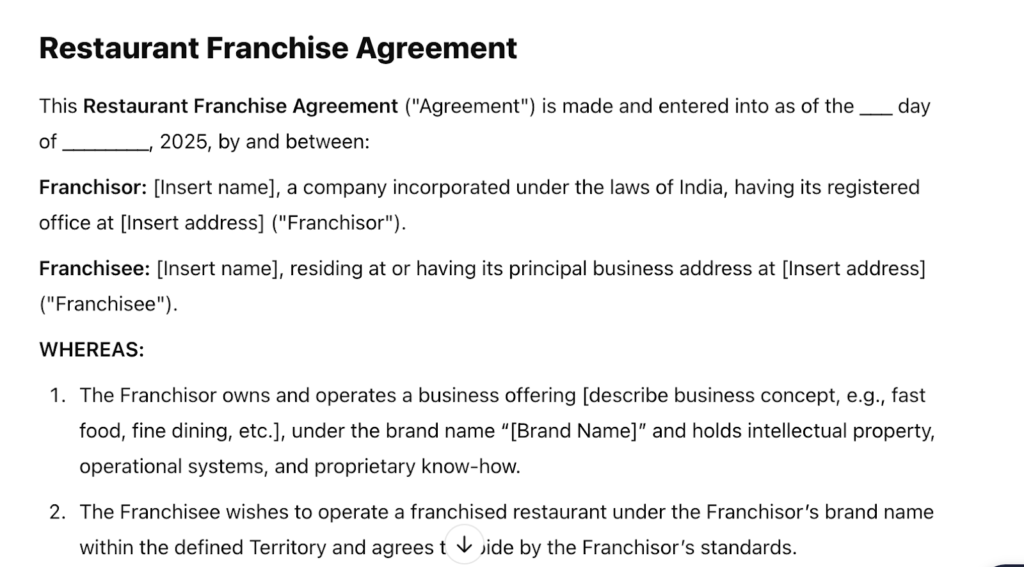
A Restaurant Franchise Agreement is a contract that lays out the terms and conditions between the franchisor, who owns the brand, and the franchisee, who runs the restaurant. It lays out what both parties can expect from each other, making sure everyone knows their rights and responsibilities for a clear and safe agreement.

Essential elements to include when drafting a Restaurant Franchise Agreement in India 2025

When putting together a solid franchise agreement, it’s a good idea to think about adding these important sections:

#1. Getting Started and Key Concepts

  • Give definitions for important phrases such as “Territory,” “Franchisee,” “Franchisor,” and “Confidential Information.”
  • Briefly explain the agreement’s aim and business plan.

#2. Distribution of Franchise Rights

  • Give the franchisee specific rights, like the ability to use intellectual property and trademarks.
  • Receive exclusive recipes, training resources, and operational guidelines.
  • Let’s talk about what kind of territory we’re looking at for the franchise—whether it’s going to be exclusive or non-exclusive.

#3. Duration and renewal clauses

  • Typically, the duration of the agreement is anywhere from five to ten years.
  • Let’s go over the renewal terms, like the conditions for renewal, any fees involved, and the performance benchmarks we need to meet.

#4. Payments & Fees for Franchises

  • Let’s talk about the financial obligations, starting with the initial franchise fee.
  • The regular payment of royalties (either as a fixed sum or a percentage of sales).
  • Contributions to marketing and advertising.
  • Let’s make sure to add in the payment schedules and what happens if payments aren’t made.

#5. Training and ongoing assistanc

  • Let’s talk about what the franchisor needs to do when it comes to training, both at the start and as time goes on.
  • Specify the methods for managing the supply chain, ensuring quality, and providing operational assistance.

#6. Standards for Operations

  • Among the requirements for preserving the reputation of the brand should be the following: Menu uniformity.
  • Guidelines for hygiene and safety.
  • Let’s talk about customer service benchmarks.

#7. Promoting and Advertising

  • It should be made abundantly clear that the franchisee is responsible for participating in both regional and national advertising campaign initiatives.
  • Let’s talk about how we’ll gather and use the funds for advertising.

#8. Protecting Intellectual Property

  • Specify in detail who may use what of the franchisor’s intellectual property, including trademarks and logos.
  • Make sure to add rules about using it without permission.

#9. Sections Regarding Confidentiality and Non-Compete

  • Safeguard confidential information like business plans, training manuals, and recipe books.
  • Make sure the franchisee can’t start any competing businesses while the agreement is in effect and for a set time after it ends.

#10. Strategies for Termination and Exit

  • Specify the circumstances that will allow one party to terminate the agreement, for example:
  • Breaking a contract.
  • Not hitting those sales targets.
  • Provide the franchisee with a plan for leaving the business, such as selling or transferring the franchise.

#11. Resolving Disputes

  • Indicate if arbitration or mediation will be used to settle disputes.

#12. Additional provisions

  • To handle unanticipated circumstances, discuss force majeure clauses.
  • Add provisions for severability, notices, and changes.

Understanding the Legal Considerations in India for 2025

#1. Following Indian Franchise Laws

Although India does not have any particular regulations pertaining to franchises, franchise agreements need to adhere to:

  • The Indian Contract Act, 1872.
  • The Competition Act, of the year 2002
  • The Trademarks Act, 1999 (for IP protection).

#2. The Consequences of Taxation

  • Examine the effects of GST on royalties and franchise fees.
  • Make sure both sides understand their tax responsibilities clearly.

#3. Privacy and data protection

  • Due to the Digital Personal Data Protection Act, 2023, include terms about client data handling in the agreement.

How To Franchise Your Restaurant Business Successfully in India 2025

Here are some important tips if you follow, you will be able to successfully grow your restaurant business across the country.

  • Tailored Services: Keep away from one-size-fits-all templates and instead make the agreement work for your restaurant chain.
  • Being clear and open: Make sure to use straightforward language to prevent any misunderstandings that might cause conflicts.
  • Get in touch with legal experts: Team up with legal pros who know Indian franchise law inside and out to make sure you’re compliant and steer clear of any loopholes.
  • Consistent Updates: Whenever there is a change in legislation, market circumstances, or company objectives, it is important to review and revise the agreement.
  • Shared Advantages: Create an environment where you and franchisees may work together in harmony by dividing up their respective interests.

Restaurant Franchise Agreement Template in India

This template is just the beginning. To make sure your agreement is legally binding and enforceable, it’s a good idea to have a professional who knows Indian franchising laws take a look at the document. They can help customise it to fit the unique needs of your restaurant brand.

To Conclude,

A solid Restaurant Franchise Agreement is key to safeguarding your brand and building an effective collaboration in India’s vibrant restaurant scene. If franchisors and franchisees focus on the essential elements, stick to the legal guidelines, and embrace best practices, they can create a business model that’s both sustainable and profitable.

If you’re thinking about franchising your restaurant in 2025, it’s a good idea to chat with legal experts at Sparkleminds. They can help make sure your agreement is in line with the latest trends and regulations in the industry. A strong franchise agreement serves as your success’s road map and is more than just a written document.

Loading