Cost of Franchising A Business in India- 7 Steps To Business Growth

Written by Sparkleminds

Written By: Resham Daswani, Sparkleminds Editorial Team – Updated August 2026

Introduction

If you’re a business owner asking “what is the cost of franchising a business in India,” here’s the short answer: turning your business into a franchise typically costs anywhere between ₹7 lakh for a lean, single-city launch and ₹60 lakh or more for a nationally ready franchise system, depending on how much groundwork — legal documentation, training manuals, brand identity, and franchisee support systems — you put in place before you sign your first franchise partner.

cost of franchising

That’s a big range and for good reason: franchising isn’t a product you buy for a certain price, it’s a system you construct and then license out over and over. Get the system right and each new franchisee is a low risk, capital-light opportunity to increase your presence without having to open and fund every new site yourself. In this write up, we break down just where that setup cash goes, what causes it to rise and fall, and how to actually budget for it before you bring your business to market.

India’s franchise market, in four numbers:

  • ₹800 billion market size today, growing 30–35% a year — one of the fastest-growing franchise markets on earth. [Source
  • 4,600+ active franchisors already running close to 2 lakh outlets nationwide. [Source]
  • 50% of new franchise expansions now land in Tier 2 and Tier 3 cities, not just metros.[Source]
  • USD 140–150 billion — where the market’s headed in the next five years. [Source]

This is exactly why so many Indian business owners are exploring franchising right now — but building the system correctly the first time is what separates a brand that scales smoothly from one that runs into disputes and stalled growth.

Key Takeaway: Franchising your business in India typically costs ₹7 lakh for a single-city launch to ₹60 lakh+ for a nationwide system — most of that going into legal setup, training, and franchisee recruitment, not store openings.

What Does It Actually Cost to Franchising Your Business in India?

Franchising your business is really about turning your operating model into a repeatable, licensable system that someone else can operate successfully, and that transition isn’t free. The cost is mostly not opening a new store but building the system that makes a new store possible.

Here’s a realistic breakdown of what business owners spend when they franchise their brand in India:

Cost Component

Typical Range (INR)

Covers

Legal docs (FDD, agreement)

₹1L – ₹5L

Contracts, IP protection

Trademark registration

₹15K – ₹1L

Brand & logo protection

Operations manual / SOPs

₹1L – ₹4L

Process & training docs

Brand identity & collateral

₹1L – ₹5L

Store design, signage

Franchise recruitment

₹2L – ₹15L

Portals, ads, consultants

Training infrastructure

₹1L – ₹6L

Onboarding, staff training

Technology (POS/CRM)

₹1L – ₹10L

Billing, inventory, reports

In contrast, a single-city, local franchise rollout can reasonably start at approximately ₹7-10 lakh. But a brand that wants a pan-India, investor-ready franchise system generally needs ₹25-60 lakh for the first year alone. If you have more sophisticated activities (multi format retail, food production units, healthcare) in your business you should anticipate to be at the higher end of that spectrum.

What Factors Decide How Much It Costs to Franchising Your Business?

No two franchise budgets look the same. Your cost of franchising climbs or shrinks based on:

  • Complexity – Kiosks franchise cheap. Kitchens don’t.
  • Geography – One city is a budget line. A national rollout is a business plan.
  • Brand pull – Known name, cheaper recruitment. Unknown name, bigger marketing spend.
  • Support promised – More hand-holding for franchisees means more cost for you.
  • Legal depth – Pay more upfront on your FDD, pay far less in disputes later.
  • Consultants – Adds ₹2–8 lakh, but usually saves you from an expensive first-year mistake.

What Types of Franchise Models Should You Choose — and What Do They Cost?

The franchise model you build changes both your setup cost of franchising and how much ongoing control you keep:

  • Business format franchise – You license the whole playbook: branding, layout, pricing, service. India’s most common model. Costliest to build, most consistent to run.
  • Product distribution franchise – Franchisees sell what you supply. Cheaper to set up, but you’re handing over more of the day-to-day control.
  • Manufacturing franchise – Franchisees produce using your formula. Equipment and quality control push the cost up.
  • Service franchise – Cleaning, tutoring, salons — franchisees deliver under your name. Usually the lightest, cheapest model to launch.

Choosing the right model upfront matters more than most business owners expect — switching midway (say, from distribution to full business format) usually means redoing your legal documentation and training systems from scratch.

What is the right price for each of the royalty fee and franchise fee?

This is one of the most common questions first-time franchisors ask, and the wrong answer either way might hinder your growth.

  • Franchise fee – One-time, upfront. The price of entry into your brand and systems. ₹1 lakh–₹30 lakh in India, depending on brand strength.
  • Royalty fee – Ongoing, monthly or quarterly. A cut of franchisee revenue, typically 4–10%. This is what keeps your support and marketing funded.

Price the fee too high and good franchisees walk away. Price the royalty too low and you can’t afford to support the ones who stay.

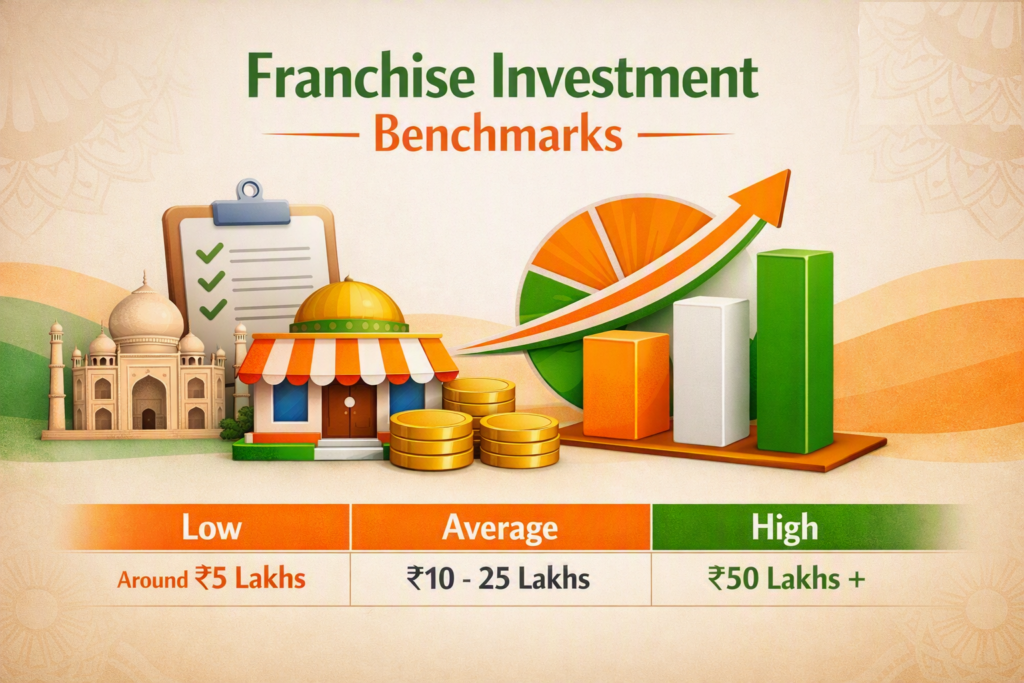
Franchise Fees and Franchisee Investment Industry Benchmarks

Before you finalise your own numbers, it helps to know what’s competitive in your sector — set your total franchisee investment too far above the market and you’ll struggle to recruit; set it too low and you’ll undersell your brand.


Industry

Typical Franchisee Investment

Typical Franchise Fee

QSR (fast food)

₹15L – ₹50L

₹3L – ₹10L

Grocery / supermarket

₹14L – ₹40L

₹2L – ₹8L

Education & coaching

₹5L – ₹25L

₹1L – ₹5L

Salons & wellness

₹8L – ₹30L

₹2L – ₹6L

Retail & D2C brands

₹8L – ₹50L

₹2L – ₹5L

Real estate brokerage

₹3L – ₹10L

₹1L – ₹3L

ATM / payment kiosks

₹1L – ₹5L

Nil – minimal

Cleaning & home services

₹1L – ₹8L

₹50K – ₹2L

Figures are indicative industry ranges — your own numbers should reflect your brand’s actual unit economics, support level, and market positioning.
cost of franchising

What Cost of Franchising Do Business Owners Often Underestimate?

Many first-time franchisors budget for the visible costs — legal fees, branding, a recruitment push — and then get caught out by the ones that show up later. Plan for:

  • Ongoing support – Field visits and refresher training that only get more expensive as you scale.
  • Quality audits – Non-negotiable once you’re past 10–15 outlets. One bad location damages every location.
  • Tech upgrades – Your POS and CRM won’t stay current on their own.
  • Disputes & renewals – Legal costs don’t stop at signing; they resurface at every renewal and exit.
  • Marketing fund upkeep – Collecting the fund is easy. Deploying it fairly across your network isn’t.
  • Franchisee financing help – Bank and NBFC tie-ups widen your applicant pool, but someone has to set them up.

Franchise My Business Or Expand Via Company-Owned Outlets?

This is a genuine strategic trade-off, not a simple “franchising is always cheaper” answer. Opening company-owned outlets necessitates the funding of 100% of the capital and the assumption of all operational risk; however, you retain full control and 100% of the profit. Franchisees take up most of the capital and local operational risk in exchange for a smaller, recurring revenue share through royalties.

Because franchising transforms years of trial and error into a system that can be licensed out instead of having to re-deploy capital at each new location, it is often considered the fastest and most capital-efficient way for enterprises to scale. In exchange for authority over a network of independent operators, not employees, a good franchise agreement and support system are crucial.

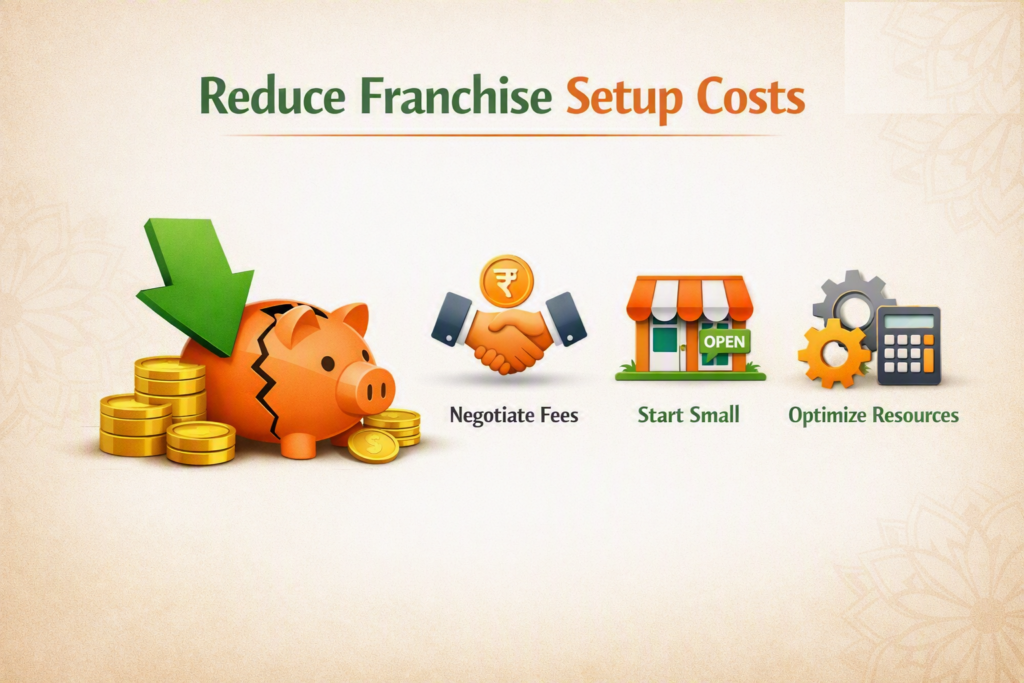
How Can You Reduce Your Setup Cost Of Franchising?

A few practical moves bring your budget down without cutting corners on quality:

  • Pilot one region before you build for the whole country.
  • Reuse legal templates — customise with a lawyer instead of drafting from zero.
  • Train digitally — video SOPs beat a physical training centre, at first.
  • Consulting early is cheaper than fixing a flawed model later.

Also Read: A detailed guide on cost of franchising in India
cost of franchising

In Conclusion – A Summary Showing Cost Of Franchising Your Business

Every franchise journey looks different, and the numbers above are meant as a starting benchmark, not a fixed quote. If you’re planning to franchise your business, a proper cost and feasibility assessment will save you far more than it costs. 

At Sparkleminds, our goal is simple — to make franchising easier, safer, and more profitable for business owners. From legal documentation to franchisee recruitment and training, we provide complete support so you can focus on growing your brand. With decades of experience and thousands of successful rollouts, we’re trusted by entrepreneurs across India to turn their expansion dreams into reality.

Connect with Franchisebazar, if you are an investor or first time buyer who wants to start or know the costs of franchising journey in India today.

Want To Know What Our Clients Are Saying About Us – Testimonials

FAQs – Cost Of Franchising Common Queries

Franchising a business costs how much today?

Considering legal documentation, basic SOP operational manual and no marketing, a single-city setup generally costs around 5 to 7 lakhs approximately. Most businesses budget higher for a stronger, dispute-proof system.

How much can I earn back from franchising my business?

Most Indian franchisors recover their initial setup cost within the first 3–8 franchise sign-ups. After that, franchise fees and royalties become largely profit.

Do I need a lawyer to franchise my business in India?

Yes. Your franchise agreement is governed by the Indian Contract Act, 1872, and a poorly drafted FDD or agreement is one of the most common causes of franchisor-franchisee disputes — this isn’t a step to DIY.

How much should I charge for royalties in India on average?

Most Indian franchise models charge 4%–10% of gross income as a royalty. ATM and kiosk franchises may be free.

What’s the franchise system setup time?

The majority of businesses need 2-4 months to finalise legal papers, SOPs and marketing materials before onboarding their first franchisee, although this may differ depending on the intricacy of the firm.

What documents are needed to franchise in India?

At the very least: franchise agreement and trademark registration. An FDD isn’t legally mandated in India yet, but having one is considered industry best practice and builds franchisee trust.

Is GST applicable on the franchise fees and royalties I charge?

Yes. Franchise fees and royalty payments are treated as a supply of service and attract 18% GST, payable by your franchisee to you.

Should I offer a single-unit or a master franchise model?

A single-unit franchise gives one franchisee rights to one outlet — easier to manage early on. A master franchise is a right to a whole city, state or region. The master franchisee then sub-franchises you. It scales faster but with a significantly better legal and operational structure up front.

Can I negotiate my franchise fee?

It depends on your brand’s demand. Early in your franchise journey, some flexibility (especially for multi-unit commitments or pilot locations) can help you land strong first franchisees. Once your brand has proven demand, negotiating less protects your brand’s perceived value.

Should my franchise costs differ between metro cities and smaller towns?

Your franchise fee and royalty structure can usually stay consistent nationwide, but expect franchisees in Tier 2 and Tier 3 cities to face 30–50% lower rent and fit-out costs than in metros. Nearly half of all new franchise expansions in India now happen outside metro cities — worth building a lower-investment format if you want to tap that growth.

Should I help franchisees arrange financing?

It’s increasingly common. Several franchisors tie up with banks or NBFCs so franchisees can access business loans more easily — this widens your pool of serious applicants, especially for higher-investment formats.

What break-even timeline should I promise franchisees?

Set expectations carefully: most franchise outlets in India break even in 18–36 months, though low-investment formats can break even faster. Promising an unrealistically fast break-even is a common cause of franchisee disputes later.


 

Loading

Franchise Marketing Strategies Driving Business Expansion in India

Written by Sparkleminds

One of the most dynamic engines for the expansion of businesses in India is the franchise industry, which has emerged as one of the most dynamic industries in recent years. Franchises are supporting business owners in expanding their operations at a rate that is faster than ever before. This is happening across a wide variety of industries, including education, retail, and health care, amongst others. Furthermore, a successful franchise is not merely a sound business model. Rather, it is the degree to which the brand is able to sell itself in such a way as to attract franchisees, customers, and investors. This is the key to a successful franchise. Utilising franchise marketing strategies allows for the establishment of connections between a brilliant idea and a successful national brand. These connections can be quite beneficial.

franchise marketing strategies

When it comes to marketing in today’s economy, which is in dominance by digital technology, traditional methods such as print advertisements and word of mouth are no longer adequate.

The use of

  • omnichannel marketing strategies,
  • content that is an optimization for search engine optimisation (SEO),
  • exposure in local search engines,
  • consumer analytics supported by artificial intelligence,
  • and collaborations with influential individuals.
  • The proprietors of firms who have interest in developing their operations in the extremely competitive market that exists in India consider these techniques to be of the utmost significance.

The purpose of this essay is to provide franchise owners and persons who are contemplating becoming franchisors. Moreover, with a thorough strategy for achieving their goals.

  • A breakdown of the most essential marketing tactics,
  • a discussion of how these strategies generate growth,
  • and an explanation of why investors have more focus on these strategies

are all part of this article.

I am confident that by the time you reach the conclusion of this, you will have a complete comprehension of how to position your franchise for expansion. And also how to utilise marketing in order to spread across India.

Despite the fact that the United States of America is the largest franchise market in the world, India is the second largest franchise market in the world.

A Growth-Inducing Factor

As a result of having more discretionary income, those who belong to the middle class are spending more money on experiences that are in association with such brands.

It is becoming increasingly difficult for franchises to keep up with the competition. This is so as tier-2 and tier-3 cities become more urbanised.

As a result of the widespread adoption of digital technology, consumers are now able to learn about businesses online. Nonetheless, before they visit physical stores.

The following is the main argument that we present to prospective investors. Franchising is all about ensuring a return on investment and providing solutions that are scalable.

Strategic Marketing Methods and the Powerful Effects They Have

In spite of the fact that franchises are in high demand, they will not be successful. That is if the franchisees are unable to adequately pitch themselves to potential customers. Moreover, when it comes to generating brand awareness, dealing with lead creation, and convincing investors that the company is scalable, the marketing department is the engine that puts it all together.

The adoption of franchise marketing strategies allows businesses to differentiate themselves from those that are unable to penetrate the highly competitive Indian market. These businesses are able to grow their operations across the country.

1. The importance of search engine optimisation and digital marketing services as fundamental franchise marketing strategies for franchising

Using search engines is one of the first things that potential consumers and franchisees do when they are looking for a business. It is important to increase your exposure for keywords. Especially those that are currently at the top of the results, such as

  • opportunities to franchise a luxury salon
  • and franchise opportunities in India.

One of the components of local search engine optimisation is the process of improving the Google Business Profile. This is to be for each independent branch.

It is the process of developing material that provides direct solutions to queries. Moreover, in order to maximise the possibility that it will appear in the results of voice searches and featured snippets. This process is famous as Answer Engine Optimisation (AEO).

2. Content Marketing

“Content is the currency of trust and authority,” says the second point in the marketing strategy. The positioning of thought leadership through the use of case studies, success stories, and insights from a certain industry by means of a company.

  • Whitepapers on the Return on Investment Model, Written by Investors
  • Customer testimonials from happy clients who have provided comments on their experience.
  • Educational blogs are a good place to look for articles. Moreover, that discuss the latest trends, difficulties, and possibilities in the franchising industry.

3. The usage of several social media platforms

It is possible that you will be able to successfully market your company through the use of social media platforms for example Instagram, Facebook, and LinkedIn.

  • It is through Instagram loops that the experience of the outlet comes to light.
  • Investors and franchisees are the people that have an interest in reading postings on LinkedIn.
  • Facebook advertisements: Grow your business locally with audience specific advertisements.

4. The franchise marketing strategies of influencers and partners make up the fourth strategy.

Developing a relationship of trust with powerful members of your community is achievable through collaborative efforts. Assist in broadening your audience by establishing collaborations with companies that have similar beliefs to your own, such as fitness centers and nutrition stores.

5. Marketing and Artificial Intelligence in the New World

  • Artificial intelligence (AI) is to improve both efficiency and customisation.
  • Utilise predictive analytics to determine which of your customers are the most valuable to you.
  • Various methods by which chatbots can provide responses to questions concerning franchisees
  • Automated marketing activities direct their attention to leads that are based on their behaviours.

Campaigns that are carried out over a number of different channels (both the offline and digital channels) need a connection to other channels). It is an expectation that a customer will have the same experience when they visit a store as they do when they watch content that is comparable on a Facebook advertisement.

How Marketing Contributes to the Acceleration of Growth

The Growth of Franchises in the Industry

The value proposition that marketing offers is something that prospective franchise partners show interest in. In order to instill confidence in franchisees that the brand is an investment that is worth making, it is necessary to provide them with transparent return on investment (ROI) models, success stories, and digital visibility.

The demand that is being generated from customers

In order for the franchisees to achieve success, it is necessary for the client to actually walk through the door. Numerous factors, including local search engine optimisation, targeted advertising, and loyalty programmes, have contributed to the consistent demand.

Invitation to Potential investors.

There are a lot of marketing measures that investors take into consideration, some of which include customer acquisition cost (CAC), repeat purchase rates, and brand visibility. There is an implication that effective marketing tactics are set to be scalable.

New Markets Coming into Existence

Prior to the establishment of stores, marketing helps franchisees become ready for entry into Tier-2 and Tier-3 cities. This preparation is possible by marketing. Creating buzz is primarily possible by geo-targeted advertising and cultivating relationships with key individuals.

Over the course of around 600 words, some examples of successful franchise marketing strategies in India When it comes to a franchise, marketing is an aspect that is even more significant than it is for any other kind of small business.

A franchise is a type of business idea that enables a corporation to expand its operations by issuing a licence to an individual or group to operate a business using the company’s brand and identity. This allows the corporation to grow its operations. Because of this, the company is able to expand its activities.

This business model is relatively successful in India, as demonstrated by the quick expansion of a number of franchisees who have successfully become well-known in their respective fields. However, the Food and Drink Quick Service Restaurant (QSR) company expanded to twenty cities from Bengaluru by utilising Instagram video and local search engine optimisation.

This was done in order to expand their business. There shows an increase in the number of questions regarding franchises generated by blogs that were optimised for search engines and published information about franchise opportunities in India.

Involved in education are: 

Preparation of Whitepapers on return on investment (ROI), and employment of LinkedIn marketing, with the intention of acquiring investors for the educational technology franchise. At the end of the first two years, it had established a presence in fifty various companies around the nation.

Allure and health and wellness

One salon chain to deploy reward systems that were powered by artificial intelligence in order to achieve a thirty percent increase in the number of customers who returned for further services. Those who made investments were pleased with the reliable streams of revenue that were the driving force behind the quick expansion.

The risks associated with marketing a franchise

Spending on non-recorded marketing: The possibility exists that you are squandering money on marketing if you do not track return on investment (ROI).

  • a brand that does not continue to be the same. The outlets are not very adept at managing campaigns, and as a consequence, the individuality of the brand is being reduced as a result of this.
  • Delay in the adoption of artificial intelligence by franchisees. It is probable that franchisees will not immediately employ AI products, which will subsequently interfere with efficiency.
  • A market that is already saturated: If you enter a category that is already crowded without delivering something that differentiates you from the competition, you won’t have much of an impact on the market.
  • The adoption of centralised marketing control, the training of franchisees, and an emphasis on distinctive brand positioning are all examples of techniques that can be used to mitigate the risk.

The Road That Lies Ahead for the Promotion of Franchises in the Indian Market

There will be a vast deal of significant shifts in marketing over the course of the next ten years. That includes:

  • In terms of Voice Search, optimise the following. AEO would be absolutely necessary in light of the fact that an increasing number of individuals in India are using voice assistants.
  • Micro-markets Hyperlocal Campaigns. presents that are individualised to the customer.
  • The delivery of a scalable and tailored experience is what we mean when we talk about artificial intelligence personalisation.

An activity that is good to the environment and is meant to attract customers who are environmentally sensitive is referred to as “green marketing.” Green marketing is a word that describes several actions.

It will be the franchises that are able to capitalise on these characteristics that will be in the position to lead the second wave of expansion.

Just a quick rundown 

Increasingly, franchise marketing strategies are being implemented in India, which is contributing to the expansion of enterprises in the country. They are able to achieve this by attracting franchisees, generating demand from customers. And further convincing investors that they have the ability to scale their business.

Franchisees can position themselves for national development in a number of different ways. Some of these strategies include

  • utilising search engine optimisation (SEO),
  • content marketing,
  • social media,
  • influencer alliances,
  • campaigns powered by artificial intelligence,
  • and omnichannel consistency.

Remembering that marketing is not a choice but rather the engine. Moreover, that drives growth is the single most critical thing for business owners to keep in mind that they should keep in mind. Those individuals that make investments in marketing at the present time will end up being at the forefront of the Indian franchise landscape in the future.


Loading

How to Expand Your Bookstore Business Like Crossword and Sapna Book House

Written by Sparkleminds

Small, family-run bookshops serving local readers were considered as charming community hubs in India for decades. Strangely, yet, in recent years, national and regional retail brands have replaced mom-and-pop bookshop as the primary means of expanding their business. In spite of the growth of online shopping and electronic reading, bookshop giants such as Sapna Book House and Crossword have demonstrated that brick-and-mortar establishments can thrive through franchising, professionalisation, and scaling.

Today, more than ever before, there is an opportunity for bookshop owners. Creating experience-driven retail locations is becoming more important for bookshops in India as the middle class expands, disposable incomes rise, and there is a revived cultural focus on education, reading, and lifestyle spending.

Taking a page out of Crossword and Sapna Book House’s playbooks, this blog delves into how you, as a bookshop owner, can make your single outlet a recognised brand, all while taking advantage of new market trends, franchising models, and investor interest in India’s developing retail industry.

Why it’s a smart idea to expand your bookshop business in 2025

Once Again, Reading Is Popular

  • Among millennials and Generation Z, reading is making a comeback as a popular pastime, particularly in major cities and secondary urban areas.
  • Booksellers have become more of a social hub due to the proliferation of reading groups, author events, and Bookstagram communities.

We are seeing a boom in hybrid retail models.

  • Nowadays, you may find more than just books at a bookshop; many now also have cafes, offices, toys, lifestyle items, and even coworking spaces.
  • More customers and more money in the tills are the results of this “retail plus experience” strategy.

The Perspective on Education and Gifting

  • Books for children’s learning, competitive tests, and academic resources will always be in demand in India’s education-driven economy.
  • If you’re looking for high-quality stationery, games, and collectibles, a bookshop is a great place to find them.

How You Can Make Your Bookstore Business A National Brand Like Sapna Bookstore Or Crosswords – Lessons & Insights

The lifestyle-oriented bookshop brand known as Crossword

  • In terms of positioning, Crossword positioned itself not only as a bookshop but also as a lifestyle destination, positioning itself frequently in malls that receive a lot of foot traffic.
  • As part of their diversification strategy, Crossword franchises now also sell stationery, toys, games, and lifestyle products in addition to books.
  • Franchise Model: Crossword has become one of the most well-known bookshop chains in India as a result of its successful expansion across the country through franchise partnerships.

The Scale-Driven Bookshop Brand: Sapna Book House

  • Having its origins in the field of education, Sapna started out as an academic bookshop and eventually expanded to become one of the most successful book shops in Asia.
  • In addition to books, multi-category retailing include other products such as stationery, office supplies, and educational aids, which results in the creation of several revenue streams.
  • Digital Expansion: Sapna was an early adopter of e-commerce, which allowed the company to supplement its brick-and-mortar shopfronts with online sales.

One thing that business owners should take away from this is that both Sapna and Crossword were successful because they went beyond books, concentrated on the customer experience, and leveraged the scalability of franchises.

A Step-By-Step Guide To Franchising Your Bookstore Business Across India

The first step is to identify your unique positioning.

  • Are you going to be more of a lifestyle-focused Crossword or an academic-driven Sapna?
  • Would you be able to develop a specific focus, such as bookshops catering to children, literature in regional languages, or book cafés?

Build a Variety of Income Sources:

  • To boost in-store spending, consider adding a cafe or shared office space.
  • Present a selection of office supplies, games, puzzles, pencils, and also other lifestyle items.
  • To increase participation, hold author events, seminars, and book clubs.

Consider a Franchise-Friendly Approach

  • Establish a uniform store design and assortment of products.
  • Ensure consistent client experience by creating franchise training materials.
  • Assist partners with their supply chains and facilitate centralised procurement.

Maximise the Potential of Technology

  • Introduce a reader loyalty program or app to your store.
  • For hybrid offerings, team up with edtech companies or audiobook platforms.
  • Keep tabs on demand for various categories with the help of inventory tools powered by AI.

Reach out to cities in Tier-2 and Tier-3

  • Market your company to young people in the workforce. Also, in school by portraying it as an ideal place to live.
  • Provide store formats that are ideal for smaller cities, with 1,500 to 2,000 square feet of space.
  • Collaborate with nearby educational institutions to get bulk orders and more exposure.

Future Trends That Are Driving the Expansion of Bookshop Businesses

  1. Blending the tradition of reading with that of coffee, book cafés are popular in metropolitan areas and high-end shopping malls.
  2. Children’s play areas, gaming zones, and augmented reality and virtual reality storytelling sets are examples of experience-first retailing.
  3. The sustainability angle includes environmentally friendly stationery, products made from recycled paper, and branding with a green motif.
  4. The growing demand for books written in Marathi, Bengali, Tamil, and Hindi in tier-2 cities is the focus of this regional language spotlight.
  5. Complementing the tendencies of e-commerce, digital-physical hybrid models include the ability to place orders online and pick them up in-store.

The Opportunity for Franchise Growth

To expand a bookshop business in India, the franchising model is quickly becoming the most lucrative route to take. To explain why:

  • Low initial Costs — When compared to franchises in the food and beverage industry or the fashion industry, bookshop franchises demand a considerably lower initial. Also, operational cost expenditure.
  • Demand that is Consistent Books and stationery are in high demand throughout the entire year, particularly in markets that are dependent on education.
  • Bookshops naturally become cultural hubs, which drives customer loyalty and word-of-mouth marketing. This is an example of community engagement.
  • Scalability is the state of being able to replicate a standardised bookshop model across multiple places without sacrificing its distinctiveness.

The Investment Spectrum:

  • The price range for small-format bookshops, which range from 800 to 1,200 square feet, is ₹20 to 30 lakhs.
  • The price range for lifestyle bookshops that are above 2,000 square feet is between ₹50 lakhs and ₹1 crore.
  • Timeline for Return on Investment for Franchises: 2.5–3.5 years, depending on the city and format.

Conclusion: Transform Your Bookshop Into a Powerhouse Brand

Indian bookshops are capitalising on a new economic and cultural upswing. Moreover, which is changing the face of retail in the country. The profitability of bookshop business expansion is not only feasible, but also highly profitable, as evidenced by the success of Sapna Book House and Crossword. This is particularly true when franchise scalability, hybrid merchandising, and strategic positioning are implemented.

The time has come for you, if you are the proprietor of a bookshop presently. You are able to develop a single outlet into a recognizable chain that connects with India’s aspirational consumers if you construct a powerful brand identity, diversify your services, and adopt a franchise model on your bookshop business.

Are you considering turning your bookshop into a famous brand on a national scale? We at Sparkleminds are experts in assisting proprietors of bookshops in the development of lucrative franchise models. Also, the establishment of connections with investors, and the attainment of seamless scaling across India.

Contact Sparkleminds today to collaborate on the next significant success story in the expansion of the Indian bookshop industry.

Loading

Best Industries For Franchise Expansion in India 2025–2026: Where Smart Retail Business Owners Should Invest Next

Written by Sparkleminds

As a retail business owner in India today, you have likely experienced the urgency to accelerate growth, expand beyond your local market, and secure a greater share of the market ahead of your competitors. The positive development? India in 2025–2026 presents a highly dynamic landscape for franchising opportunities. As disposable incomes increase and aspirations rise in Tier II and Tier III cities, along with the prevalence of digital-first consumer behaviours, franchising emerges as a strategic and secure pathway for expansion. However, the critical inquiry that every driven entrepreneur is posing is: Which industries currently present the most promising opportunities for franchise growth?

By achieving this, you are not merely expanding; you are significantly enhancing your growth potential in one of the most profitable markets globally.

Reasons for Retail Business Owners to Consider Franchising in 2025–2026

As a retail entrepreneur, you have likely established a dedicated customer base, a robust supply chain, and a validated business model. Scaling across India involves more complexities than merely opening new branches. Expenses accumulate, operations grow intricate, and regional specifics complicate management.

Franchising plays a crucial role here. This enables you to:

  • Accelerate growth while preserving capital.
  • Utilise the networks and expertise of local franchise partners.
  • Establish brand visibility in multiple cities at the same time.
  • Maintain your competitive edge as both national and international entities enter the Indian market.

With India’s consumer spending expected to exceed $6 trillion by 2030, the period of 2025–2026 presents an ideal opportunity for retail business owners to consider franchise expansion.

Top Industries for Franchise Growth in India 2025–2026

Franchise prospects in these industries are not only increasing but also blowing up.

Food & Beverage (F&B) – Continues to Dominate the Franchising Landscape

Regardless of changing trends, India’s passion for food guarantees that the food and beverage sector continues to thrive. The franchise sector is currently dominated by a diverse range of opportunities, including quick-service restaurants, cloud kitchens, unique cafés, and regional snack chains, making it highly attractive for potential franchisees.

Reasons for increased interest in these franchise industries in 2025–2026:

  • Customers seek convenience and a diverse range of options.
  • Emerging food brands are rapidly gaining the attention of investors.
  • Cost-effective investment options enable growth potential in metropolitan and Tier II markets.

For retail owners: If you currently operate a successful restaurant, café, or packaged food business, franchising presents a strategic opportunity to elevate your brand to a household name throughout India in a remarkably short timeframe.

EdTech and Skill Development – A Growing Opportunity

Given India’s status as one of the youngest nations globally, the education sector remains resilient against economic downturns. In the post-pandemic landscape, there has been a notable transition from conventional coaching centres to a strong emphasis on EdTech, skill development, and hybrid learning models.

The reasons for increased interest in 2025–2026:

  • Government initiative to enhance skill development and promote digital learning.
  • Significant demand exists in semi-urban and rural markets.
  • Parents are placing education at the forefront of their investment strategies.

Opportunity for retail owners: For retail brands with an education or training component—such as after-school tutoring, coding classes, or vocational courses—now is an ideal opportunity to grow through franchising.

Healthcare and Wellness – An Essential Industry

Wellness has become an essential component of modern business strategy. Across various sectors, including diagnostic labs, fitness chains, Ayurvedic spas, and healthy food stores, Indian consumers are making significant investments in preventive healthcare and lifestyle wellness.

The reasons for its prominence in 2025–2026:

  • Expenditure on preventive healthcare is experiencing significant growth, with increases in the double digits.
  • Fitness and wellness are gaining traction in smaller towns.
  • Recurring customer demand attracts investors.

As a retail owner, you have a unique opportunity: If you manage a health product brand, pharmacy chain, or wellness centre, franchising can provide you with a competitive edge in smaller cities eager for modern healthcare solutions.

Aspirations in Fashion and Lifestyle Are Growing More Rapidly Than Incomes

Gen Z and millennials in India are fuelling the need for reasonably priced yet fashionable apparel, accessories, and lifestyle goods. Regional companies are achieving national success by franchising their boutique, innerwear, and athleisure brands.

The reasons for its prominence in 2025–2026:

  • Social media is driving significant demand for niche brands.
  • Consumers in Tier II and III markets are seeking branded fashion options that are priced affordably.
  • The integration of e-commerce and offline retail is driving the emergence of omnichannel demand.

For retail owners: If you operate a boutique or fashion retail store, franchising presents a strategic opportunity to expand your local brand to a national level quickly.

Innovative Retail and Electric Vehicle Ecosystem – Embracing the Future

India’s initiative towards electric vehicles (EVs) and innovative retail formats is attracting significant attention from investors. Electric vehicle charging stations, electric vehicle showrooms, and retail technology enterprises such as smart kiosks are thriving.

The factors driving interest in 2025–2026:

  • Incentives from the government to promote the adoption of electric vehicles
  • Emerging consumers favour solutions that are both sustainable and technologically advanced.
  • Retail owners have the opportunity to expand their portfolios with innovative business ventures.

Retail owners have a significant opportunity: regardless of whether your existing business is traditional, you can expand into the EV retail sector or retail technology through franchising. This approach effectively safeguards your growth strategy for the future.

How to Select the Right Sector to Work in

As a businessman, consider these 3 steps to determine the most suitable franchise expansion sector for your business:

  • Leverage Your Core Competencies – Select an industry that aligns with your current expertise or customer demographic.
  • Analyse Local Demand – Identify which sectors are lacking adequate service in your target markets.
  • Evaluate Franchise Investment Models – Align your growth objectives with the financial capabilities of franchisees for 2025–2026.

Conclusion: Optimise Your Success in 2026 with an Effective Franchise Strategy

India’s retail ecosystem is advancing rapidly, and opportunities are set to expand significantly in 2025–2026. For retail business owners, pinpointing the most advantageous industries for franchise expansion is now centred on strategic decision-making that guarantees sustained profitability.

If you are committed to expanding your brand on a national scale, you don’t have to navigate this journey by yourself. Introducing Sparkleminds, a premier franchise consulting firm in India. With more than twenty years of experience in franchising, Sparkleminds assists retail business owners in developing the optimal franchise model, securing qualified investors, and establishing a strong brand presence both in India and internationally.

Make your decision before 2026. Schedule a consultation with Sparkleminds today and transform your retail operation into a leading franchise success in India.

FAQs

What advantages do retail business owners gain by opting for franchising instead of expanding with additional branches?

Franchising enables rapid expansion with reduced capital investment, utilises the expertise of local partners, and fosters a nationwide brand presence while ensuring profitability.

Is EdTech franchising still a viable investment following the pandemic?

Affirmative. There is a significant demand for hybrid learning, skill development, and after-school tutoring services. There is significant growth being driven by parents and students in semi-urban markets.

What strategies does Sparkleminds offer for expanding my retail business into a franchise model?

Sparkleminds assists business owners in developing tailored franchise models, formulating franchise agreements, recruiting franchisees, and strategically scaling operations throughout India.

Loading

Is my business ready for franchising in India in 2026

Written by Sparkleminds

I have been an Indian business owner for a long time, and I’ve always wondered: Is my business franchise ready?

It’s more than simply an interesting question; the outcome of this choice can determine the fate of any brand. The franchise industry in India has had remarkable growth over the last decade, surpassing even the United States as the world’s second-largest market.

Looking ahead to 2026, the outlook is even more bright. Tier 2 and Tier 3 cities no longer have to be global behemoths to franchise, thanks to increased disposable incomes, digital-first customers, and a strong thirst for branded experiences. Even a small, locally owned restaurant, clothing line, gym, or education technology company can now expand nationally through franchising.

The reality, though, is that not all companies are prepared to franchise. And trust me when I say that desire growth isn’t enough; I know this from experience. Profitability, systems, and a story behind your brand that others can follow are essential.

Consequently, if you’re wondering, “Is my business ready to franchise in India in 2026?”—I wish I had this information when I was starting out.

If You Were to Franchise Your Business, What Would It Signify?

When you offer your brand, processes, and business model to other people (franchisees) in return for a royalty payment and a franchise fee, you’re essentially franchising. Consider the meteoric rise of Café Coffee Day, FirstCry, and Cult.Fit; these companies weren’t able to do it alone; they created scalable mechanisms that franchisees could use to make a profit.

Instead than being involved in day-to-day operations, your responsibility as a franchisor is to focus on:

  • Entices investors with a powerful brand identity.
  • Methods for training franchisees to provide identical service.
  • Assistance models that facilitate the success of franchise partners.

All the more reason to ask, “Is my business ready to franchise?” after this. It’s not enough to have a fantastic product; you must also be willing to delegate management of your firm to others.

Before I Invest in a Franchise, Is My Business Ready?

Years ago, while assessing my own brand, I devised a brief checklist that I now offer to other entrepreneurs. Assuming you can tick off most of these items by 2026, you will be more prepared than you believe to be franchise-ready.

Profitable for Sure:

  • Determine whether you have been successful for at least two or three years as a business owner.
  • Franchisees prefer guaranteed profits over risky ventures.

Advantage Over Competitors (USP):

  • Out of all the brands out there, why would someone pick yours? Your unique selling proposition (USP) should be compelling enough to entice franchisees, whether it’s a proprietary recipe, a tech-driven procedure, or an outstanding customer experience.

System Replicability:

  • Would it be possible to run your company without you being there in person? Franchising won’t work if your brand is successful only due to you. So that another qualified franchisee can repeat your achievement, document your SOPs (Standard Operating Procedures).

Expanding Your Business Outside Your City:

  • The key to a successful franchising model is a widely appealing product or service. Take a look at how interested individuals in different cities are in your brand. Franchising could be the next logical step if you see that Instagram orders or enquiries are coming from all over India. Social media can be a wonderful indicator of this.

Financial Stability for Expanding:

  • Initial investments are necessary for the launch of a franchise model, including but not limited to: supply chain, legal paperwork, marketing, training, and franchises. Can you afford to construct this foundation?

Infrastructure for Support:

  • When you sell a franchise, what they really get is your backing, not only your name. Is it feasible for you to offer training, logistical support, marketing, and support for vendors with the resources you have?

Therefore, saying “yes” to the majority of these should put you in the correct direction.

The Year 2026 and How It Will Revolutionise Franchising in India

There are three main developments that will cause the Indian franchise industry to surpass USD 140 billion in 2026:

  • City Growth in Tiers 2 and 3: Branded experiences similar to those in Delhi or Mumbai are sought for by customers in Indore, Lucknow, Bhubaneswar, and Coimbatore. Get in on the action in the markets that people dream about joining.
  • We Focus on Digital Franchising: It is becoming easier for business owners to remotely manage franchises with AI-driven customer relationship management resources, automated training applications and digital franchise management platforms.
  • Appetite for Investment: After the year 2025, investors are looking for chances with minimal risk and high return. If you’ve established a trustworthy brand, franchising is a great way to capitalize on it.

If you’re wondering if your business will be prepared to franchise in 2026,—the timing is perfect.

Mistakes That Many Businesses Make When Considering Franchising

I assumed expansion would happen on its own when I first thought about franchising. That wasn’t a typo. These are some of the most common blunders I notice among Indian business owners:

  • Starting a franchise without first establishing a small test market is an example of rapid expansion.
  • Facing the reality that franchise partners can’t stay in business if they lose money is ignoring franchisee ROI.
  • Absence of a formal Franchise Agreement leads to disagreements along the road.
  • Franchisees don’t have a scalable model if they are overly reliant on the brand owner for minor concerns.

Thus, the secret to establishing a franchise network that lasts is to stay away from these traps.

My Process for Assisting Pre-Franchising Business Owners

“Is my business ready to franchise?” is a question that many business owners now ask, just as it was for me in the past.

I will now provide you with the detailed framework:

  • Make a Profitability Analysis—Provide a Return on Investment (ROI) of 20-30% to Franchisees.
  • Creating Franchise Models – Select the business model that best suits your needs: franchise-owned and operated (FOFO), franchise-owned and company-operated (FOCO), or a combination of the two.
  • Establish Standard Operating Procedures and Training Modules—Develop a mechanism to guarantee alignment.
  • Protect Yourself Legally by Draughting an FDD and other Agreements.
  • Sell to Potential Backers – Present your brand as more than simply a company; make it an opportunity.
  • To test the waters and identify potential problems, launch with one or two franchise locations.
  • Instead than going national all at once, scale slowly by expanding city by city and region by region.

Thanks to this plan, a number of Indian company owners can now state with certainty, “Yes, my business is ready to franchise.”

Some Suggestions for Business Owners in 2026

My recommendation if you’re sitting on a prosperous company and asking, “Is my business ready to franchise?” is:

  • Franchising is not a get-rich-quick scheme; rather, it requires patience and dedication.
  • A solid legal and operational structure can help you protect your brand.
  • Keep the franchisee’s financial success in mind at all times; their success is what guarantees your own success.
  • A handful of prosperous franchisees are preferable than fifty unsuccessful ones, therefore prioritise scalability above sales.

In conclusion,

Finally, in 2026, will your business be ready to franchise?

I’ll leave you with this: franchising revolutionised my business and allowed me to expand beyond my local area, state, and even my personal capabilities. I had to ask myself early on whether my business was ready to franchise, but that was the only reason it worked.

If you’re an Indian business owner in 2026 at this crossroads, keep in mind that franchising is about more than just selling rights; it’s about creating a community of independent business owners who will continue your brand’s legacy.

And this is precisely what I do for business owners who are in need of assistance: I assess their preparedness, develop franchise models, establish legal frameworks, and promote investment options.

Because the point of franchising isn’t merely personal advancement; it’s also about making a success story out of everyone involved.

Loading

How To Franchise My Business in India in 2026

Written by Sparkleminds

You may be asking the same thing that I did when I initially considered taking my brand global: how can I franchise my business in India?

how can i franchise my business

I didn’t know anything that is known now. After going through it all and assisting other business owners, I can tell with certainty that 2026 will be the most profitable year for franchising in India.

With the Indian consumer market projected to surpass $6 trillion by 2030, ambitious entrepreneurs are finding the franchise industry to be a powerful avenue for expanding their business. Franchising is the quickest way to scale any type of business, whether it’s a fitness studio, café, retail store, EdTech brand, or boutique.

Consequently, I will show you, step by step, how to franchise your business in India in 2026.

Consider This: Is My Company Prepared to Be a Franchise?

Whether you are thinking about getting into franchising, you need first determine if your firm is marketable.

I had to make sure of three things when I franchised my own business:

  • Consistent Profitability—Investors like models that have a track record of consistently producing a profit.
  • Systematically Replicable: Is it possible for someone else to run my café without my physical presence? Crucial were standardised procedures, recipes, and training.
  • The Allure of the Brand—Is the Brand Distinct? Is it noticeable in India’s saturated market?

Investors in 2026 are pickier. They aren’t content with a “cool” idea; they want a profitable business model that can compete in both major cities and smaller ones.

Create an Effective Franchise Model for the Indian Market

When you franchise, you’re doing more than simply selling the rights to use your brand. It’s all about establishing a mutually beneficial business relationship with your franchisee.

The lessons I took away from developing my franchise model are as follows:

  • Franchise Fees: Establish a flat rate that reflects the value of your brand while still attracting investors.
  • Royalty Structure: In India, royalties typically range from 5 to 10% of gross sales.
  • The training, technology, and marketing assistance you offer is the true power of franchising.
  • To make your franchise work in all of India’s numerous marketplaces, you need to be ready to adapt. Think of multiple forms like kiosks, express shops, or flagship stores.

The year 2026 saw a rise in the popularity of hybrid franchise models, which allowed franchisees to earn money through both online and offline channels.

Regulatory Structure for Franchises in India

One of my initial steps in franchising my business was to meet with a franchise consultant and a lawyer to create solid agreements.

First things first:

  • Your franchise’s financial, operational, and legal aspects are detailed in the Franchise Disclosure Document (FDD).
  • Agreement outlining franchisee’s rights and responsibilities as well as fees, territory, and dispute resolution procedures.
  • Before you offer franchises, make sure you register your trademark.

Your contracts need to be robust enough to safeguard both parties, as India does not have a special Franchise Law. By 2026, investors have become considerably more savvy and demand openness prior to signing any contracts.

Draft manuals for both training and operations

Many company owners make the mistake of thinking franchisees would “figure it out.” But standardisation is necessary for uniformity in India.

As I expanded my brand, I made investments in:

  • A comprehensive manual outlining all operations was prepared, including daily checklists and vendor sourcing.
  • The franchisees and their employees received training identical to that of my own store in the form of modules.
  • Every single franchise location is now required to use point-of-sale systems, customer relationship management software, and delivery apps.

This guarantees that my brand’s customers in Mumbai, Lucknow, and Coimbatore have an identical experience.

Attract Potential Investors to Your Franchise

The promotion of your franchise opportunity will be as critical as the operation of your primary business in the year 2026. Too many options are available to investors.

The things that helped me:

  • Expos and Portals for Franchises: Major investors frequent sites like Sparkleminds, BusinessEx, Franchise India, and Franchise India.
  • Utilising social media platforms to launch campaigns aimed squarely at would-be business owners in secondary and tertiary urban areas.
  • Building trust through sharing success stories of existing franchisees is the goal of case studies

Take note: Evidence is what investors seek. Demonstrate your model’s scalability, testimonials, and numerical data.

Choose the Appropriate Franchisees

The hard way, I realised that you can’t say “yes” to every investor with cash

An ideal franchisee will be able to manage and expand the business in accordance with your guidelines, not merely someone who can afford to pay your fees. My experience has been that things run more smoothly when I work with entrepreneurs that have backgrounds in food and beverage and retail.

Think about this:

  • Is this individual familiar with my field?
  • Do they intend to stay for the foreseeable future?
  • Are their physical space and local network adequate?

Offer Continuous Assistance

Signing the agreement and collecting the fee are not the end of your duties.

How I made sure my franchisees were successful is this:

  • Consistent Audits: To uphold standards and ensure conformity.
  • Running nationwide campaigns to benefit all outlets is an example of centralised marketing.
  • Pipeline for Innovation: Continually releasing new products and services to maintain the brand’s relevance.
  • More recommendations, quicker growth, and a more powerful brand are the results of satisfied franchisees.

Exciting Reasons to Consider Franchising Your Business in 2026

Forecasts indicate that the franchise market in India would expand between 2025 and 2030, with a CAGR of 30–35%. The franchising environment will see an influx of capital from secondary and tertiary cities by the year 2026.

Notable tendencies that I’ve noticed:

  • Many people are looking for affordable franchise models that cost between fifteen and twenty lakhs of rupees.
  • Brands that have made e-commerce and delivery integral parts of their franchise strategy are digital-first franchises.
  • Regional Penetration—The main driver of growth is the expansion into smaller cities.

You should start planning your “how to franchise my business in India” strategy in 2026.

What I Would Tell Business Owners Off the Record

Reflecting on my personal experience, I would advise any business owner thinking about franchising in the year 2026:

  • Put forth the time and effort to lay the groundwork before selling your first franchise.
  • Putting money into creating your brand will attract investors on its own.
  • Save yourself a lot of time and energy by consulting with professionals. This includes legal counsel, franchise development companies, and consultants.
  • Consider the big picture: Building a franchise ecosystem that can withstand the test of time is more important than simply making a profit.

Final Thoughts: Is Your Company Prepared to Be Franchised?

Clearly, you take growth very seriously if you’ve made it thus far. And that bodes well.

Rather than being a quick fix, franchising provides a methodical way to achieve exponential growth. I learnt the value of building a national brand from a single prosperous location when I franchised my own business.

Possibilities are greater than they have ever been in 2026. But the real question is, are you prepared to jump?

An opportune moment has never existed for company owners who have been asking “how to franchise my business” to take action. Construct your infrastructure, establish your legal groundwork, promote your opportunity, and, most crucially, select collaborators who believe as you do.

I highly recommend Sparkleminds, a franchise consultant, to anyone seeking expert advice on franchising their business in India. They made my trip much easier. Models, legal paperwork, marketing plans, and investor connections are all areas in which they might lend a hand.

Loading

Restaurant Owners’ Guide to Franchising Like Haldiram’s & Saravana Bhavan 

Written by Sparkleminds
Franchising Indian Restaurants

The meteoric rise of Haldiram’s from a little family-run confectionery in Bikaner to a worldwide food and beverage behemoth delivered a powerful message: Indian flavours are loved by people all over the world. A similar story unfolds at Saravana Bhavan, a once-modest eatery in Chennai selling genuine dosas and filter coffee that has expanded to over 20 nations. Rather than just providing ideas, this serves as a road map for modern Indian restaurant business operators.

Tier-2 and tier-3 cities, as well as countries abroad, are now playing host to Indian restaurant chains. The timing is perfect for franchising, what with the rise of eating-out, the convenience of delivery services, and the unprecedented interest in Indian food around the world.

Read this article to find out why franchising is the best way for Indian restaurant owners to scale their business, what famous companies like Haldiram’s and Saravana Bhavan have done it, and how you can do it too.

The Market Pulse: Why the Indian restaurant business is growing so quickly

Franchising Indian Restaurants

By 2028, the forecast calls for the Indian food service sector to surpass ₹7.5 lakh crore. The most rapid expansion, at 20% CAGR, is occurring in the organised market, which includes franchises and chain restaurants. Several changes in the market are driving this trend:

  • Restaurant dinners are becoming more affordable for wealthy city inhabitants.
  • The Spread of Indian Food Around the World: From Dubai to New York, Indian food has gone from “exotic” to popular.
  • The tech-enabled delivery ecosystem is allowing even localised firms to reach a wider audience through platforms like Swiggy, Zomato, and ONDC.
  • Untapped growth zones exist due to the Tier-2 and Tier-3 appetites of smaller communities, who desire comparable dining experiences as metros.
  • Consumers are looking for regional, authentic, and wellness-focused Indian cuisines.

In a nutshell, both local demand and international interest are shaping the chance for Indian restaurants to expand their businesses.

Haldiram’s: The Sweet and Savoury Empire Analysis

The year 1937 marked the beginning of everything with a small bhujia shop known as Haldiram’s. Its current capitalisation is in the multi-billion dollar range, and it runs stores, restaurants, and fast-moving consumer goods packaged goods. What is the key? Standardisation, franchising, and diversification.

Growth Principles from Haldiram’s Business:

  • Multiple-Format Approach – They generated a lot of money from packaged items, fast food joints, and casual dining establishments.
  • By forming partnerships with other franchises, businesses were able to quickly expand their operations without having to invest heavily in new stores.
  • Advertising Indian snacks as a global aspirational brand with a global presence, aiming at the Indian diaspora.
  • Good Taste Standardised recipes and careful supply chains ensure consistency across all sites.

In addition to being scalable and successful on a worldwide scale, Haldiram’s demonstrates to Indian restaurant owners that franchising Indian food is possible.

A look into of Saravana Bhavan, a prominent South Indian international establishment

There are already Saravana Bhavan restaurants throughout the United States, the United Kingdom, the Middle East, Singapore, and other countries, expanding from its 1980s origins in Chennai. It was different from Haldiram’s in that it served only genuine South Indian cuisine.

Saravana Bhavan’s Expansion Lessons:

  • Speciality Positioning—Refrained from watering down the brand by concentrating on genuine vegetarian South Indian cuisine.
  • Attracting expats and residents alike who are looking for real Indian flavors—a global phenomenon.
  • A franchise-led global growth strategy using affiliates overseas for low-risk expansion.
  • Operational Discipline: Strict regulation of all ingredients, employee education, and production processes.

Thus, Saravana Bhavan exemplifies the successful global expansion of a regional food brand without compromising its uniqueness.

A Guide for Businesses Looking to Franchise Their Restaurant Business

Using the examples set by Haldiram and Saravana Bhavan, here is how to launch your own expansion project:

Enhance the DNA of Your Brand

Position yourself in a distinct way. Do you provide real North Indian thalis? Indian contemporary music? Focus on a specific area? Attracting franchisees requires a memorable brand story.

Make All Recipes and Processes Standard

Consistency is key to the success of a franchise. Keep records of recipes, inventory systems, and procedures. Make a training program that anyone can follow.

Create Models for Franchising

Choose a format: fast food, fine dining, express counters, or foreign. A variety of models appeal to a wide range of investors.

Construct a Robust Franchise Option

Provide transparent agreements, marketing, training, and supply chain assistance, and ROI frameworks that are easy to understand.

Utilise Technology

Tech integration lowers risk and assures consistency, whether it’s cloud kitchens for distribution or centralised kitchens for supply chain.

Promote Your Franchise

Make use of online resources, franchise expos, and food and beverage investor groups. Emphasise indicators for consumer demand and success stories.

Experiment in Tier-2/International Vendors

Expand in modest increments first, and then scale internationally. When you do well in regional cities, it usually gives you the confidence to go global.

Why Franchising Is the Most Effective Approach for Expanding an Indian Restaurant Business

Opening more locations of a restaurant chain requires a lot of money and comes with a certain amount of risk. In contrast, franchising provides:

  • More locations in more cities in less time means faster market penetration.
  • Franchisees share in the initial investment, which eases their financial burden.
  • Franchise partners have a deep understanding of how consumers behave in their specific area.
  • Brand Loyalty: Growing a business’s reach increases its credibility, which wins over loyal customers.
  • Franchise fees and royalties bolster the brand’s bottom line.

Thus, Franchising is a great way for even well-established businesses to grow, such as Bikanervala, Sagar Ratna, and Kailash Parbat.

Future Trends in Indian Restaurant Franchising

These major trends should be considered by business owners who are thinking about expanding their Indian restaurant businesses:

  • Hyperlocal foods are becoming national trademarks, such as Rajasthani thalis and Chettinad chicken, through regional food franchises.
  • Fusion with Contemporary Indian Ideas — Innovative products that combine street food with a contemporary presentation are becoming popular among millennials.
  • Tech Integration – AI-powered demand forecasting, cloud-based kitchens, and insights powered by point-of-sale systems.
  • Sustainability-New age customers are drawn to eco-friendly packaging and plant-based menu items.
  • Global Footprints—Indian cuisine franchises that target the diaspora continue to thrive in countries like the United Arab Emirates, the United Kingdom, and Singapore.

These tendencies show that franchising your Indian restaurant brand is a smart move right now.

Before you expand, look out for these obstacles:

  • Keeping All Retail Locations Uniform
  • Locating Trustworthy Franchise Affiliates
  • Managing the Supply Chain in More Compact Urban Areas
  • Preserving the Originality of International Cuisines through Menu Adaptation
  • Managing Expansion while Preserving Identity

Moreover, You can lay the groundwork for long-term success by planning ahead for these.

In conclusion, your restaurant will be the next big franchise story.

Restaurants in India are riding an expansion tsunami that shows no signs of abating. The world is prepared to welcome further Indian cuisine brands, thanks to the meteoric rise of thali brands from regional chains to national chains and the widespread interest in Indian flavours around the world.

There should be no reason for your restaurant brand to not achieve the same level of success as Haldiram’s and Saravana Bhavan. After all, they went from selling bhujias to a global empire and dosas to a household name in New Jersey, respectively.

It is entirely possible for your restaurant to become the next Indian cuisine behemoth influencing the world’s taste buds with the correct business strategy, operational discipline, and market timing.

Is opening a franchise a possibility for your restaurant? Here at Sparkleminds, we are experts in assisting Indian restaurant entrepreneurs in developing strong franchise models, finding the correct investors, and expanding their businesses throughout India and beyond.

Loading

Classroom to Countrywide: How EdTech Brands Scale Like LEAD and Teachmint 

Written by Sparkleminds

A Turning Point in Education Technology That No One Can Ignore! An opportunity of a lifetime has presented itself to you, the education businessman in India, at this critical juncture. From its humble beginnings as an online tutoring service, India’s edtech business sector has grown into a multi-billion dollar behemoth that is influencing education in cities, towns, and rural areas alike.  

India is still one of the world’s biggest and most rapidly expanding markets for edtech, even though worldwide investment in the sector slowed after the epidemic boom. Indian education technology is moving beyond online tutoring and towards creating scalable companies that benefit schools, instructors, parents, and investors. This is exemplified by initiatives like LEAD School’s hybrid learning approach, which reaches communities in Tier-II and Tier-III, and Teachmint’s SaaS-first classroom solutions. 

If you run an edtech business and are interested in franchising it, now is the moment to take your show on the road. Let’s have a look at the present demand and performance patterns in India’s EdTech industry, how companies like Teachmint and LEAD are scaling, and how you can create your own growth path. 

Edtech Franchise in India

Education Technology: The Next Big Franchise Play in India 

Prekindergartens and coaching institutes have long held sway over India’s education franchise industry. However, by integrating technology, accessibility, and affordability, EdTech business has revolutionized the laws of the game. EdTech is quickly replacing traditional franchise models for the following reasons: 

  • Many parents in rural, Tier-II, and Tier-III towns want their children to have a good education, but they don’t have the resources to make that dream a reality. By expanding into these markets through franchising, brands like as LEAD are filling this void. 
  • Hybrid learning is highly persistent: many parents, having learnt about the pandemic’s impact on digital learning, continue to favour a combination of online and offline instruction. 
  • Investment models that are easy on the wallet: An EdTech franchise opportunity in India takes less capital and fewer assets than establishing a big private school. 
  • Potential for recurring revenue: Franchisees can sustainably earn recurring revenue through subscription-based learning apps, online tutoring, and school SaaS solutions. 

Thus, EdTech offers a sustainable, scalable business opportunity for investors. 

The Example Setted by LEAD and Teachmint 

When discussing innovative models for scaling up in the education technology industry in India, two names stand out: 

LEAD School 

  • Primary goal: collaborating with low-cost private schools to supply instructional materials, computers, and teachers. 
  • The business model of LEAD involves integrating with schools to form lasting institutional partnerships rather than selling directly to parents. 
  • An attractiveness to investors is that it has successfully expanded into rural and semi-urban areas of India, where demand is increasing at a faster rate, using a school-partnership model similar to a franchise. 

TeachMint Franchise Model: 

  • The business model behind Teachmint is that schools utilize its platform to improve efficiency, and teachers use it to digitize their classrooms. 
  • The low-cost, user-friendly strategy that Teachmint employs has allowed it to scale quickly across several locations. 
  • An attractive feature for potential investors is the model’s adaptability, which allows franchisees to use it in a variety of settings, including schools, tutoring centres, and coaching centres. 

Whether it’s an institution-first (LEAD) or a teacher-first (Teachmint) strategy in education technology, both businesses prove that it’s possible to scale on a national scale. 

What Buyers Want in India Right Now? 

To see why now is the right time to grow your EdTech company in India, let’s look at the numbers for demand and performance: 

  • Market Size: Both business-to-business (schools, teachers) and business-to-consumer (parents, students) demand is expected to propel India’s education technology industry to a USD 10 billion mark by 2025. 
  • Adoption Outside of Major Cities: The bulk of new users originate from smaller cities in Tier-II and Tier-III regions. Moreover, where the cost of smartphones and data is driving a surge in digital penetration. 
  • Demand for Franchises: Investor enquiries for EdTech models have increased by 30-40% year-on-year compared to levels before the pandemic, according to franchise directories in India. 
  • Franchise viability is strong for hybrid learning facilities, since retention rates are better than for online models. 

Aside from an increase in demand, the trend towards more accessible, inexpensive, and tech-enabled formats is also noticeable. 

The Importance of Franchising for Business Owners 

You may be asking why you should franchise your existing business if you manage a tutoring centre, coaching institute, or even a tiny EdTech company. 

The best way to grow your education tech business in India is to franchise, and here’s why: 

  • Franchising allows you to tap into the resources and connections of local entrepreneurs. This allowing you to enter new markets more quickly. 
  • Personalized Expansion: Franchisees in different regions can tailor your brand to meet the specific demands of each market and culture. 
  • Distributing operational risks and generating predictable revenue through royalties and franchise fees is the principle of shared risk and reward. 
  • Magnet for Investors: Proven franchise models are more able to attract venture financing than dispersed standalone centres. 

Because their business models are franchise-inspired, LEAD and Teachmint have been able to achieve rapid and massive distribution. Moreover, which is the exact reason for their exponential growth. 

Challenges You Should Be Prepared For 

In spite of the enormous potential, there are a number of obstacles to overcome when trying to expand an EdTech company in India through franchising: 

  • Keeping What They Have: Before committing to a single EdTech app, parents may test out a few other options. It is more difficult to keep them engaged than to enrol them. 
  • Dependence on Technology: Hybrid models are necessary because internet connectivity is still spotty in rural regions. 
  • There is a lot of competition in the industry from both domestic and international companies, so standing out is essential. 
  • Unlike in the food and beverage or retail industries, franchisees in the education technology sector require extensive training in pedagogy, technology usage, and customer service. 

The bright side? Success usually befalls those that are proactive in identifying and addressing these issues. For example, Teachmint with their mobile-first software or LEAD with their hybrid classrooms. 

Proven Strategies for Growing Your Business Right Away 

Here is a detailed plan to help you expand your EdTech brand nationwide: 

  • Figure Out What You Do Best: Are you good at content, technology, or presentation? Use it as the foundation for your franchise model. 
  • Put Your Product or Service in a Productive Presentation: Make sure that all the systems (tech, training manuals, curriculum) are standardized. So that franchise partners can easily copy them. 
  • Select Appropriate Markets: Begin with cities in Tier-II and Tier-III, where demand exceeds supply. 
  • To guarantee success, build franchisee support systems that provide training, marketing, and continual tech improvements. 
  • Franchise models are attractive to investors. Because they allow for scalable, asset-light growth, which may be a powerful tool in attracting capital. 

If you follow these steps, your brand has the potential to become India’s next Teachmint or LEAD. 

One View of EdTech Franchising from the Perspective of Investors 

Several factors make 2025 a very promising year for investors in India’s EdTech franchise opportunities: 

  • Unit Economics that Scale: Franchise centres can retain consistent income while distributing expenses. 
  • Demand that Remains Stable: Education remains a non-discretionary expenditure for Indian households, even in times of economic hardship. 
  • There is opportunity for aggressive expansion in the semi-urban Indian market, which is currently underserved. 
  • Adoption of EdTech is in line with government initiatives that aim to increase digital literacy and improve NEP 2020. 

This makes education technology one of the rare franchise sectors where customer demand matches investor expectations for return on investment. 

Between local classrooms and national leaders 

Indian EdTech companies have grown through scalability, franchising, and entrepreneurship. LEAD and Teachmint demonstrate that scaling nationwide is inevitable if you establish a model that tackles India’s education access issues. 

firm owners who wish to franchise their EdTech firm are ready. Parents, schools, and investors want better education, stronger systems, and scalable opportunities. All you need is the courage to jump. 

Call to Action 

Franchising can help you build your EdTech business quickly from classroom to national. Sparkleminds has helped hundreds of education and other business owners create profitable franchise models, acquire investors, and construct sustainable expansion processes. 

Loading

Gym to Empire: How Fitness Brands Scale Like Talwalkars and Gold’s Gym India 

Written by Sparkleminds

The Indian fitness industry has evolved from a community of people to a massive social movement. The demand for organized fitness centres and wellness spaces is soaring, thanks to the growing consciousness of health, lifestyle diseases, and the desire to achieve specific physical transformations. Market research indicates that India’s fitness and wellness sector will experience rapid growth in the next years, with the country’s organized gym industry playing a pivotal role in this expansion. There has never been a better time for fitness studio and business owners to take advantage of franchising and grow their businesses into household names, similar to what Talwalkars and Gold’s Gym India achieved. 

Gym Business Franchise in India

Readers of this blog will find advice for gym business owners on: 

  • The best way to grow a fitness centre in India is to franchise 
  • Brands like Talwalkars and Gold’s Gym India have a lot to teach us. 
  • How to expand your fitness business from one location to many 
  • How to overcome obstacles and achieve sustainable success in India’s market 

The Top Reasons to Consider Franchising Your Fitness Studio in India 

The fitness business should consider franchising as a means of expansion if it wishes to expand. Let me explain: 

  • Capital-Light Expansion: Franchisors can expand with the help of franchisee capital, rather than putting a lot of money into opening additional sites. 
  • A standardized franchise model enables quick entrance into unexplored regions, resulting in faster market penetration. 
  • Consistency in Branding: All franchise units provide the same level of service to customers because of well-coordinated training, branding, and equipment supply chains. 
  • Franchised chains are more attractive to private equity and investors due to their higher valuation measures. 

Thus, franchising a fitness centre business in India allows you to expand your reach with little personal investment and exposure to risk. 

The Step-by-Step Guide to Expanding Your Fitness Business from One Location 

If you want to take your gym to the next level, you need a plan, not just aspiration. This is a detailed plan: 

Creating a Remarkable Brand Image 

  • Develop a brand identity (name, logo, and story) that speaks to the young people who fuel India’s economy. 
  • Choose a distinct positioning for your gym, whether it’s upscale, inexpensive, or specialized (for example, a women-only gym or a functional fitness centre). 

Make Your Business Model Consistent 

  • Create Standard Operating Procedures (SOPs) that address areas such as hiring, induction, customer service, and personal cleanliness. 
  • Sort out the membership plans, pricing structures, and class times. 

Build a Franchise Package 

  • Include operational manuals, return on investment estimates, startup costs, and franchise agreements. 

Provision of Investment Options with Different Levels 

  • Malls and enterprises can have hybrid gyms, Tier-3 villages micro gyms, and metro areas flagship gyms. 

Investment in Tech 

  • Digital fitness tracking, member applications, and customer relationship management technologies all work together to produce a better experience for customers and keep them as customers. 

Marketing and Community Development 

  • Build an aspirational brand with social media virality, influencer partnerships, and fitness challenges. 

Exploring the Expansion of Talwalkars and Gold’s Gym in India 

The Indian health market is home to several household names, including Gold’s Gym India and Talwalkars. 

Talwalkars Gym Business Plan 

  • Starting with a single location in 1932, Talwalkars expanded to become the biggest chain of fitness centres in India. 
  • Quickly expanded into Tier-2 and Tier-3 cities by embracing franchising as a critical growth model. 
  • Added spa services, Zumba classes, and Pilates to the mix for more potential income. 
  • Dedicated to building trust in the brand through the use of standardized equipment, competent trainers, and clearly organized training programs. 

Gold’s Gym Business Strategy 

  • Attracted high-class customers by bringing a well-known brand to India. 
  • Streamlined scalability through the adoption of master franchise and sub-franchise structures. 
  • Brand positioning and celebrity endorsements helped it maintain its aspirational status. 
  • Branching out from major cities to smaller villages, we now offer franchise investment choices for varying budgets. 

The lesson here for Indian business owners is that systemizing operations and aggressively franchising is the key to success, regardless of whether you’re a local brand like Talwalkars or an international player like Gold’s Gym. 

Why Gyms Are a Hot Investment in India Right Now 

  • A growing number of urbanites, influenced by social media and concerned about the health risks associated with their way of life, are making gym memberships a priority for many Indians. 
  • Fitness and wellbeing are very important to India’s youthful population (65% of the population is under the age of 35), making it a youth-driven market. 
  • There has been a boom in the demand for professional gym chains in smaller towns like Indore, Surat, and Coimbatore, leading to the creation of new franchise opportunities in Tier-2 and Tier-3 cities. 
  • Health and Wellness in the Workplace: More and more businesses are forming B2B relationships with fitness centres to offer wellness programs to their employees. 

Thus, gym owners in India now have a much larger challenge than selling treadmills and weights: building a recognizable, trustworthy brand that customers in different cities can associate with their establishment. 

Watch out for these obstacles while franchising your fitness business in India! 

  • Gym equipment is pricey, and the initial setup costs are high as well. The solution is to form partnerships with leasing businesses or to obtain discounts for large purchases. 
  • Trainer Attrition: Professional trainers frequently change employment. Make internal training academies that reward employees for staying loyal. 
  • Addressing Competition from Local Gyms: One way to distinguish out is by presenting your brand as something that local gyms can’t match: aspirational and standardised. 
  • Seasonal Memberships: Many members drop out following the summer or New Year. The solution is to broaden your income streams to include products, physiotherapy, and nutrition. 

Gym Franchising in India: What the Future Holds 

In the coming decade, fitness franchising will undergo a sea change: 

  • Models for Hybrid Fitness: Merging Traditional Gyms with Virtual Instruction. 
  • Gyms catering specifically to women, seniors, or children are examples of specialized niches. 
  • Gyms Driven by Technology: AI-Enabled Personal Training, Virtual Reality Workouts, and Smart Wearables Integration. 
  • Dominance in Tiers 2 and 3: Outside major cities is where future gym franchises will find the most success. 

Therefore, Indian entrepreneurs will be at the forefront of their fields if they are quick to embrace these developments. 

In conclusion, 

Indian gyms now focus on developing scalable fitness brands rather than single locations. Talwalkars shown local brands can win. Gold’s Gym India showed that worldwide brands can survive locally. Now your turn. 

Gym owners should franchise their strategy, develop wisely, and become India’s next iconic fitness empire. 

Market ready. Demand rises. Now is now. 

Start working with Sparkleminds 

Sparkleminds helps Indian business owners like you build successful franchises. We create franchise kits, establish scalable models, and discover the right franchise partners to help your brand flourish in the right areas. 

Register with Sparkleminds today to develop your empire in India’s gym industry. 

Loading

Sweet Profits: How Bakery Business in India Can Expand Like Monginis and Bikanervala 

Written by Sparkleminds

There is a whole lot more to the Indian bakery business than just bread and cakes. Changing consumer lives, rising disposable incomes, and an increased taste for both traditional sweets and global bakery items have turned it into a multi-billion-rupee sector. Nearly every home in the country has some kind of baked good, whether it’s a daily birthday cake, a holiday hamper, a snack shop, or a high-end patissery. 

Still, Monginis and Bikanervala are the names that come up most often when discussing successful bakeries. These brands became national and even beyond the borders of their home states, becoming beloved names in consumers’ hearts and minds. Furthermore, how did they manage to do it?  Successful franchising, strong branding, and constant innovation are the keys. 

The chance to become the next Monginis or Bikanervala is present for all Indian bakery owners today, whether they own a mom-and-pop shop, a hip café, or a small patisserie. So, what’s the way to go? Growth of your bakery by way of a franchise. 

Bakery Franchise

Reasons India’s Bakery Business Is erupting 

Prior to discussing franchising tactics, let’s examine the factors contributing to the Indian bread industry’s success: 

Embracing Different Cultures through Baking 

  • Nowadays, celebrations like weddings, anniversaries, and birthdays wouldn’t be complete without cakes, pastries, and cookies. 
  • Baking forms that combine old and new are becoming more common for traditional desserts. 

The Expansion of Cities and Suburbs 

  • As more and more shopping centres, computer parks, and fast food joints pop up, bakeries are finding themselves in the middle of all the action. 
  • Once reliant on mithai businesses, semi-urban India is increasingly embracing sophisticated bakery goods. 

Spending Capacity of Consumers 

  • Experiencing a branded bakery is more appealing to a youthful, well-off demographic. 

Platforms for Online Sales and Delivery 

  • Thanks to hyperlocal delivery models, apps like Zomato and Swiggy, more people may enjoy baked goods. 
  • The rise of online gifting has created a massive market for pre-packaged baked goods. 

Nevertheless, a considerable chunk of the anticipated expansion in India’s bread business, which is headed by franchise-led brands, is anticipated to exceed ₹60,000 crores by 2025. 

Now let us look at the success stories of the two most profitable and highest ranking bakery franchises in India, and what strategies they used to grow from one to many. 

Insights from Bikanervala and Monginis 

India’s Cake King: Monginis 

Monginis, which has been around since the 1950s, is well-known for its reasonably priced, high-quality cakes and other bakery items. Its approach: 

  • Consistency: All of Monginis’s locations in India provide the same flavour profile. 
  • By partnering with franchisees, who shared the financial risk and ensured quick growth, Monginis was able to develop its business model beyond its own locations. 
  • Local Adaptation: Cakes were the main attraction, but Monginis also had foods that were popular in the area, which helped them gain devoted customers. 

From Sweets to a Global Presence: Bikanervala 

What was once a little Delhi candy store is now a household name with locations all over the world, including Dubai, Singapore, and the United States. Some of its growth levers are: 

  • By embracing diversification, Bikanervala expanded her business beyond candies to include restaurants, snacks, and pre-packaged meals. 
  • Developed a strong brand identity by updating store forms while preserving cultural and ethnic uniqueness. 
  • Using aggressive franchising, Bikanervala trusted local businesses and quickly expanded its reach. 

But what is common between the two brands? Franchising & Some Great Strategies.  Let’s have a look. 

Despite the fact that Monginis specialized in cakes and Bikanervala in traditional sweets, the two companies’ growth strategies were quite similar. Every bakery in India can learn a lot from these common strategies: 

  1. Growth through Franchising: Owning every store would limit expansion, as both of them quickly realized. Instead, they encouraged local entrepreneurs to open stores under their name, which allowed them to expand quickly and with little investment. 
  1. Taste and Process Standardization: You won’t notice a difference in flavour between Monginis in Mumbai and Bikanervala in Dubai. Both companies put a lot of money on training, recipe manuals, and supply chains to make sure quality was consistent everywhere. 
  1. Brand Recognition: Customers were able to form emotional bonds with both companies. As Monginis represented “birthday cakes,” Bikanervala signified authentic Indian mithai and snacks. 
  1. Expansion and Modification: Their focus was not on a single product line. 
  1. Monginis stocked up on tasty nibbles to entice customers who dropped by on a daily basis. 
  1. Packaged food and fast food were new areas of business for Bikanervala. 

Not to forget, perpetual Innovation!  Both companies were ahead of the curve when it came to anticipating and catering to shifting consumer tastes with products like festive hampers, seasonal specialities, eggless cakes, and sugar-free sweets. 

This is a lesson for Indian bakery owners: the formula for success is franchising plus standardization plus innovation if you want to expand outside your city. 

Key Takeaways For All Bakery Business Owners Out There!! 

Advantages you will have if you franchise your bakery business in India today include: 

  • Quicker growth with less capital outlay because franchisees pay for initial setup. 
  • Franchise partners specialize in adapting to the preferences of individual cities. 
  • Improved name awareness thanks to more exposure through various channels. 
  • Franchising fees, royalties, and the supply network are all new revenue sources. 
  • Bread is a low-barrier, high-demand investment opportunity. 

5-Step Guide To Franchise Your Bakery Business Today! 

Here is a route to take if you want to become a member of the Bikanervala or Monginis: 

Creating a Remarkable Brand Image 

  • Offer something unique, like artisan breads, cakes, cookies, or fusion mithai. 
  • Create an eye-catching logo, package design, and retail ambiance. 

Establish Uniform Procedures and Recipes: 

  • In franchising, consistency is key. 
  • Make sure every location serves the same flavour by developing comprehensive recipe books, training sessions, and relationships with suppliers. 

Create a Business Model That Can Grow: 

  • Choose if you want to focus on freestanding bread shops, mall kiosks, or cafés. 
  • A franchise investment range of ₹10-30 lakhs is considered accessible for entry-level outlets, whereas flagship stores require a higher investment. 

Franchise and Legal Paperwork: 

  • Designing an FDD should cover territory rights, royalty agreements, and operational requirements. 
  • Protect your brand from imitators by registering a trademark. 

Build A Support & Marketing Plan: 

  • Give franchisees access to the supplier chain, training, launch marketing kits, and audits on a regular basis. 
  • Local franchisees can benefit from national-level campaigns. 

Trends in Bakery Franchises India (2025 and Beyond) 

  • Eggless gourmet pastries, chocolate rasgulla cakes, and mithai cheesecakes are fusion products. 
  • The health and wellness market is seeing a dramatic increase in the demand for sugar-free, vegan, and gluten-free baked goods. 
  • Hybrid cafés that serve both baked goods and coffee aim to maximize profits. 
  • Instagram highlight reels, influencer partnerships, and online cake delivery are all examples of digital-first branding. 
  • Expansion into Tier-2 and Tier-3: Unrealized potential exists in semi-urban centres such as Indore, Surat, Bhubaneswar, and Mysore. 

Why Bakery Businesses Should Act Now 

Indian bakeries are at a turning moment. Franchises are a proven growth strategy, consumer demand is rising, and semi-urban India wants branded baking experiences. Your bakery might become a household name, like Monginis and Bikanervala did for cakes and sweets. 

Your local bakery can become a nationwide franchise powerhouse with branding, standardisation, and franchising. Market demand is there, and investors are looking for the next big bakery franchise opportunity

Conclusion: Success is on the way 

Monginis and Bikanervala show that franchising can make a local bakery a national or worldwide brand. The Indian market is ready for bakery entrepreneurs who think large, structure franchise models well, and prioritize quality. 

Are you happy being your community’s favourite, or do you yearn to be one of the future Monginis as a bakery owner in India? The reaction will shape your franchising experience. 

Loading