FirstCry Success Story: How 1 Idea Grew Into 400+ Cities Across India

Written by Sparkleminds
FirstCry Success Story

Written By: Resham Daswani, Sparkleminds Editorial Team – Updated August 2026

FirstCry Success Story: How This Startup Became India’s Largest Kids Brand

How did FirstCry become one of the biggest baby and kids retail businesses in India? FirstCry succeeded by recognising a clear vacuum in the Indian market, developing strong category expertise, earning consumer trust and then scaling thru an omni-channel business strategy integrating online shopping, physical locations, private labels and smart acquisitions. The greater message for business owners is simple: a healthy business doesn’t need to remain in one place. With the correct expansion plan, systems and partners it may be a scalable national brand.

FirstCry Success Story

So FirstCry’s transition from an online baby-products firm to a huge omnichannel store is more than an inspiring Indian startup success tale. It’s a real-world example of how companies may establish a repeatable expansion model. And for entrepreneurs who are thinking, “How can I expand my business in India?”, FirstCry has some good responses.

The FirstCry Success Story Began With A Simple Problem

Supam Maheshwari and Amitava Saha launched FirstCry in 2010. The creators saw a need that many Indian parents were struggling with at that time – there weren’t many places where you could buy a wide variety of trusted baby and children’s products.

 Rather than building another generic e-commerce portal, they decided to focus on one category – babies, children and maternity. That was a big decision. The company began as an online platform providing baby-care, maternity and children’s products. And the proposition was simple:

  • a whole range of products in one easy destination for parents.
  • It wasn’t a strategy of selling everything to everyone.
  • It was about being so pertinent to one segment of customers.

That category-centric approach became one of the cornerstones of the FirstCry business model.

From Online Startup to Omnichannel Brand

A big part of the FirstCry success story was its expansion beyond only internet retail.

The company understood that for Indian consumers, brick-and-mortar stores would remain important, especially for categories related to babies and children. Parents want to view things, compare sizes, understand quality and shop in person. So, FirstCry came up with an omnichannel retail strategy.

Its internet platform provided ease and variety, while physical shopfronts offered exposure, accessibility and an in-person shopping experience.” The company also entered offline retail thru franchised outlets in 2011. Strategically, this was a big step, as franchising allowed the brand to grow its physical footprint without having to rely only on the cash and operations from company-owned stores.

This is where the FirstCry success story is very relevant to owners of existing Indian businesses. This does not mean that a successful business has to create and operate every new outlet. A good franchise model allows a business owner to partner with local entrepreneurs that contribute investment, market expertise and operational engagement while the brand brings the business plan, systems, branding and support.

That’s the power of franchise business expansion when it’s done right.

Why the Omnichannel Model Succeeded

FirstCry does not consider online commerce and retail shopfronts as two independent business lines. Rather, the two channels complemented one other. “Customers can find products online, visit a store, purchase offline and continue to interact in the digital space. Physical stores also helped increase brand identification in regions where online buying was still growing.

Its physical retail base became an important aspect of the company’s multichannel approach, complementing its digital platform, the company said in its disclosures. This is a lesson for Indian Entrepreneurs to take a cue from. If you have a thriving retail, food, education, healthcare, beauty or service business, the question of whether to go all offline or all online may be the wrong one.

The proper question is:

  • How can the various channels collaborate to make my brand more accessible?
  • And that approach can produce a lot larger scalability.

FirstCry Created a Network of Over

The FirstCry success story was also because it was able to break the boundaries of being just a marketplace. The company expanded its product ecosystem and created private brands such as BabyHug. The private labels let FirstCry have greater control over product positioning, pricing and customer experience, while enhancing the broader brand ecosystem.

The corporation also grew thru smart acquisitions. In 2016, FirstCry bought BabyOye from Mahindra Retail to boost its footprint in the baby and maternity segment. It later branched out into neighbouring parts of the parental ecology.

This demonstrates a key principle of corporate growth:

  • And expansion doesn’t have to imply additional outlets.

It might also signify:

  • Expanding to new cities
  • Expanding Product Categories
  • Producing private-label products
  • Acquiring related businesses
  • Establishing distribution relationships

Franchise network building –

  • Going global
  • Build a stronger customer ecosystem
  • These are various roads to advancement for the aspiring business owner.

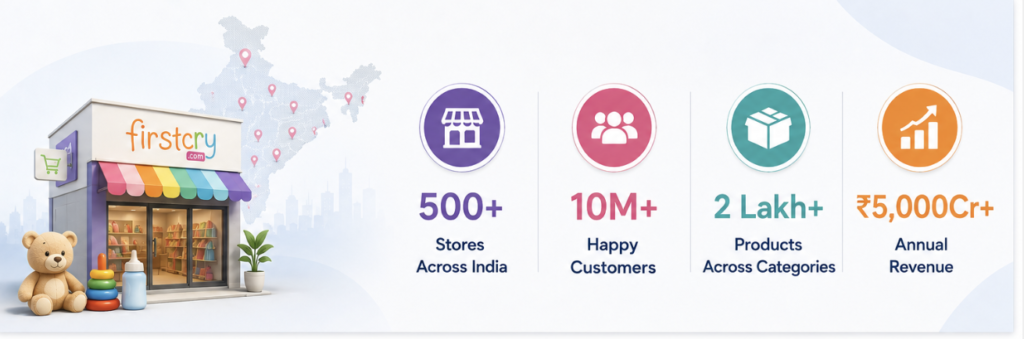
The numbers show what scale can be. FirstCry’s growth has also resulted to tremendous operating scale.

According to its financial reports, FirstCry’s parent firm Brainbees Solutions has announced that its consolidated revenue for FY2024-25 rose 18% to almost ₹7,659 crore compared to the previous year. Its India multichannel business accounted for ₹5,278 crore.

  • As of March 2025, the company operated 1,156 modern outlets including corporate-owned stores under the labels FirstCry and BabyHug. Its own brands accounted for more than 55% of revenues.
  • The corporation still issues quarterly earnings and financial reports, giving investors and business watchers a glimpse of its operating outcomes.

These numbers key because they tell a story entrepreneurs typically underestimate: It’s not simply ambition that creates scale, but systems. One successful outlet is one success. But coming up with a business strategy that can be copied across hundreds of locations is a whole different challenge.
FirstCry Success Story

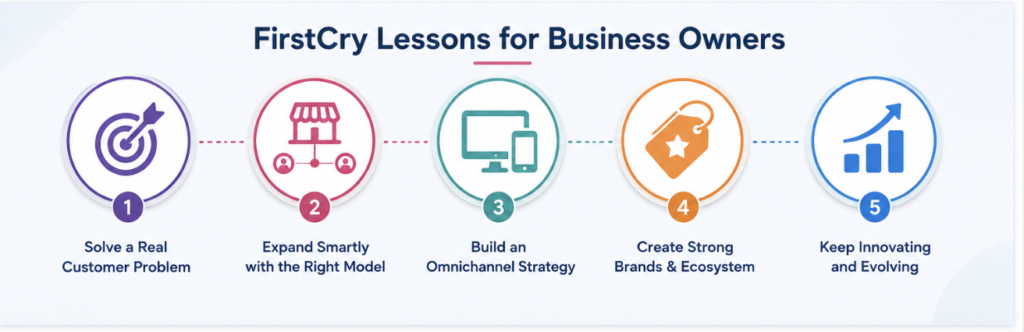
FirstCry Lessons for Business Owners

1. Address an actual customer concern

FirstCry did not start with the query, “What business can we start? It identified an issue for parents and went about solving it. That’s equally vital for existing business owners. Before expanding, question:

  • What makes my business different from the competition and why would clients seek the same experience in another city?

If the answer is obvious, you could have the ingredients for a scalable business.

2. Create a scalable business model

It’s hard to grow a business model that depends wholly on its creator. Opening ten extra shops can create ten times the complexity if the owner has to be involved in every decision, customer interaction, supplier negotiation and operational procedure. The opposite strategy is required for franchising.

The business needs established processes for topics like:

  • Store operating (
  • StaffTraining
  • Customer support
  • Purchasing
  • Marketing Technology
  • QC (Quality control)
  • Finance accounting
  • Brand guidelines

This turns the business from a founder-dependent operation to a replicable franchise model.

3. Physical expansion must not be underestimated

At times, the growth of e-commerce gives the sense that traditional stores are becoming irrelevant. But FirstCry’s experience is a more complex story. It has run an online platform and a physical retail network side by side as part of a multi-channel strategy.

Many Indian firms still believe in the power of physical presence to build trust, visibility and local market penetration. Franchise networks can expedite that presence.

4. Look beyond your home cities

Many successful Indian firms get complacent once they have established themselves in one city. The founder understands the customers, suppliers, employees and the market firsthand. But that comfort can be a hindrance to advancement.

FirstCry’s expansion is a case in point of the possibilities of moving away from a specific business offering to many markets rather than being geographically concentrated.

The question should eventually become for a business owner:

  • Can my business operate anywhere else?

to:

  • What do I need to modify for my business to work elsewhere?”

Now that’s a far more strategic expansion.

5. Leverage franchise partners as local growth drivers

A franchise partner is not just a source of money. The appropriate franchisee may offer:

  • Knowledge of local market
  • Real estate know-how
  • Local relations:
  • Staff management
  • Customer intelligence
  • Money for expansion
  • Entrepreneurial Dedication

This can be especially helpful for a company that wishes to penetrate many cities without having to bear the full financial and operational burden itself. This is why the early utilisation of franchise-owned outlets by FirstCry is one of the most important portions of the company’s journey to entrepreneurs considering franchise business opportunities in India.
FirstCry Success Story

Why FirstCry Is More Than a Startup Success Story

Looking at FirstCry, it is tempting to think that e-commerce was the reason for its success.

This would be to miss the point.

The corporation didn’t just erect a website and wait for clients.

  • It created a brand category specialist.
  • It created a vast product ecosystem.
  • It also incorporated a physical retail store.
  • It employed franchising as a way of expanding.
  • It created private labels.
  • It made purchases.
  • It grew internationally.
  • And it kept investing in the client experience.

That was the beginning of a much more powerful business than just an online store. That is an essential distinction to entrepreneurs. Technology can assist a business to grow but it is a scalable business strategy that allows for continued expansion.

Implication to Indian Business Owners

Suppose you already have a profitable business.

  • You have clients.
  • You have a product or service with a market demand.
  • Your brand is known in your city.

But it’s beginning to slow down since you can’t personally oversee another location. This is where franchising can be worth looking at for growing your firm.

Don’t have all your personal capital invested into every new store. Create a franchise opportunity that has a structure where partners who qualify invest in and operate locations under your brand. But franchising should not be considered just the sale of franchise rights.

Before creating a franchise model a business owner must consider:

  • Is the company financially sound?
  • Are the unit economics compelling?
  • Can the operations be reproduced?
  • Is it a different brand?
  • Can new franchisees get a good return?
  • Are the processes written down?
  • What will franchisees get?
  • What lands should be proposed?
  • What is the correct fee/royalty structure for franchises?
  • What are the legal agreements and compliance requirements?

These questions will establish if a business is truly ready to franchise.

Key Takeaways From the FirstCry Success Story

Perhaps the most essential lesson from FirstCry is not about the number of stores, its income or even its technology. It’s the ability to take a strong business idea and convert it into a repeatable growth engine.

The founders noticed a gap in the market.

  • They specialised.
  • They created trust with their customers.
  • They increased their product line.
  • They blended internet and offline channels.
  • And they built systems that gave the brand the opportunity to reach customers beyond what the founders could accomplish themselves.

That’s entrepreneurship, scalable, literally.

Should I Franchise My Business or Not: Is It the Right Decision for You?

If your firm has reached a point where clients are begging for your brand in other places, your unit economics are established and you can reproduce your operations, franchising could be the next natural stage of expansion. But it should not only be “get more franchisees.”

The aim should be:

  • Create a franchising structure that is mutually beneficial for the brand, the franchisee and the customer.
  • FirstCry’s story is a case study on how a business may evolve from solving a local need to developing a national ecosystem.

That’s the actual lesson for Indian entrepreneurs.” You don’t need to develop another FirstCry. You have to understand why FirstCry was able to scale and what of those concepts can you apply to your firm.

Final Thoughts

At the end of the day, the FirstCry success story is a narrative about scaling.

  • A niche idea turned into a niche brand
  • A speciality brand become an omnichannel enterprise.
  • An omnichannel business created a physical presence.
  • And a scalable approach paved the way for national and international expansion.

The message to Indian business owners is simple. If you have a business with established demand, excellent unit economics and a replicable operating model, then expansion thru franchising can help you reach markets that would be difficult to win thru company owned growth alone.

The next important question for the ambitious entrepreneur might not be “Should I continue to grow?”

It could be:

“Is my business ready to be a brand that other entrepreneurs can grow with?”

Loading

Top 5 Keys to Franchise Success – A Guide For Every New Franchisor

Written by Sparkleminds

Just making your business into a franchise is not a way to understand the long-term success of your business. You will need to apply some strategies and take the advice of successful business owners in understanding the key elements they used to attain success. But don’t forget, that what works for one business owner may not be the same in your case. So after proper analysis, we have for you the top five keys which will ensure franchise success in India.

So, if you are a new franchisor, this one is surely for you.

Top 5 Keys to Franchise Success

How To Achieve Long-Term Franchise Success? – A Comprehensive Guide For First-Time Franchisors

If a franchisor is venturing into the Indian market for the first time, there are a few important things they should do to improve their chances of long-term franchise success.

1. Having a clear and well-defined franchise concept.

It is important to develop a franchise concept that is not only well-defined but also clear and can be readily copied across various places. Among these are standardised operational methods, rules for branding, and a business strategy that has been demonstrated to be successful.

This is important for franchise success for various reasons as listed below.

  • Providing a blueprint for consistency: Clear franchise concepts ensure uniformity among franchise sites. It defines SOPs, branding, product/service offers, and customer experience. Since customers know what to anticipate at each franchise site, consistency builds brand trust and loyalty.
  • Easy replicability: The franchisor can quickly expand with a well-defined franchise model that is easy to replicate. Processes and procedures reduce the learning curve and brand standards deviations for franchisees.
  • Foundation for scalability: A solid franchise concept allows the franchisor to scale the network without sacrificing quality or consistency. Standardised processes and procedures can be expanded to handle more operations as the franchise grows.
  • Establishing a strong brand identity: Customers connect with a strong brand identification and defined franchise concept. Franchise locations can differentiate themselves apart and attract customers with unified logos, messaging, and visual aspects.
  • Easy adaptability: A well-defined franchise model lays forth the ground rules, but it should be flexible enough to account for regional tastes and customs. While maintaining brand values and standards, franchisees may need to adapt the business to their market.

2. Being Flexible and Easily Adaptable.

To meet the specific demands of the Indian market, you must maintain a high degree of adaptability and flexibility. This could necessitate making changes to pricing tactics, tailoring products and services to specific needs, or accommodating cultural variations.

This is essential for first time franchisors for various reasons such as.

  • Adapting to changing market conditions: Staying competitive requires adapting to market and customer changes. By being flexible, franchisors may quickly adjust to new trends, consumer behaviour changes, and regional market dynamics, keeping franchise locations current and desirable.
  • Ensure regulatory compliance: In a diversified market like India, laws and regulations may differ by location. Franchisors must adjust to these regulatory complications. This may include changing business methods, contractual agreements, or processes to comply with local legislation.
  • Innovations for your product or services: Flexibility lets franchisors adapt to changing consumer tastes and market trends by introducing new products, services, and business models. Franchise models that can change can seize new opportunities and stay relevant.
  • Management of risks: Adaptability helps franchisors reduce risks and solve challenges. Franchise owners can better weather economic storms, supply chain interruptions, and competitive threats if they are flexible and receptive to new ideas.

3. Financial Stability.

Always ensure that your business is financially stable and transparent in all of your transactions with franchisees. To avoid misunderstandings or disagreements, the franchise agreement should provide a detailed description of the financial duties, fees, and revenue-sharing arrangements.

This key plays a crucial role for first time franchisors in franchise success because.

  • Investing in necessary infrastructure: Financial stability lets the franchisor invest in franchise infrastructure. Moreover, this includes standardising operating practices, training, marketing, and franchisee support. These investments enable a profitable and scalable franchise.
  • Research and development initiatives: Financial stability helps the franchisor to fund franchise system improvement research and development. As an example, it could include investing in technology to improve operational efficiency, discovering new markets or territory, or testing out new products or services. The franchisor can ensure the franchise system’s longevity by anticipating consumer needs and driving innovation.
  • Growth and expansion franchise opportunities: Financial stability gives the franchisor the resources to grow the franchise business. Open new franchise sites, enter new markets or acquire existing franchise units. The franchisor can capitalise on development prospects and maximise franchise system potential by carefully reinvesting profits and being financially strong.
  • Unexpected challenges during economic downturns: Economic downturns and unanticipated hurdles can hurt franchise operations. Financially stable franchisors can help franchisees through these storms. The franchisor can reduce risks and assure franchise system viability by ensuring financial stability.

4. Effective marketing strategies for building a strong brand presence.

Invest in the development of a powerful brand presence and the implementation of efficient marketing techniques to attract clients to franchise locations. In order to raise consumers’ awareness of the brand, this encompasses both regional marketing activities and national advertising campaigns.

This can play a vital role for first time franchisors in terms of franchise success because:

  • Stand out for your competitors: Strong branding distinguishes franchise sites from competition. Moreover, franchisors may attract customers who share their brand’s values and positioning by effectively articulating the distinctive selling point and brand promise. Success for a long time in a crowded market requires this competitive advantage.
  • Ensures consistency across all units: All franchise stores, regardless of location, have consistent branding and marketing. No matter where buyers see the brand, this uniformity supports its image and also message. Brand-wide marketing boosts franchisees’ local exposure and credibility.
  • Easy adaptability to the local markets: Though they should stay true to their core values, effective branding and marketing can change to fit different markets and cultures. To ensure relevance and effectiveness in multiple markets, franchisors might tailor marketing messages and methods to regional target groups.
  • Supports franchisee growth: Branding and marketing boost franchisee expansion by boosting foot traffic and sales leads. The franchisor provides marketing skills, materials, and centralised advertising to franchisees. Because of this assistance, franchisees are free to concentrate on operating their businesses rather than coming up with their marketing plans.

5. Vision For Long Term Growth.

Make a clear long-term plan for the Indian branch network, as well as keep working to come up with new ideas and make the business model better. Therefore, to ensure long-term success, review performance, seek franchisee and consumer input, and adjust strategy.

Here’s why this is important for franchise success.

  • Provides a road map for strategic planning: Moreover, strategy and decision-making are guided by long-term visions. It aids the franchisor in outlining the system’s long-term aims and steering short-term investments and actions accordingly. Strategic planning allocates resources to promote franchise network expansion and sustainability.
  • Helps identify opportunities for market expansion: A long-term perspective helps franchisors spot market growth prospects. Therefore, franchisors can strategically expand into new markets, regions, or demographic segments by looking at where the franchise system is headed in the future. In short, this proactive growth strategy keeps the franchise system competitive in the changing market.
  • Helps navigate through challenges: A long-term vision helps franchisors overcome obstacles. The franchisor can weather economic storms, shifts in consumer demand, and fierce competition so long as it keeps its eye on the prize: the franchise system’s long-term objectives. This resilience helps the franchise system overcome challenges and grow.
  • Gradual innovation of the brand over time: Franchise brand evolution is guided by long-term vision. Therefore, the franchisor can establish and hone the brand’s values, positioning, and identity in a way that appeals to its target demographic. Moreover, customer loyalty and long-term franchisee success are driven by consistent brand development activities, which enhance brand equity and recognition.

From franchising your business to franchise success, here’s what you need.

So are you ready to watch your business grow successfully as a franchise in India? Get more information on franchising business from our experts at Sparkleminds.

Loading

Learn to Become a Successful Franchise Owner

Written by Sparkleminds

Have you ever wondered how to be a successful franchise owner? This is probably the most common question which a franchisor/business owner will ask themselves. Everyone wants franchises to run smoothly. But the reality is far from beyond. So many activities need to be done in a short span of time. Managing franchisees is not a rosy as it looks. The fight between productivity and the functioning of franchises differs for various reasons.

So, what makes a successful franchise? What are the franchise owner responsibilities? With two decades of experience and over 500+ clients, we give you the simplest answers that have been formulated through a fair share of learning.

Yet, we do have some control over our productivity and progress. But with so much to do, is working more hours better? In fact, it is not—productivity decreases as the workday and workweek grow longer. But do not despair. Here are few ways to work smarter in your franchise.

One must understand the difference between control and mismanagement of resources. Remember, when you take care of your franchisee, you take care of yourself. At times in the name of attaining perfection, franchise owners lose anchor towards the core of the idea/product/service of the business.

Let us now look at how you can be a successful franchise owner:

Technology here to stay

Brick and motor companies are shutting down at a rapid rate. Many companies have taken the technology and integrated it into their traditional businesses. Most of the management software’s helps you to get direct access to the franchise without even being physically present. This has also substantially reduced the cost of hiring an additional manager. More time you will have with fewer distractions. Many small businesses use free tools and increase their bottom line without spending a bomb.

Clarity in Communication

This is the biggest reason many organizations don’t survive. These Communication challenges exist in every organization, but if you increase your skills, you will reduce misunderstandings. Plus, the more collaborative you are, the less time you’ll need to dedicate to overcoming avoidable mistakes. The better the communication, the more efficient team projects will be.

Categorize

Prioritize what is the most important task. With time, franchises tend to deviate from their core services and start modifying the systems. Any good brand, if you notice creates strong fundamentals before franchising. Without the solid base, the whole system can be brought down before you know it. Even the smallest change must add value to the franchise. Use scales or a list of the functions in a separate manner to ensure the tasks are not affected and the compulsory actions are not postponed.

The Art of Delegating

No one is perfect and this makes it all the more reasons to make franchising interesting. Succuss of the franchisees leads to the overall success of the franchisor. It has to be a win-win situation for both. Different roles require different specializations. If at all you can delegate a task to someone who can do it better, do not hesitate and delay. Use them to free your time to focus on your areas of expertise.

Trend Analysis& Research

See how each of your franchises is functioning in different markets. It is impossible for all of them to be giving the expected return that is desired. Keeping track gives you a way to check where improvements and audits need to be done. This is a continuous process, but if done right, creates wonders in the long run for all the parties involved in the franchise.

Stop Micromanagement

You may not see it coming, or for the fact understand how huge an impact it has on others. This may sound very foolish, but putting an end to taking small decisions frees your mind up for bigger and important ones. This also gets you to do high priority tasks that need to be taken care of at the top level. Create consistency in your daily activities. Making few solid decisions automatic, you will find the work much smarter and less fatigued when you need to make an important decision.

Don’t Stop Learning

Business is always dynamic and keeps changing. new technologies, acquire new skills, and add new business needs to be addressed in an open-minded approach. Most of the successful franchises seek continuing education, attend events and workshops, and frequently get in touch with the franchise headquarters to be updated always.

Not all franchises have the knack that will make their lives and businesses better. When you work smarter, you will feel accomplished, less stressed, and freer to grow an even more successful franchise than you could’ve ever imagined. this is how simple and effective steps make you a successful franchise owner.

Loading