
Written By: Resham Daswani, Sparkleminds Editorial Team – Updated August 2026
Introduction
If you’re a business owner asking “what is the cost of franchising a business in India,” here’s the short answer: turning your business into a franchise typically costs anywhere between ₹7 lakh for a lean, single-city launch and ₹60 lakh or more for a nationally ready franchise system, depending on how much groundwork — legal documentation, training manuals, brand identity, and franchisee support systems — you put in place before you sign your first franchise partner.

That’s a big range and for good reason: franchising isn’t a product you buy for a certain price, it’s a system you construct and then license out over and over. Get the system right and each new franchisee is a low risk, capital-light opportunity to increase your presence without having to open and fund every new site yourself. In this write up, we break down just where that setup cash goes, what causes it to rise and fall, and how to actually budget for it before you bring your business to market.
India’s franchise market, in four numbers:
- ₹800 billion market size today, growing 30–35% a year — one of the fastest-growing franchise markets on earth. [Source]
- 4,600+ active franchisors already running close to 2 lakh outlets nationwide. [Source]
- 50% of new franchise expansions now land in Tier 2 and Tier 3 cities, not just metros.[Source]
- USD 140–150 billion — where the market’s headed in the next five years. [Source]
This is exactly why so many Indian business owners are exploring franchising right now — but building the system correctly the first time is what separates a brand that scales smoothly from one that runs into disputes and stalled growth.
Key Takeaway: Franchising your business in India typically costs ₹7 lakh for a single-city launch to ₹60 lakh+ for a nationwide system — most of that going into legal setup, training, and franchisee recruitment, not store openings.
What Does It Actually Cost to Franchising Your Business in India?
Franchising your business is really about turning your operating model into a repeatable, licensable system that someone else can operate successfully, and that transition isn’t free. The cost is mostly not opening a new store but building the system that makes a new store possible.
Here’s a realistic breakdown of what business owners spend when they franchise their brand in India:
Cost Component |
Typical Range (INR) |
Covers |
|
Legal docs (FDD, agreement) |
₹1L – ₹5L |
Contracts, IP protection |
|
Trademark registration |
₹15K – ₹1L |
Brand & logo protection |
|
Operations manual / SOPs |
₹1L – ₹4L |
Process & training docs |
|
Brand identity & collateral |
₹1L – ₹5L |
Store design, signage |
|
Franchise recruitment |
₹2L – ₹15L |
Portals, ads, consultants |
|
Training infrastructure |
₹1L – ₹6L |
Onboarding, staff training |
|
Technology (POS/CRM) |
₹1L – ₹10L |
Billing, inventory, reports |
In contrast, a single-city, local franchise rollout can reasonably start at approximately ₹7-10 lakh. But a brand that wants a pan-India, investor-ready franchise system generally needs ₹25-60 lakh for the first year alone. If you have more sophisticated activities (multi format retail, food production units, healthcare) in your business you should anticipate to be at the higher end of that spectrum.
What Factors Decide How Much It Costs to Franchising Your Business?
No two franchise budgets look the same. Your cost of franchising climbs or shrinks based on:
- Complexity – Kiosks franchise cheap. Kitchens don’t.
- Geography – One city is a budget line. A national rollout is a business plan.
- Brand pull – Known name, cheaper recruitment. Unknown name, bigger marketing spend.
- Support promised – More hand-holding for franchisees means more cost for you.
- Legal depth – Pay more upfront on your FDD, pay far less in disputes later.
- Consultants – Adds ₹2–8 lakh, but usually saves you from an expensive first-year mistake.
What Types of Franchise Models Should You Choose — and What Do They Cost?
The franchise model you build changes both your setup cost of franchising and how much ongoing control you keep:
- Business format franchise – You license the whole playbook: branding, layout, pricing, service. India’s most common model. Costliest to build, most consistent to run.
- Product distribution franchise – Franchisees sell what you supply. Cheaper to set up, but you’re handing over more of the day-to-day control.
- Manufacturing franchise – Franchisees produce using your formula. Equipment and quality control push the cost up.
- Service franchise – Cleaning, tutoring, salons — franchisees deliver under your name. Usually the lightest, cheapest model to launch.
Choosing the right model upfront matters more than most business owners expect — switching midway (say, from distribution to full business format) usually means redoing your legal documentation and training systems from scratch.
What is the right price for each of the royalty fee and franchise fee?
This is one of the most common questions first-time franchisors ask, and the wrong answer either way might hinder your growth.
- Franchise fee – One-time, upfront. The price of entry into your brand and systems. ₹1 lakh–₹30 lakh in India, depending on brand strength.
- Royalty fee – Ongoing, monthly or quarterly. A cut of franchisee revenue, typically 4–10%. This is what keeps your support and marketing funded.
Price the fee too high and good franchisees walk away. Price the royalty too low and you can’t afford to support the ones who stay.
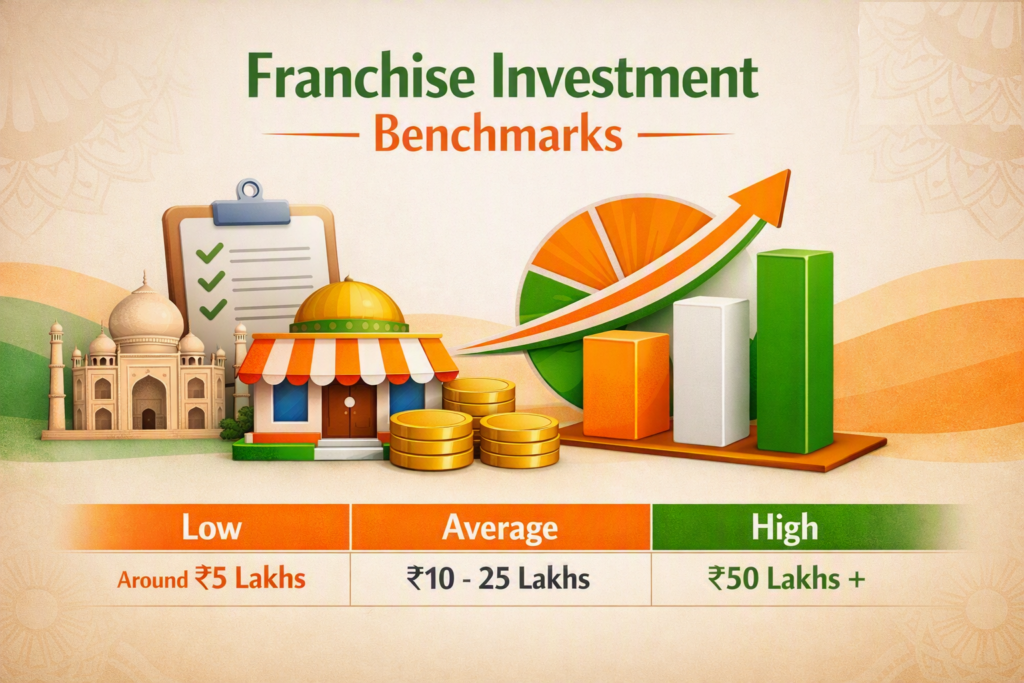
Franchise Fees and Franchisee Investment Industry Benchmarks
Before you finalise your own numbers, it helps to know what’s competitive in your sector — set your total franchisee investment too far above the market and you’ll struggle to recruit; set it too low and you’ll undersell your brand.
|
Industry |
Typical Franchisee Investment |
Typical Franchise Fee |
|
QSR (fast food) |
₹15L – ₹50L |
₹3L – ₹10L |
|
Grocery / supermarket |
₹14L – ₹40L |
₹2L – ₹8L |
|
Education & coaching |
₹5L – ₹25L |
₹1L – ₹5L |
|
Salons & wellness |
₹8L – ₹30L |
₹2L – ₹6L |
|
Retail & D2C brands |
₹8L – ₹50L |
₹2L – ₹5L |
|
Real estate brokerage |
₹3L – ₹10L |
₹1L – ₹3L |
|
ATM / payment kiosks |
₹1L – ₹5L |
Nil – minimal |
|
Cleaning & home services |
₹1L – ₹8L |
₹50K – ₹2L |
Figures are indicative industry ranges — your own numbers should reflect your brand’s actual unit economics, support level, and market positioning.
What Cost of Franchising Do Business Owners Often Underestimate?
Many first-time franchisors budget for the visible costs — legal fees, branding, a recruitment push — and then get caught out by the ones that show up later. Plan for:
- Ongoing support – Field visits and refresher training that only get more expensive as you scale.
- Quality audits – Non-negotiable once you’re past 10–15 outlets. One bad location damages every location.
- Tech upgrades – Your POS and CRM won’t stay current on their own.
- Disputes & renewals – Legal costs don’t stop at signing; they resurface at every renewal and exit.
- Marketing fund upkeep – Collecting the fund is easy. Deploying it fairly across your network isn’t.
- Franchisee financing help – Bank and NBFC tie-ups widen your applicant pool, but someone has to set them up.
Franchise My Business Or Expand Via Company-Owned Outlets?
This is a genuine strategic trade-off, not a simple “franchising is always cheaper” answer. Opening company-owned outlets necessitates the funding of 100% of the capital and the assumption of all operational risk; however, you retain full control and 100% of the profit. Franchisees take up most of the capital and local operational risk in exchange for a smaller, recurring revenue share through royalties.
Because franchising transforms years of trial and error into a system that can be licensed out instead of having to re-deploy capital at each new location, it is often considered the fastest and most capital-efficient way for enterprises to scale. In exchange for authority over a network of independent operators, not employees, a good franchise agreement and support system are crucial.
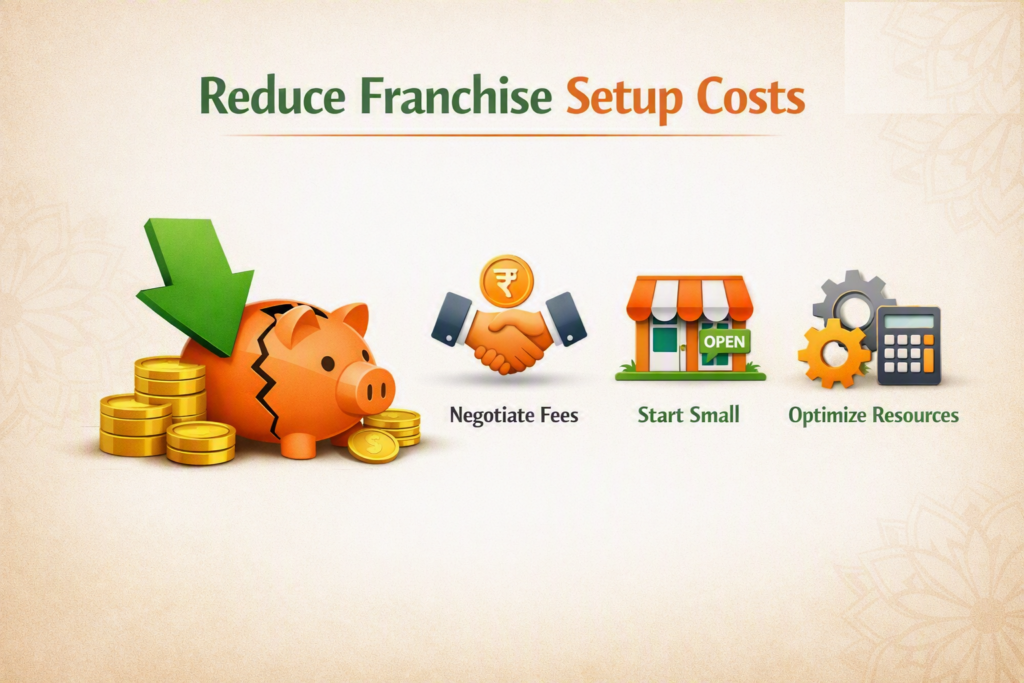
How Can You Reduce Your Setup Cost Of Franchising?
A few practical moves bring your budget down without cutting corners on quality:
- Pilot one region before you build for the whole country.
- Reuse legal templates — customise with a lawyer instead of drafting from zero.
- Train digitally — video SOPs beat a physical training centre, at first.
- Consulting early is cheaper than fixing a flawed model later.
Also Read: A detailed guide on cost of franchising in India
In Conclusion – A Summary Showing Cost Of Franchising Your Business
Every franchise journey looks different, and the numbers above are meant as a starting benchmark, not a fixed quote. If you’re planning to franchise your business, a proper cost and feasibility assessment will save you far more than it costs.
At Sparkleminds, our goal is simple — to make franchising easier, safer, and more profitable for business owners. From legal documentation to franchisee recruitment and training, we provide complete support so you can focus on growing your brand. With decades of experience and thousands of successful rollouts, we’re trusted by entrepreneurs across India to turn their expansion dreams into reality.
Connect with Franchisebazar, if you are an investor or first time buyer who wants to start or know the costs of franchising journey in India today.
Want To Know What Our Clients Are Saying About Us – Testimonials
- https://www.youtube.com/shorts/Z08MP2c46ro?feature=share
- https://www.youtube.com/shorts/3tEZn8D69ec?feature=share
FAQs – Cost Of Franchising Common Queries
Franchising a business costs how much today?
Considering legal documentation, basic SOP operational manual and no marketing, a single-city setup generally costs around 5 to 7 lakhs approximately. Most businesses budget higher for a stronger, dispute-proof system.
How much can I earn back from franchising my business?
Most Indian franchisors recover their initial setup cost within the first 3–8 franchise sign-ups. After that, franchise fees and royalties become largely profit.
Do I need a lawyer to franchise my business in India?
Yes. Your franchise agreement is governed by the Indian Contract Act, 1872, and a poorly drafted FDD or agreement is one of the most common causes of franchisor-franchisee disputes — this isn’t a step to DIY.
How much should I charge for royalties in India on average?
Most Indian franchise models charge 4%–10% of gross income as a royalty. ATM and kiosk franchises may be free.
What’s the franchise system setup time?
The majority of businesses need 2-4 months to finalise legal papers, SOPs and marketing materials before onboarding their first franchisee, although this may differ depending on the intricacy of the firm.
What documents are needed to franchise in India?
At the very least: franchise agreement and trademark registration. An FDD isn’t legally mandated in India yet, but having one is considered industry best practice and builds franchisee trust.
Is GST applicable on the franchise fees and royalties I charge?
Yes. Franchise fees and royalty payments are treated as a supply of service and attract 18% GST, payable by your franchisee to you.
Should I offer a single-unit or a master franchise model?
A single-unit franchise gives one franchisee rights to one outlet — easier to manage early on. A master franchise is a right to a whole city, state or region. The master franchisee then sub-franchises you. It scales faster but with a significantly better legal and operational structure up front.
Can I negotiate my franchise fee?
It depends on your brand’s demand. Early in your franchise journey, some flexibility (especially for multi-unit commitments or pilot locations) can help you land strong first franchisees. Once your brand has proven demand, negotiating less protects your brand’s perceived value.
Should my franchise costs differ between metro cities and smaller towns?
Your franchise fee and royalty structure can usually stay consistent nationwide, but expect franchisees in Tier 2 and Tier 3 cities to face 30–50% lower rent and fit-out costs than in metros. Nearly half of all new franchise expansions in India now happen outside metro cities — worth building a lower-investment format if you want to tap that growth.
Should I help franchisees arrange financing?
It’s increasingly common. Several franchisors tie up with banks or NBFCs so franchisees can access business loans more easily — this widens your pool of serious applicants, especially for higher-investment formats.
What break-even timeline should I promise franchisees?
Set expectations carefully: most franchise outlets in India break even in 18–36 months, though low-investment formats can break even faster. Promising an unrealistically fast break-even is a common cause of franchisee disputes later.