
Written By: Resham Daswani, Sparkleminds Editorial Team – Updated August 2026
Quick Answer: Defining A FICO Franchise Model in India
The FICO franchise model (Franchise Invested Company Operated model) provides business owners with a means of combining franchise partner investment with company-led operations. The new shop is run on a day-to-day basis by the corporation and funded by the franchise partner.
Expanding into new cities is a major growth opportunity for Indian businesses—but scaling quickly while maintaining brand control, operational consistency and customer experience can be challenging.

For established brands wishing to expand through franchising in India, this approach can provide a viable mix between outside investment and control over operations. In this post we explain what the FICO franchise model is, how it works, its five core benefits, which firms can use it and why it may be the perfect franchise expansion plan.
Understanding The FICO Franchise Model in India
Under this franchise business model, the franchise partner provides the investment for establishing a new outlet, while the franchisor or company operates the business.
The company may manage:
- Recruitment and staff training
- Daily operations
- Customer service
- Inventory management
- Marketing implementation
- Quality control
- SOPs and operational standards
- Performance monitoring
The basic structure is:
Franchise partner invests → Company operates → Brand expands
The FICO model allows the business owner to have a greater degree of engagement in the day to day operations as opposed to a typical franchise where the franchisee usually runs the outlet.
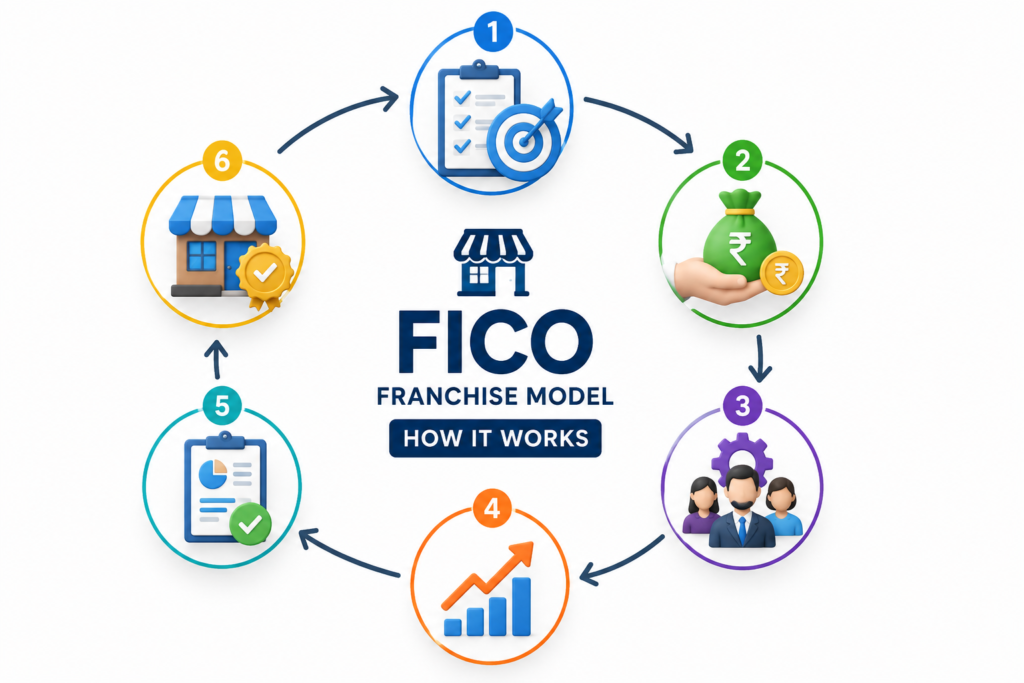
Knowing More About The FICO Franchise Model- How It Works?
A typical FICO expansion strategy follows a structured process:
- The business validates its model – The company establishes that its concept, unit economics and operations can be replicated.
- The franchise partner invests – Capital is provided for the new outlet according to the agreed commercial structure.
- The company operates the outlet – The franchisor manages staffing, training, SOPs, inventory and customer experience.
- Performance is monitored – Sales, customer behaviour, operational efficiency and profitability are tracked.
- The model is replicated – Successful locations provide a foundation for expansion into additional cities and markets.
The exact investment, ownership, revenue-sharing and return structure should always be clearly defined in the commercial and legal agreements.
5 Key Benefits of the FICO Franchise Model for Business Owners
1. Expand Faster Without Funding Every Outlet
Opening company-owned branches requires significant capital.
With FICO franchising, franchise partners can provide the investment needed for new locations while the business continues to focus on operations, brand development and strategic growth. This allows existing companies to think about multi-city expansion without the need to fund each new outlet totally from internal resources.
2. Greater Brand and Operational Control
The larger a franchise network expands, the more difficult it is for many business owners to safeguard their brand. Since the firm operates FICO locations, it has greater control over:
- Staff recruitment
- Training
- SOP implementation
- Service standards
- Quality control
- Customer experience
For service-oriented businesses such as healthcare, education, food, beauty, and wellness, as well as other service-oriented enterprises, this can be especially beneficial because operational consistency has a direct impact on the reputation of the brand.
3. Increased Consistency in the Customer Experience
Customers have the expectation that different locations of the same brand will provide them with the same experience.
The firm is able to establish uniform standards for service quality, customer engagement, hygiene, product or service delivery, and complaint resolution when it uses a franchise model that is controlled by the company itself.
By maintaining this consistency, brands that are expanding their operations to Tier 1, Tier 2, and Tier 3 locations in India may better safeguard the trust of their customers as the network expands.
4. Centralised Hiring, Training and SOPs
People and processes become increasingly important as a business expands.
Instead of leaving recruitment and training entirely to individual franchisees, a FICO structure allows the company to centralise:
- Recruitment
- Employee onboarding
- Training
- Performance management
- SOP implementation
- Operational audits
This creates a more consistent operating culture across the franchise network.
5. Better Operational Data for Smarter Expansion
Company-operated outlets can provide valuable operational insights.
Business owners can monitor:
- Sales performance
- Customer behaviour
- Inventory movement
- Staff productivity
- Marketing effectiveness
- Outlet-level profitability
This data can help management identify what is working, improve underperforming locations and make more informed decisions about future franchise expansion in India.
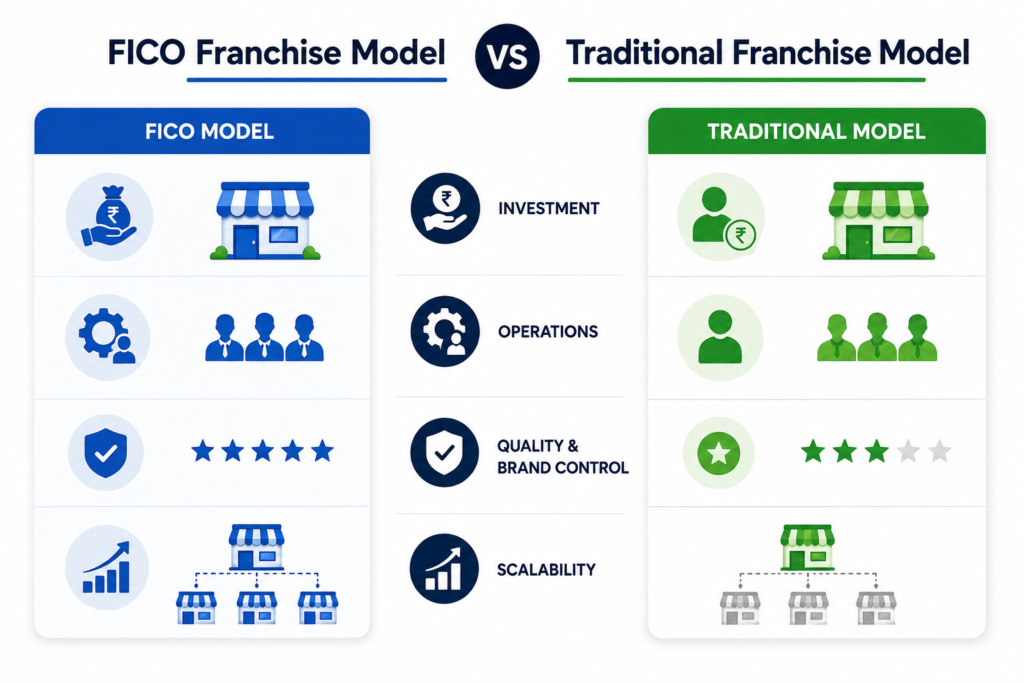
FICO Franchise Model vs Traditional Franchise
The main difference is who operates the outlet.
|
Factor |
Traditional Franchise |
FICO Franchise Model |
|
Investment |
Franchise partner |
Franchise partner |
|
Daily operations |
Franchisee |
Company |
|
Staff management |
Franchisee |
Company |
|
Brand control |
Can vary |
Generally higher |
|
Customer experience |
May vary |
More centrally controlled |
|
SOP implementation |
Franchisee-led |
Company-led |
|
Expansion approach |
Franchisee-led |
More company-led |
For business owners who want to expand while retaining greater operational involvement, FICO can be an attractive alternative to a conventional franchise structure.
FICO vs FOCO: What’s the Difference?
FICO and FOCO are often discussed together because both can involve franchise partner investment and company-operated outlets. However, the nomenclature used for franchises might differ from brand to brand.
It is not enough for a business owner to merely know which acronym is being used; the thing that is more significant is how the actual agreement itself defines:
- Investment
- Ownership
- Operations
- Revenue sharing
- Expenses
- Returns
- Exit terms
- Operational responsibilities
Business owners should therefore evaluate the commercial structure behind the model, rather than relying only on the terminology.
Which Businesses Can Prove Profitable By Expanding As The FICO Franchise Model?
FICO may be useful for firms in which maintaining operational consistency and providing a positive experience for customers is essential to the success of the brand.
Some of the potential industries are:
Healthcare and Diagnostics
Standardised service, hygiene and operating procedures are critical.
Food and Restaurants
Food quality, service speed, inventory and hygiene need consistent management.
Beauty and Wellness
Customer experience and staff expertise directly influence brand perception.
Education and Training
Consistent centre management, teaching standards and student experience are important.
Fitness and Sports
Equipment, trainers, member engagement and service standards require regular monitoring.
Retail and Consumer Brands
Store presentation, merchandising and customer service can benefit from centralised control.
Is the FICO Franchise Model Right for Your Business?
FICO is not automatically the right franchise model for every business.
Before adopting it, business owners should have:
- A proven business model
- Demonstrated customer demand
- Clear unit economics
- Documented SOPs
- Structured HR processes
- Reliable technology and reporting systems
- A scalable supply chain
- Strong operational management
A simple rule is:
FICO can help a proven business scale—it cannot replace a proven business model.
If the business is still testing its concept or struggling with inconsistent operations, strengthening the core business should come before aggressive franchise expansion.
Common FICO Franchise Expansion Mistakes
Business owners should avoid:
- Expanding before the model is proven
- Operating without documented SOPs
- Underestimating staffing requirements
- Ignoring technology and performance reporting
- Using unrealistic financial projections
- Entering markets without adequate demand research
- Creating unclear franchise agreements
- Assuming investment alone will guarantee expansion success
In order to achieve sustainable franchise growth, it is necessary to have operational discipline, financial transparency, and a business model that can be replicated.
How Sparkleminds Helps Business Owners Build FICO Franchise Models
For business owners, developing a franchise is about more than finding franchise partners. The business needs the right franchise expansion strategy, operating systems and commercial structure.
Sparkleminds helps businesses evaluate and develop scalable franchise models through services including:
- Franchise feasibility studies
- Franchise strategy development
- FICO model development
- Financial modelling
- Franchise documentation
- Operations manuals and SOP development
- Franchise recruitment strategy
- Expansion planning
- Franchise support systems
The objective is to help business owners build sustainable, professionally managed franchise networks rather than simply add more locations.
Must Reads:
- Step By Step Guide To Make A Franchise Model in India
- Which Franchise Model Is Best For Your Business Expansion in India?
FAQs About the FICO Franchise Model
Can startups use the FICO franchise model?
It can be considered, but the model is generally better suited to businesses with a proven concept, established SOPs, clear unit economics and demonstrated customer demand.
How can Sparkleminds help with FICO franchise expansion?
Sparkleminds helps business owners assess franchise readiness and develop franchise strategy, FICO structures, financial models, SOPs, franchise documentation, recruitment plans and expansion systems.
Conclusion
The FICO franchise model in India can give established business owners an alternative route to expansion by combining franchise partner investment with company-operated locations.
For firms with a proven business model looking to grow to numerous cities while retaining a good deal of operational control, FICO can be a useful tool for franchise expansion. But the correct foundation is the key to successful franchising: robust SOPs, defined unit economics, skilled personnel, operational systems and a scalable business plan.
If you’re a business owner looking at how to franchise your business in India, FICO can be considered when your business has a proven model, strong SOPs and the operational capability to manage multiple locations. The right franchise structure should ultimately support your growth goals without compromising the systems and customer experience that built your brand.
Sparkleminds helps business owners evaluate franchise readiness and develop structured franchise expansion strategies, including FICO franchise models.
View More:
- Grow your business from a small town to anywhere in the country
- Business Plan To Help You Fix Your Business Franchise Model